


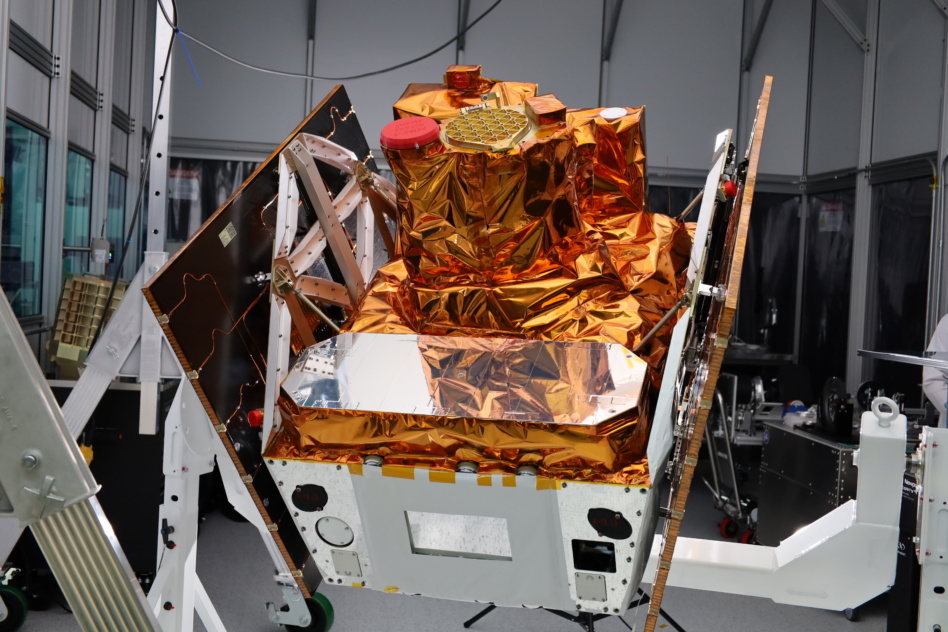
Few rideshares come with a theme, but SpaceX’s Transporter-18—which launched Thursday from Vandenberg—had one: getting power to compute in orbit.
Three of its payloads are each testing a different piece of the ODC puzzle.
- Cowboy Space’s Reason-1 will attempt to beam solar power to Earth via laser—a test run for the optical links its future data centers will need.
- Google’s Project Suncatcher will run AI chips on traditional solar power to see how they hold up in orbit.
- Star Catcher’s Protostar will try to beam power between two spacecraft, with orbital data centers among its customers.
“We passed the point of saying, ‘Will there be people doing AI computing in space?'” Cowboy Space COO and Chief Legal Officer Joseph Yaffe told Payload. “We’re focused on building the infrastructure for that.”
cowboy like me: Cowboy Space began as Aetherflux—a power-beaming startup—before rebranding in May to focus on orbital data centers and rockets. Reason-1 is the stepping stone that brings the two efforts together.
- Cowboy hopes to attempt to beam as soon as late October, sending solar power via infrared laser to a 10–20 m spot at a ground test facility and aiming to deliver 30–100 W. Cowboy calls it the first commercial kilowatt-class laser in space designed to deliver energy to Earth.
- The same laser technology will form the backbone of the data link on Reason-2, which is slated to fly H200 GPUs in the first half of 2027—this time beaming data instead of power.
- Longer term, Cowboy is building its own rocket, whose upper stage doubles as a 1 MW data center, targeted to launch in December 2028.
“We’re an orbital energy infrastructure company that’s delivering power, computing power, and the ability to connect all of those things through laser infrared technology,” Yaffe said.
Hot N Cold: While Cowboy is testing the laser, Google is testing out chips. Its Project Suncatcher MVP—built with Planet Labs—was announced last year as a research “moonshot” to run AI in orbit.
The fridge-sized satellite carries four Trillium TPUs—roughly one server’s worth of compute—using about 1kW of solar to run Gemini queries in short bursts.
On Thursday, Google also released an updated, peer-reviewed version of its Suncatcher paper in the energy research journal Joule, sketching the company’s long-term vision:
- The constellation: Satellites that could eventually hold a data-center rack’s worth of compute, roughly 50–100 kW each, flying in tight, laser-linked clusters. One illustrative example packs 81 satellites within a 1 km radius.
- Radiation: In ground tests, the TPUs survived a radiation dose equivalent to five years in orbit. Radiation still caused occasional silent errors—about one per three million queries—which is manageable for answering questions but may be a problem for training models.
- Heat: The paper calls thermal management a major challenge. MVP’s chips will have to power down every 15 to 20 minutes to avoid overheating. Google says its two follow-up satellites in 2027 will run continuously.
If launch costs fall to $200/kg, Google estimates the cost of launching a kilowatt of solar power to orbit would be about $810 per year, comparable to what US data centers spend on electricity. Its learning-curve analysis suggests that price is possible by the mid-2030s, if Starship flies about 180 times a year.
Pocketful of Sunshine: The final piece is power. Star Catcher’s Protostar will be the company’s first end-to-end in-space demo.
- Protostar will deploy a cubesat and beam measurable power to its off-the-shelf solar panels—aiming to validate commercial power-beaming operations.
- Orbital computing companies Starcloud and Aethero are among Star Catcher’s publicized customers.
As Yaffe put it, the “if” of AI compute in space may be settled. The next few weeks will give a glimpse into how far along the “how” is.

Exclusive: DoD Taps Orbital Operations for Cryogenic Spacecraft Demo
The Long Beach, CA, startup has won up to $35M from the DoD under a prototype Other Transaction Agreement to fly a full-scale, in-orbit demo of Astraeus—its cryogenic-maneuvering vehicle.
Xona Raises $250M Series D to Scale Commercial GPS Constellation
Xona’s long-term plan is to build a ~258-sat constellation to offer an upgraded commercial alternative to government GPS networks.
Hewlett Packard Enterprise to Send AI Compute Module to the Moon
Hewlett Packard Enterprise ($HPE) is taking remote working to a whole new level.
Reaction Dynamics Targets 2031 for Borealis Medium-Lift Launch
In the contest to build up commercial launch capabilities in Canada, Quebec-based startup Reaction Dynamics has entered a new weight class.


While investors pour billions of dollars into orbital-data-center (ODC) concepts that require new feats of engineering, Satlyt’s virtual ODC network is already flying above us—and growing rapidly.
The startup—with joint headquarters in Nairobi, Kenya, and Sunnyvale, CA—unveiled a $8M seed round today to expand its team and its virtual ODC network.
non sibi ventures led the round, which included additional participation from TLCOM, Antler, Slauson & Co., Launch Africa Ventures, Enza Capital, Demos Capital, BAG Collective, Gaingels, Askya, AXIAN Investment and others. It brings Satlyt’s total funds to “well past $10M,” according to CEO Rama Afullo.
Keep reading