


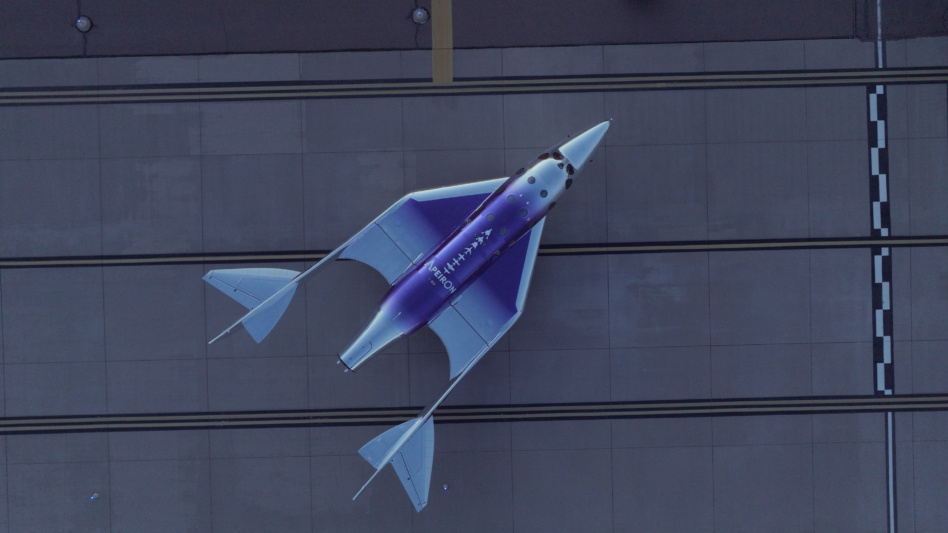
Virgin Galactic introduced Apeiron to the world on Wednesday, drawing from the ancient Greek concept of the boundless in naming its newest spaceship.
“The arrival of our lead spaceship at Spaceport America will be an enormous milestone in a years-long journey to build the world’s first human spaceship platform designed for regular commercial spaceflight,” Virgin Galactic CEO Michael Colglazier said in a statement.
Virgin is now moving 100+ ticket holders—whom it refers to as astronauts—into their first phase of flight readiness, with more cohorts to follow on a rolling basis.
Slipping ships: Apeiron hitched a ride from Mesa, AZ, to Spaceport America in NM attached to mothership Eve. Meanwhile, Virgin pushed its return to commercial spaceflight to early Q2 2027.
According to Virgin, the timeline extension will allow for exhaustive testing and validation of the integrated avionics software.
The delay is Virgin’s second this year. As recently as May, the company was targeting a return to commercial service by Q4 2026. In August, it pushed that to February 2027. The second ship is scheduled to be completed in late Q2 or Q3 2027.
Grounded: Virgin hasn’t flown to space since VSS Unity’s final mission in June 2024. While Unity resumed glide flights in May, those flights were only used to train pilots and topped out around 9 miles in altitude compared to a spaceflight’s ~55 miles.
Apeiron is supposed to end the drought as the first of Virgin’s Delta-class ships. The Deltas are designed to carry six passengers up to 8x per month, with the latest seats priced at $850k.
Until they fly, Virgin is running on almost no revenue.
- Cash and marketable securities stood at $286M at the end of June, padded by $134M from selling new shares.
- With an expected Q3 burn of $95M–100M, a single quarter eats more than a third of that cushion.
- The Q2 report flagged substantial doubt about Virgin’s ability to continue operating T.he company is set to release Q3 earnings in November.
Clear skies: Virgin is also returning to a much quieter suborbital market. In January, Blue Origin paused New Shepard flights for at least two years to focus on its lunar efforts.
Once it flies, that leaves Virgin as the only crewed option for suborbital research. Last week, it signed a two-year research agreement with AFRL to evaluate sensors that could ride on its spaceship and collect space weather data.
BlackSky Renews HEO Deal, Adds Gen-3 Imagery for Space Domain Awareness
BlackSky Technology inked a seven-figure deal to extend its partnership with Australian non-Earth imaging (NEI) provider HEO for another year.

Nebex Partners with Thrusters Unlimited to Unlock $700M for LATAM Space Ecosystems
The capital will fund EO, telecoms and other strategic capabilities, according to Nebex.
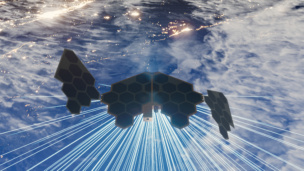
Exclusive: Meridian Space Spins Out from SpinLaunch
“Meridian will carry forward the satcom infrastructure business… SpinLaunch will continue to build on its vision for a lower-cost approach to launch, with further applications in hypersonics to support the Golden Dome program and in the lunar economy,” Meridian Space CEO Massimiliano Ladovaz told Payload.
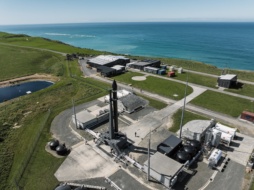
Rocket Lab CFO Adam Spice Predicts More M&A Deals on the Horizon
Iridium shareholders voted overwhelmingly to approve the company’s acquisition by Rocket Lab. According to Rocket Lab CFO Adam Spice, there’s more M&A on the horizon.


Thinking of going back to school? Seraphim Space is taking applications.
The space-focused venture capital firm today announced the launch of the Seraphim Academy, a new program for early-stage space startups offering courses in fundraising, scaling, and operations. The program comes with up to a year of support, and $150,000 of investment for each company that takes part.
The syllabus: The Seraphim Academy is designed to succeed Seraphim’s startup accelerator, which ran between 2018 and 2025.
Keep reading