


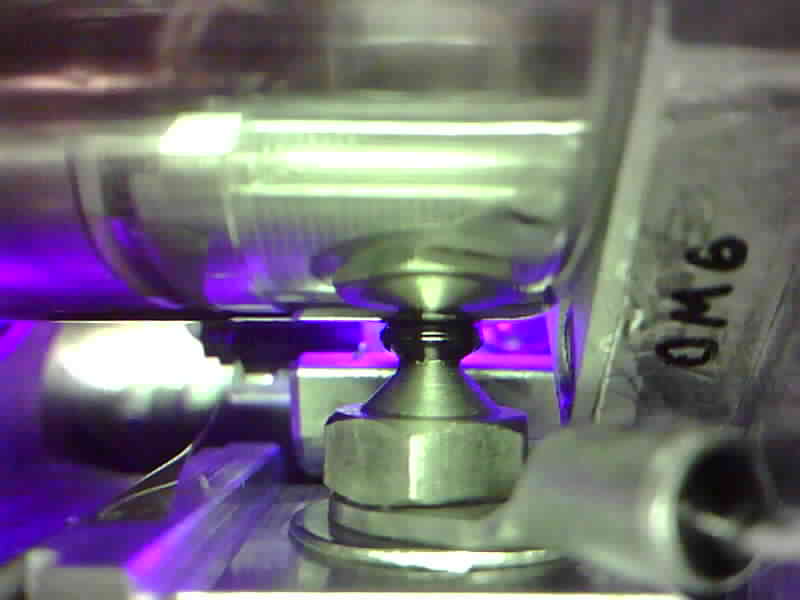
Following off the success of its latest demo, in-space manufacturing startup Orbital Matter announced today that it would partner with EnduroSat for another mission in 2028, this time to deploy a 5 kW solar array with the help of Orbital Matter’s 3D printing capabilities.
The demo aims to validate a new method to create large structures in orbit. Instead of folding bulky solar arrays into tight configurations to fit into launch vehicles, the companies plan to 3D print support structures in space to facilitate large solar-array deployments.
“Basically, [folding] means that you need to design and develop all the space systems—all the spacecraft—mostly for the launch, and not for operations in orbit,” CEO Jakub Stojek told Payload.
Copy and paste: The announcement comes shortly after Orbital Matter released results of its second demonstration mission, called Replicator 2, which proved the company’s ability to print structures in the vacuum of space for the first time.
- Replicator 2, launched on SpaceX’s Transporter-17 rideshare in July, using an EnduroSat bus.
- It carried four Orbital Matter printers, each equipped with liquid material which could be printed onto a spinning cylinder, and hardened using a UV light.
- As it prints, the hardened beam pushes out and holds a silicon solar blanket.
Replicator 2 attempted its first print job in August, where it ultimately failed to create a fully viable structure, as there were gaps between layers of printed material.
Orbital Matter then spent two months running terrestrial print jobs, before updating Replicator 2’s firmware to print a second, fully-bonded structure that was 32.5 cm long. Finally, Replicator 2 partially deployed a solar array along this single boom.
Stretching out: Replicator 2 laid the groundwork for future missions to go bigger. The 2028 mission with EnduroSat will attempt to support a 5 kW solar array—about 5 m in length, according to CTO (and 2026 Payload Pioneer) Robert Ihnatisin—with rigid booms manufactured in-space by Orbital Matter printers.
The mission is specifically targeting the nascent orbital-data-center market, which relies on satellite operators’ ability to generate huge amounts of power in space without breaking the bank.
“Orbital data centers, and AI compute in orbit, will require hundreds of kW per satellite,” EnduroSat CTO Victor Danchev said in a statement. “Building the array’s structure in orbit opens up a whole new realm outside of today’s deployable structures limit. This first flight is an important milestone in our partnership with Orbital Matter, which will scale to 100+ kW arrays in the next few years at a fraction of the current market USD/W.”
What’s next: Orbital Matter doesn’t plan to stop at 5 kW, and hopes the follow-on demo can convince customers it can support larger missions down the line. While Orbital Matter is focused on solar-array booms for now, the long-term plan is to transfer the technology to 3D print other large structures in space, including lunar and Martian infrastructure.
The company is also raising a round of financing to support an increased team—Orbital Matter employs just seven people today—and a new production facility to churn out more printers for future customers, according to Stojek.
Starfish Loses Contact with Otter, Cutting SSPICY Short
Starfish’s Otter spacecraft has joined the graveyard it was sent to inspect.
Tumbleweed Raises €6.9M to Build its Own Reentry Vehicle
Vienna-based startup Tumbleweed is attempting to build an anti-gravity machine.
Exclusive: Stellar Alpina Unveils Monarch Orbiter and Morpho Lunar Lander
The Swiss startup is unveiling two new vehicles: a high-performance orbiter, Monarch, and a lunar lander, Morpho.
Hydrosat Unveils New High-Res MWIR Thermal Capability
Hydrosat is zooming in on the thermal EO market.
Starfish’s Otter spacecraft has joined the graveyard it was sent to inspect.
Yesterday, Starfish Space announced that it lost contact with Otter 24C, putting an end to a $15M NASA in-space inspection mission one month after launch. While NASA and Starfish are exploring whether they can complete the remaining objectives with other Starfish missions—this Otter is a goner.
Cause of death: Otter 24C launched on SpaceX’s Transporter-18 rideshare mission on Oct. 1, and established contact with the ground shortly after deployment.
Keep reading