


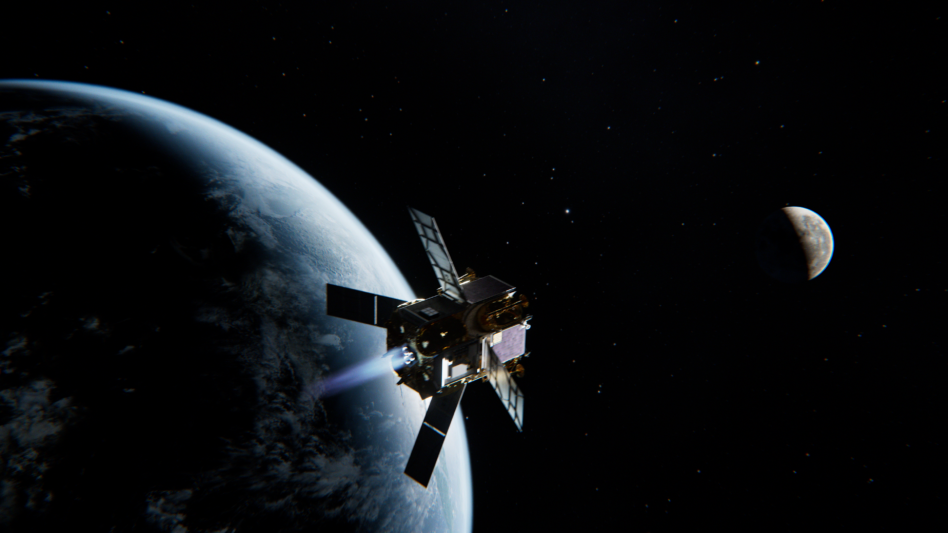
Stellar Alpina is breaking free from its cocoon.
The Swiss startup is unveiling two new vehicles: a high-performance orbiter, Monarch, and a lunar lander, Morpho.
Stellar Alpina began as a propulsion startup focused on building rotating detonation rocket engines (RDREs). However, the company has pivoted to building vehicles that can actually put the engines’ efficiency gains to work.
Wingspan: Stellar Alpina cofounder Victor Elliesen called Monarch the “Swiss Army knife of orbital operations,” built for high-delta-V missions ranging from in-space transport to responsive defense.
- Monarch is designed for up to 6,000 m/s of delta-V, 1,000 kg of wet mass, and 200 kg of payload.
- Its engines are being developed to run on hydrogen peroxide and propane, which Elliesen called “green, but also storable” propellants.
- The team is targeting an in-orbit demo by 2029, depending on launch availability.
The spacecraft is also designed to be launcher-agnostic. Elliesen said that Monarch could hitch a ride on a European microlauncher—and still reach GEO.
Eventually, Stellar Alpina wants to run Monarch as a service. “We definitely want to be able to operate our own fleet of satellites and also resell the mobility-as-a-service aspect, where we could think of business models like a pricing based on the delta-V used,” Elliesen told Payload.
Meta-morpho-sis: Stellar Alpina released fewer details about its lunar lander, Morpho, which will use an upgraded version of Monarch’s architecture. Its timeline depends on how Monarch does in the market.
- Morpho is designed to deliver up to 50 kg of payload to the Moon.
- The vehicle is built to accommodate smaller, more flexible missions across the lunar surface.
Elliesen said that beyond ESA’s Argonaut lander, Europe has no clear commitment to commercial exploration on the lunar surface. He sees Morpho as a smaller complement to Argonaut.
“Europe hasn’t established a CLPS program yet,” Elliesen said, referring to NASA’s Commercial Lunar Payload Services program. “With the developments around Moon Base and on how the roadmaps are aligning, we do see more and more demand emerging.”
Chrysalis: Stellar Alpina isn’t the only company pairing RDREs with Moon-bound vehicles.
- Astrobotic, which was acquired by Voyager Technologies in July, also plans to bolt RDREs onto its Griffin lunar lander.
- Astrobotic also announced in April it had hotfired its own RDRE for a record 300 seconds.
Neither Astrobotic nor Stellar Alpina has flown an RDRE yet. Stellar Alpina is still in the prototyping phase, with 150+ engine tests under its wing. Next up for Stellar Alpina is a water-cooled engine to tackle one of the tech’s biggest hurdles—keeping it cool “so it doesn’t melt itself,” Elliesen said.

Hydrosat Unveils New High-Res MWIR Thermal Capability
Hydrosat is zooming in on the thermal EO market.
Northwood Space Raises $375M Series C at $2B Valuation
Northwood Space is attempting to build the world’s largest ground-station network, and now it has a massive pool of capital to fund its buildout.

Seraphim Space Launches Space Academy
Thinking of going back to school? Seraphim Space is taking applications.

Exclusive: Rendezvous Robotics Raises $20M to Develop Self-Assembling Spacecraft
Rendezvous Robotics is developing technology to allow future satellites to launch in pieces that can self-assemble in space.


Hydrosat is zooming in on the thermal EO market.
Today, the company unveiled a new thermal mid-wave infrared (MWIR) program, called Nyktòs, which is designed to capture high-resolution imagery to complement the company’s lower-res, always-on, wide-swath imagery gathered through its planned Osiris constellation.
“With Osiris and Nyktòs, we have our own tip and cue capability,” CEO Pieter Fossel told Payload. “It’s really a family of products, or almost a Hydrosat ecosystem of products…It’s like having your iPhone and your MacBook. They do different things, but it can be nice to have two products from the same family.”
Keep reading