


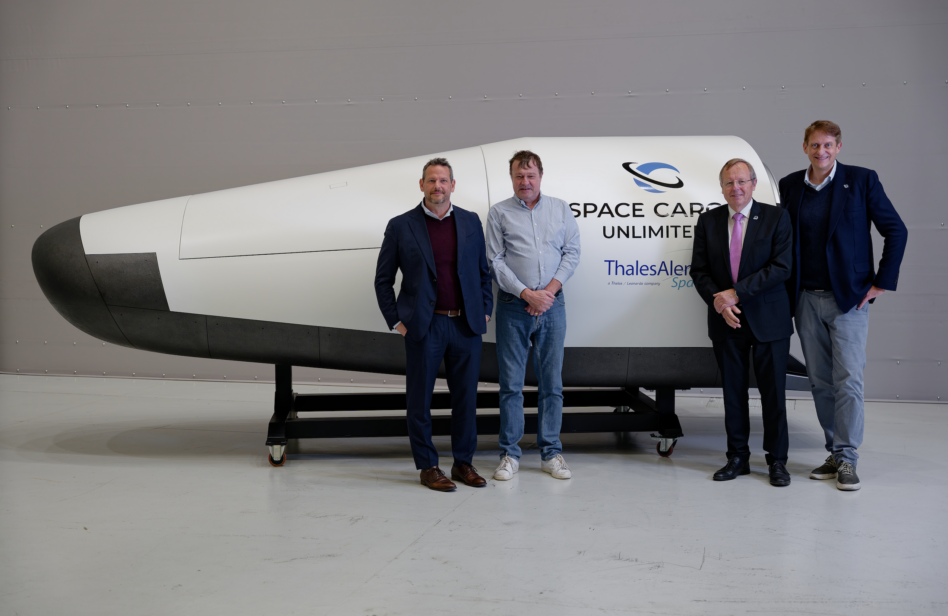
Space Cargo Unlimited unveiled its new reusable reentry vehicle—called REV1—at Space Tech Expo in Bremen, Germany today.
Developed in partnership with Thales Alenia Space, REV1 is designed to increase the total mass Space Cargo Unlimited can bring to orbit and back. The vehicle is targeting a first flight in 2030.
“We have always believed that microgravity can become a new environment for industry, but that potential depends on building the right infrastructure.” Space Cargo Unlimited CEO Nicolas Gaume said in a statement.
What’s inside: REV1 is designed around Space Cargo Unlimited’s BentoBox in-space testing and manufacturing platform.
The company has a one-ton BentoBox mission planned to fly on SpaceX’s Starfall reentry vehicle NET 2028, and is also working with Thales Alenia Space to fly future missions on REV1 at the same scale.
- REV1 will offer 1,200 liters of pressurized internal volume.
- It will deliver 2.5 kW of continuous power.
- REV1 is also designed to spend up to six months on orbit depending on the mission.
The vehicle has a two-module reusable architecture, with one reentry module intended to bring payloads back to Earth while the other remains in space.
- REV1 is being designed to allow for late integration of time sensitive payloads—such as biological samples.
- The vehicle is built with vibration and load mitigation capabilities to protect samples during launch and reentry.
- REV1 will also include real-time sensor feedback, as well as onboard autonomy and edge computing capabilities to help customers make the most of their in-space experiments.
Traffic jam: The unveiling comes amid a booming year for Space Cargo Unlimited, which has booked at least 10 missions on various reentry vehicles. Building its own reentry vehicle, however, gives it more flexibility and access.
“With BentoBox, we are developing the space factory that can fly across a fleet of vehicles. REV1 is being designed from the inside out to take this BentoBox capability even further,” Gaume said. “Our ambition is to bring space closer to industry and, ultimately, create value for the customers of our customers.”

Asynchronics Raises $3.1M To Boost its Digital-Twin Software
Asynchronics today announced the closing of a $3.1M seed round to bring more affordable digital-twin software to the market, and grow its virtual catalog of off-the-shelf components.
Exclusive: SpaceComputer Books a D-Orbit Demo Mission with Aptos Orbital in 2027
A new security standard is headed to orbit.
Exclusive: Sagittarius Logistics Raises $1.2M to Build Inland Launch Capabilities
There’s a new launcher in town.

Gama Raises €15M Seed to Boost Europe’s Solar Array Supply Chain
Europe continues to stack the building blocks for a more robust space economy.

As a species, aerospace engineers typically give birth to twins: One spacecraft destined for orbit, and another digital replica to test before its sibling flies. As in real life: Twins are expensive.
Polish engineering software startup Asynchronics today announced the closing of a $3.1M seed round to bring more affordable digital-twin software to the market, and grow its virtual catalog of off-the-shelf components to help space engineers more quickly build and test.
b2venture led the round, which included additional participation from Movens Capital, HEARTFELT, and Hard2beat.
Keep reading