


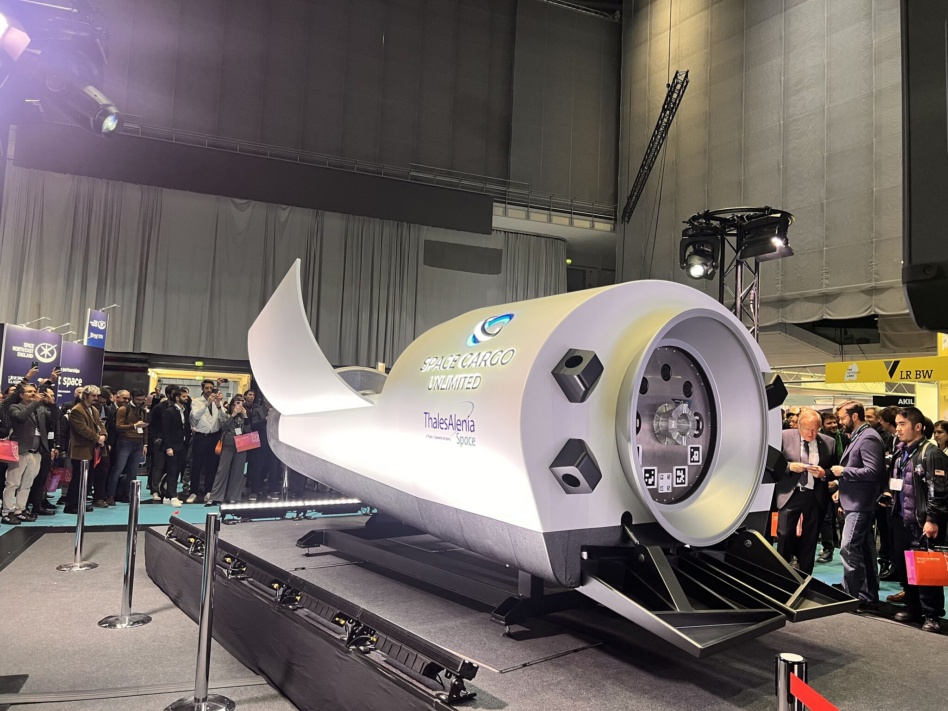
Europe is a region chock full of builders. At least, that’s the vibe we got this week watching the news wire from Space Tech Expo in Bremen, Germany.
Like all space conferences, the Expo coincided with a firehose of announcements, but one theme stood out: Europe is building a metric ship-load of hardware.
Production lineup: For well over a year, Payload Europe has covered the growth in manufacturing capacity coming from the region’s satellite manufacturers, and components suppliers. In all, Europe is on the verge of being able to produce high-hundreds of satellites annually, and demand from programs like IRIS2 will require at least as much.
Space Tech Expo proved that Europe’s manufacturing boom is still on an upswing—and it extends far beyond the production of satellite buses and subcomponents. New technologies on the road map include:
- Optical comms: SSC Space and NTT—the Japanese optical comms company—signed an agreement to explore adding NTT tech into SSC’s global ground station network.
- Reentry and in-orbit manufacturing: Space Cargo Unlimited unveiled its REV1 reentry vehicle, built in partnership with Thales Alenia Space.
- Debris removal: OHB System AG won a €102M contract to serve as the prime contractor for the ClearSpace-1 mission, aiming to deorbit a defunct satellite NET 2030.
- Orbital weapons: ATMOS Space Cargo and MBDA signed an agreement to team up to study the creation of deep-strike weapons from orbit.
- Quantum comms: Thales Alenia Space also announced the establishment of a new quantum lab, focused on building and testing new quantum comms equipment.
What’s next: In an attempt to keep up the momentum—and further wean Europe off its reliance on US space infrastructure—ESA director general Josef Aschbacher announced yesterday that the agency’s end-of-year meeting would hold a vote on a €10B program for Europe to develop capabilities to put astronauts in space.
“Europe has a choice to make about the role it wants to play because exploration is not only about where we go, it’s about what we gain along the way: new knowledge, new technologies, new opportunities for European industry, and inspiration for a new generation,” Aschbacher said. “We want to develop critical technologies in Europe, strengthen our industrial capabilities, and give European talent the opportunity to fulfil its potential. And we want to take a historic step, develop our own capability to transport European astronauts into space.”
We’re not taking bets on which way the end-of-year vote will go, but there are signs that Europe’s space industry is ready to answer the call, as at least one company—The Exploration Company—has already put human-rated flight systems on the development roadmap.

HEO Unveils Insights Next SDA Tool
If a picture is worth a thousand words, then Australian non-Earth imaging (NEI) startup HEO has a lot to say about the state of orbital traffic.
Sophia Space Tests Orbital-Compute Software on Kepler Constellation
Sophia Space has deployed its Sophia Orbital Operating System (SOOS) across multiple Kepler Communications optical-data-relay sats.
Exclusive: CUBECOM Expands to the Netherlands to Scale European Biz
Europe’s space industry is heating up, and it’s starting to attract outside attention. CUBECOM, the South African company developing RF communications systems for satellites, today announced it’s opening a new office in Delft, the Netherlands as part of an effort to lock down more deals across the continent. The new office will initially host the…
Space Cargo Unlimited Unveils REV1 Reentry Vehicle
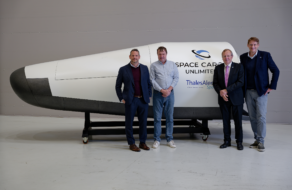
Space Cargo Unlimited unveiled its new reusable reentry vehicle—called REV1—at Space Tech Expo in Bremen, Germany today.
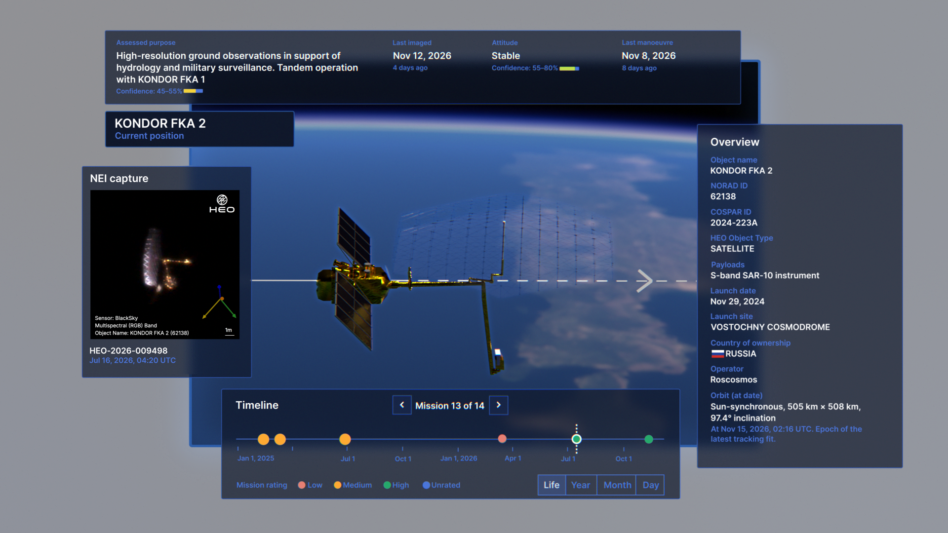
If a picture is worth a thousand words, then Australian non-Earth imaging (NEI) startup HEO has a lot to say about the state of orbital traffic.
The company unveiled a new intelligence tool—called Insights Next—aiming to give satellite operators and defense organizations a more robust understanding of what’s happening across the space domain. The platform puts HEO’s non-Earth imagery into a 3D visualization, giving users the ability to understand what an object is doing on orbit, where its sensors are pointing, and how its behavior is changing.
“Insights Next is an important step in our vision for how space intelligence should be delivered,” HEO cofounder and CEO Will Crowe said in a statement. “We’ve spent years building the infrastructure to image objects across orbit, on demand. The next step is connecting those observations with the information needed to make sense of activity in space.”
Keep reading