


What’s the scariest thing about space exploration? Probably the snakes. The second most frightening thing? Untrackable debris.
Atomic-6 built Space Armor to shield satellites from debris too small to track. The startup released test results today exploring whether the same tiles could protect astronauts on spacewalks.
“Building Space Armor, we want to protect assets in space,” Atomic-6 CEO Trevor Smith told Payload. “I can’t think of a higher value asset than a human life.”
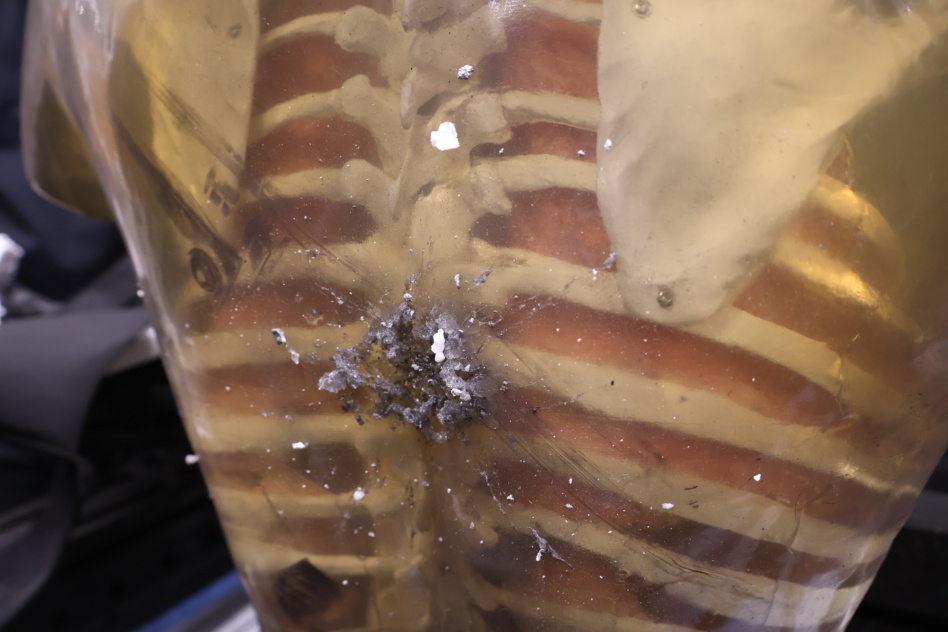
Bullseye: At Texas A&M University’s Hypervelocity Impact Laboratory, Atomic-6 fired a 3-mm aluminum sphere speeding ~7.2 km/s (~16,100 mph) at a ballistic torso—once behind a Space Armor Lite tile and once behind a 4-mm-thick solid aluminum plate. Atomic-6 said the plate stands in for current spacesuit protection.
“No humans were harmed in the testing of this,” Smith said.
- Behind the Space Armor Lite tile, the torso showed no visible damage or penetration, and the tile’s back didn’t bulge, crack, or shed material.
- The aluminum plate, on the other hand, let the sphere punch right through, leaving fragments embedded in the ballistic torso.
The company cautioned that a stationary torso isn’t a spacesuit, so the results don’t show injury outcomes or whether a suit would hold pressure after impact. Next up, the company is planning tests with curved tiles and new impact angles. Atomic-6 is also in early talks with suit makers about where armor can fit without cramping movement.
Suit of armor: Space Armor comes in two versions.
- Space Armor Lite—the version used in the test—stops hypervelocity impacts from objects up to 3 mm in diameter, according to Atomic-6.
- Space Armor Max targets objects up to 12.5 mm and is built for human-rated spacecraft and habitats.
Unlike metal Whipple shields, which need 4–6 inches of standoff space—too bulky for a suit—Space Armor is under an inch thick, Smith said. The tiles can also double as a radome, letting RF signals through to protect comms gear, while a second version blocks RF to keep signals from escaping, at the same price and weight.
Trial by fire: Last month, a Space Armor Lite tile hitched a ride to orbit on Portal Space Systems’ Starburst-1 spacecraft to see whether it would survive launch (it did). Smith joked to Portal CEO Jeff Thornburg that he hopes the satellite gets hit—just in the right spot.
“There’s really no way to orchestrate an impact in orbit,” Smith said. “You can’t just call up a space debris strike.”
Achilles’ bullet: Unfortunately, if you find yourself duelling with a true space cowboy, Atomic-6 armor still may not be enough to save you. Smith once took a tile to his local gun range and shot it with his Glock 9 mm, and the round went right through. The reason? Bullets are too slow.
“The faster the projectiles are, the better for our system,” Smith explained. “It starts working around Mach 10, and my 9 mm Glock will not shoot a bullet at Mach 10.”
RBC Signals Raises $10M to Commercialize New Comms Tech
The fresh funds are intended to expand the company’s government services business, and scale its product lineup to commercialize capabilities such as intersatellite links, optical ground comms, SDA, and spectrum monitoring.
European Hardware Takes Center Stage at Space Tech Expo
Europe is a region chock full of builders. At least, that’s the vibe we got this week watching the news wire from Space Tech Expo in Bremen, Germany.

HEO Unveils Insights Next SDA Tool
If a picture is worth a thousand words, then Australian non-Earth imaging (NEI) startup HEO has a lot to say about the state of orbital traffic.
Sophia Space Tests Orbital-Compute Software on Kepler Constellation
Sophia Space has deployed its Sophia Orbital Operating System (SOOS) across multiple Kepler Communications optical-data-relay sats.

RBC Signals, the WA-based ground station network provider, raised a $10M round led by Washington Harbour Partners, the company announced yesterday.
The fresh funds are intended to expand the company’s government services business, and scale its product lineup to commercialize capabilities such as intersatellite links, optical ground comms, SDA, and spectrum monitoring.
Hearing footsteps: The new capital comes amid a period of rapid expansion for RBC, which has spent the last few years developing new partnerships and technologies to increase both the coverage and capabilities of its ground station network.
Keep reading