


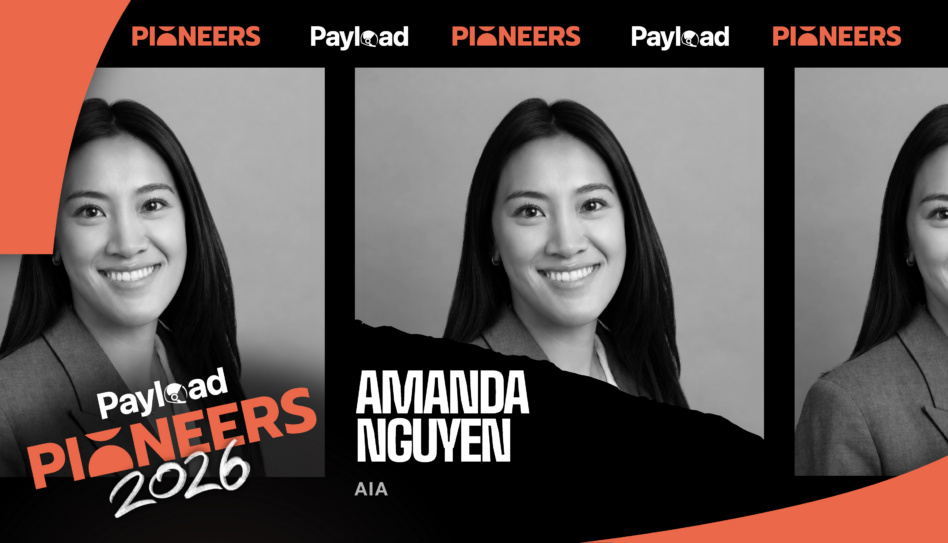
It took just 66 years to get from the Wright brothers’ first powered flight to landing humans on the Moon—a fact Amanda Nguyen loved pointing out as a student educator at the Smithsonian’s National Air and Space Museum. Today, Nguyen is working to make sure space policy can still keep up.
Nguyen’s dad, an engineer at both Orbital and Northrop Grumman, “brainwashed” her into thinking space was cool, she told Payload. As she “just wasn’t STEM-minded,” the museum showed her that not everyone in space is an engineer.
“As a political-science major, I knew I wasn’t going to design rockets or build satellites,” she said. “But I understood I could contribute by shaping the policies that enable those missions.”
Cleared for takeoff: As senior manager of space systems at the Aerospace Industries Association (AIA), Nguyen runs the group’s space-regulatory portfolio. Launching a rocket or accessing spectrum “runs through a policy, a procedure, a bureaucracy,” she said. She turns members’ feedback on what is and isn’t working into unified industry responses to rule-makings.
“We’re not bending metal,” she said. “I just want to keep the path that they’re on as clear as possible.” That often means pushing regulators to reflect “where technology and markets are heading, not just where they are today.”
Ground game: Much of Nguyen’s attention now goes to what happens before liftoff. The new National Space Transportation Policy has put a spotlight on launch infrastructure, from pads and roads, to utilities and workforce. More rockets are coming online, Nguyen said, but what keeps her up at night is “whether the infrastructure underneath can support it.”
The rockets themselves still get her, though. At her first in-person launch experience—Artemis II this spring—she kept her phone in her pocket to stay in the moment, and was brought to tears. “It was described to me as a religious experience, and I very much agree,” she said.
Her long-term goal is a lot less flashy. “I hope to be in this industry long enough to see space stop being treated as a niche policy area and become an ordinary part of conversations about the industrial base, infrastructure, economic policy, and national security,” she said.
Maximillian Bhatti, Basalt
Max Bhatti’s recipe for success in the space industry is one part luck, and nine parts hustle.

Robert Ihnatisin, Orbital Matter
As an expert in 3D printing for terrestrial applications, Robert Ihnatisin was surprised by how slow the in-orbit manufacturing industry was progressing. So, naturally, he started a company to solve the problem himself.

Patrick Miga, Advanced Space
In first grade, Patrick Miga saw a photo of Neptune (snapped by the Voyager 2 spacecraft).. Ever since then, his life has been directed toward space.

Muhammad Hunain, Melagen Labs
“That’s where I realized we’re stuck at a 1980s standard: still shielding spacecraft with aluminum, and rad-hardened electronics [were] too expensive to build at the scale this economy demands,” Hunain told Payload.
Dallas-based Balerion Space Ventures has surpassed its $200M target for its second fund, the firm announced Thursday. Fund II—which remains open—is more than five times the size of the firm’s debut fund, which came in at just under $40M.
Balerion had closed ~$90M as of May, according to Venture Capital Journal. Cofounder and General Partner Daniel Kleinmann chalked up the momentum since then to portfolio companies hitting milestones and raising up-rounds—which he said resonated with LPs.
The firm is also holding back capital for follow-on rounds. “These are really capital-intensive businesses,” Kleinmann told Payload. “Having the ability to reserve capital to continue supporting these businesses as they hit major technical, commercial, government milestones is really important to us.”
Keep reading