


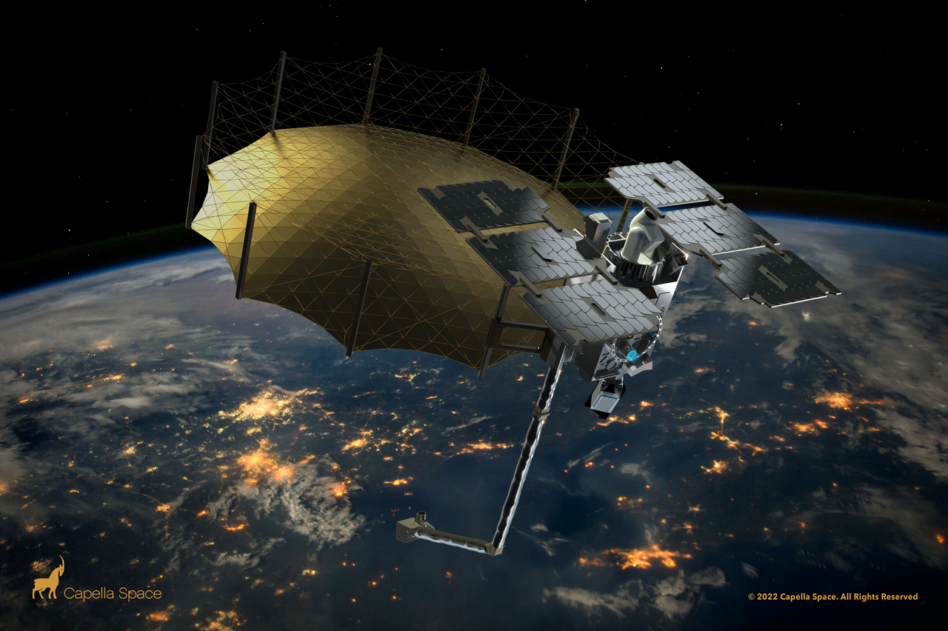
San Francisco-based Capella Space has announced Acadia, its next generation of synthetic aperture radar (SAR) satellites. Capella’s SAR satellites can see through clouds and provide all-weather, 24/7 imaging. The startup primarily serves defense and intelligence customers.
Backstory: Capella launched Denali, a backpack-sized SAR satellite, in late 2018. Next came the 100-kg. Sequoia in Aug. 2020. More recently, Capella launched the Whitney subconstellation, consisting of satellites that are ~2x Denali’s size. Capella will start launching Acadia in 2023.
While we’re here: Capella is already calling the post-Acadia generation Bryce, CEO Payam Banazadeh told Payload, but the startup isn’t ready to share any details. Curious about the naming conventions? We were too. Capella uses national parks as sources of inspiration for constellation names, Banazadeh said.
Now, on to Acadia’s specs…
Better resolution + bandwidth: Acadia will boost radar bandwidth (500 MHz → 700 MHz), while also boosting resolution (slant range res @ 0.214m; ground range res @ 0.31m for standard look angles).
Higher quality: The company is augmenting power by 40+% in its new fleet. Paired with the bandwidth boosts, Acadia will enable Capella’s customers to tap into more granular SAR imagery and see more details from space.
Speed: Capella has two nifty tricks up its sleeve here:
- Firstly, its satellites already communicate overhead with Inmarsat GEO satellites to enable more rapid tasking of its equipment, rather than having to wait on ground stations to uplink new orders. Acadia will have upgraded antennas for speedier comms.
- Secondly, Acadia will also operate with optical inter-satellite links (OISL), which should significantly cut latency across the board.
Put it all together…
“We’re already the best on resolution and quality,” Banazadeh said. “We’ve found that putting all of our chips on those three variables: resolution, quality, and timeliness…is really the right bet.”
Capella designs, builds, tests, integrates, and operates its key components (like the radars). The startup clearly adheres to agile development doctrine and operates on 12–18 month development cycles for big component and satellite upgrades.
- Reaching economies of scale brings unit production costs down, Banazadeh said, to the point that it can offset the costs of adding new bells and whistles.
- In addition, Capella is also selectively building out specific software applications for its SAR datasets, like vessel, aircraft, car, and flood detection.
Runway? Doesn’t seem to be a problem. The six-year-old startup has banked $190M to date, most recently raising $97M in April.
“We actually have gotten so much interest from investors who want to put money in [just months later], because really, our business is just booming,” Banazadeh said. Demand and revenue are up and to the right and “margins are healthy.”
DIU, SDA Select Winners for Deorbit-as-a-Service Designs
Last week, the SDA and DIU selected three companies to develop designs for scalable satellite capabilities including rendezvous, capture, and deorbit.
Exclusive: Reflect Orbital Responds to its Critics
The space community is divided over whether Reflect Orbital’s sunlight-reflecting satellites are a bright idea.
Exclusive: Space Kinetic Awarded $50M for Space Maneuverability
Space Kinetic announced a $50M OTA award from the Space Force to develop Whirlwind—its space maneuverability and deployment system.
Astrolight, ATMOS Partner on Laser Comms Reentry Demo
Astrolight will fly a laser comms terminal onboard ATMOS’ PHOENIX 2 reentry vehicle during a 2027 demo mission.

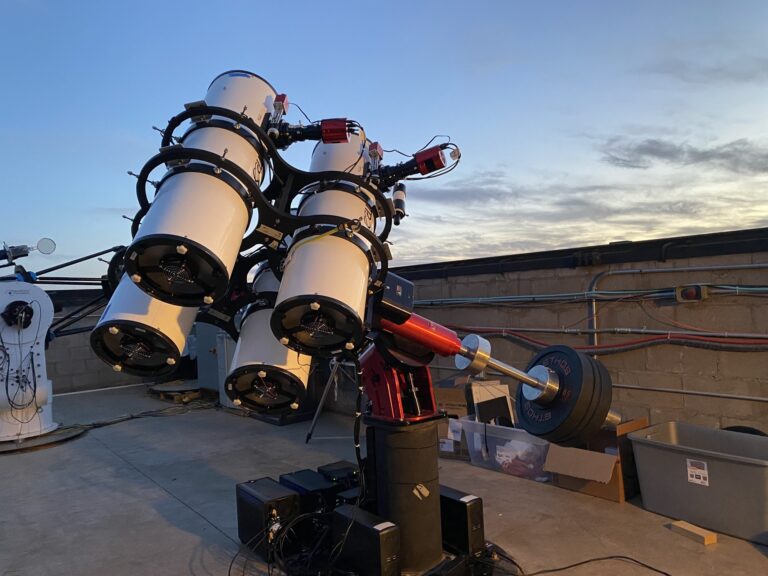
Students across the globe could soon have the ability to identify near-Earth asteroids (NEAs) for a grade, thanks to a collaboration between TransAstra and Slooh. The two companies have announced a partnership that will ultimately let K-12 students book time on a telescope.
Students will reserve observation time on a telescope equipped with TransAstra’s Sutter technology and search for NEAs via Slooh’s virtual classroom interface.
Through this partnership, the two companies plan to expand their combined network of telescopes globally to achieve full-sky, 24-hour, all-weather coverage.
Keep reading