


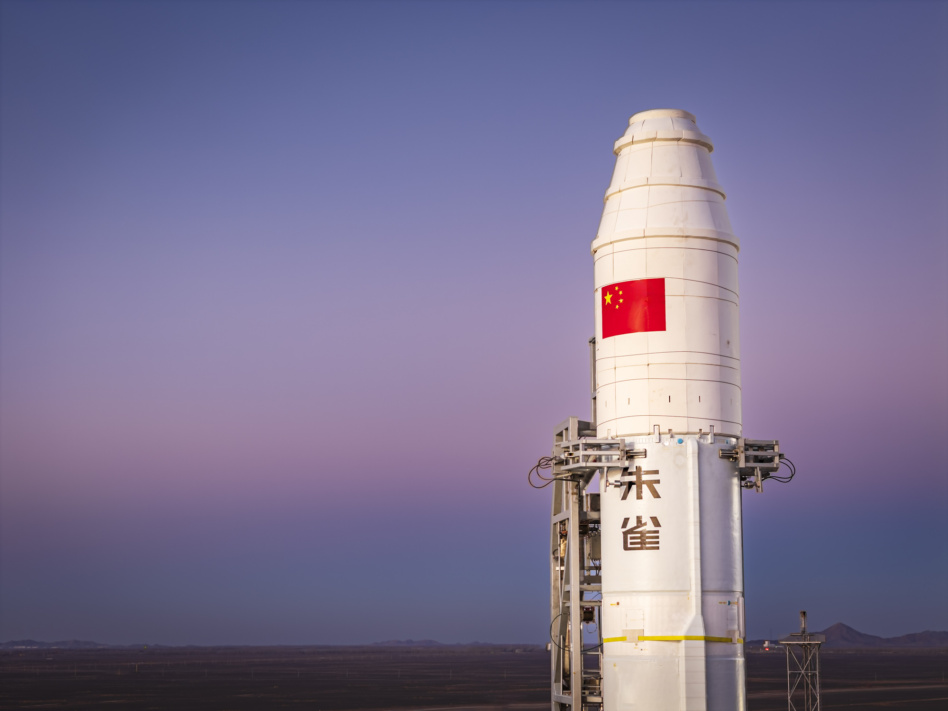
To go public as a rocket company in China, you first have to fly one.
That’s roughly the effect of a rule the Shanghai Stock Exchange issued in December, as part of a set of market reforms that has a handful of Chinese space startups lining up for listing on the STAR Market—the country’s Nasdaq alternative for domestic tech.
By transforming a technical accomplishment into a securities-compliance event, China has built a queue of companies where their progress on the pad tracks their progress toward a listing.
Fine print: China’s stock market has a specific pathway for not-yet-profitable companies to go public—designed for high risk, innovative industries such as AI, biotechnology, and commercial space.
Last year, China updated this pathway:
- In June 2025, Chinese regulators issued the “1+6” STAR Market reform, widening the listing standards for unprofitable companies with core technologies, including commercial space. Rather than imposing a revenue or profit floor, the standards require national authorization, a large market, and staged company results.
- In December, the Shanghai Stock Exchange issued specific guidelines setting a threshold for commercial rocket companies. Now, applicants must achieve a successful orbital insertion of a payload using a medium-to-large, reusable launch vehicle.
Pad to prospectus: With these changes, China is seeing the debut of several new launch vehicles—and each company’s progress on the pad now mirrors its path to go public:
- LandSpace is the farthest along in the process of entering the STAR Market. Last month, the company made history with the successful landing of its Zhuque-3 rocket’s first stage—joining SpaceX and Blue Origin as the third company to land an orbital booster on legs. I
- In March, CAS Space—a commercial spinoff of the Chinese Academy of Sciences—successfully reached orbit with the debut of its medium-lift Kinetica-2 vehicle. The Shanghai exchange accepted its IPO application the next day.
- Galactic Energy launched its first medium-lift Pallas-1 rocket on Monday, successfully reaching orbit. The company is aiming for a recovery attempt in late 2026 and began IPO counselling (the mandatory step before filing) in October 2025, but has not yet filed an application.
Burn rate: Not all launch startups have seen the same level of success. Space Pioneer’s first launch of its medium-lift Tianlong-3 rocket failed in April. The company filed for IPO counselling in 2025 and remains there.
Meanwhile, the path that these companies are taking means that they aren’t profitable.
- LandSpace is asking investors for ¥7.5B (~$1.1B) against 2025 revenue of ¥52M ($7.7M) and a net loss of ¥1.71B ($253M)—while projecting that it will reach profitability NET 2029.
- CAS Space is seeking ¥4.18B ($607M) and lost ¥748M ($105M) on ¥243M ($34M) of revenue in 2024.
Capital gains: It’s not only companies at the front of the IPO queue getting in on the action. Several Chinese space companies have made funding announcements in recent months:
- Satellite internet operator SpaceSail (also known as Shanghai Spacecom Satellite Technology) raised ~¥7B (~$1B) in a Series B to speed up the build out of its Starlink competitor, Qianfan.
- Launch firm iSpace raised ¥1B (~$148M) in the first tranche of a Series E round, following a ¥5B D++ February round. It has completed IPO counselling and is reportedly targeting a STAR Market listing in the second half of 2027.
- LandSpace’s satellite manufacturing affiliate Hongqing Technology announced a round of ¥1.3B (~$191M). Hongqing filed Honghu-3, China’s third 10,000+-satellite constellation, with the ITU in 2024.
- Launch company Orienspace announced a pre-C round worth several hundred million yuan on Aug. 5 as it prepares for its IPO and the debut of its Gravity-2 reusable rocket.
Each of these raises featured significant participation from state-backed investors, with asset investment companies affiliated with state-owned banks anchoring two of them, emphasizing the country’s strategic emphasis on the sector.
Europe’s Space Defenses Fall Just Shy of Weaponization
Europe doesn’t have any weapons in space—but that doesn’t mean the region is comfortable flying around in orbit defenseless.
ArbaLabs Launches AI Verification Demo On South Korea’s Nuri Rocket
“In short, tons of companies are looking at the latest and greatest physical AI deployments,” ArbaLabs CEO Ashley Reeves told Payload. “Nobody is really thinking about putting some checks and balances on what these AI models are doing.”

Turkey Uses IAC Stage to Pitch Peace & Homegrown Hardware
During the 2026 IAC in Antalya, representatives from Turkey are leveraging the opportunity to showcase the country’s prgoress in space.

Nebex Partners with Thrusters Unlimited to Unlock $700M for Mexico’s Space Ecosystem
The capital will fund EO, telecoms and other strategic capabilities, according to Nebex.


Europeans aren’t known for airing their dirty laundry in public, but let them speak anonymously and the clotheslines will fill up quickly.
ASD Eurospace, the trade association for Europe’s space industry, released a report this week built on anonymized interviews with 15 space industry CEOs—leaders of both A&D primes and newer scaleups. The results showed many industry leaders are disgruntled with the current setup of the region’s space sector.
In the report—titled GALAXY—the CEOs highlighted structural issues limiting the growth of Europe’s space industry, stifling its competitiveness on a global scale. But these leaders were also aligned in proposing changes that could right the ship.
Keep reading