



Europe doesn’t have any weapons in space—but that doesn’t mean the region is comfortable flying around in orbit defenseless.
During the past few weeks, comments from US Air Force Secretary Troy Meink—confirming the presence of US weapons in orbit—have forced European leaders to urge caution.
ESA Director General Josef Aschbacher told reporters this week at the International Astronautical Congress in Turkey that “Europe does not deploy weapons in space,” warning that the use of weapons to damage adversarial spacecraft would ensure the spread of debris, and potentially make space unusable for all.
But while officials decry the militarization of space, they’re also funding their own programs to boost their in-space defense postures—often aiming just shy of destructive force.
Money for ‘nothing’: In its 2026 Global Counterspace Capabilities report, the Secure World Foundation highlighted European programs focused on building defensive satellites to protect government assets. Crucially, many of these programs go beyond ISR and into the realm of effecting adversarial satellites on orbit—albeit in a non-destructive fashion.
In addition to nationally led efforts, this week all 27 EU member states approved a new collective framework to respond to threats in orbit, expanding the scope of what the bloc can do to counter aggression in orbit.
- In 2023, The European Defense Fund gathered a coalition of companies in eight countries to develop the building blocks of BODYGUARD—an autonomous SSA satellite—capable of detecting adversarial satellites up close, and counteracting “with a robot or laser.”
- Germany’s 2025 Space Safety and Security Strategy ended with a call to develop “bodyguard satellites and reusable spaceplanes to inspect and affect an adversary’s systems.”
- France has invested in programs to defend its orbital assets, including a pair of GEO satellites set to launch before 2030 to demo new defense maneuvers, and a program called FLAMHE to develop laser-based capabilities to disable adversarial satellites without causing debris.
Hired guns: Space defense in the UK has already looked beyond the demo stage.
Last month, the MoD announced the creation of a Space Effects Squadron “focused on disrupting, degrading, and denying enemy activity targeting British interests in space.”
The unit will contribute to the country’s development of space-warfare capabilities, including electronic-warfare systems, and countermeasures against anti-satellite weapons. And those efforts will likely be built by the commercial space sector.
Thomas Santini, CEO of UK security satellite startup Lodestar Space, told Payload that the difference between defense and weaponization is an important distinction.
“Being able to defend yourself in space isn’t the same as putting weapons in space,” Santini said via email. “We’re giving allied forces a graduated set of options, from watching to responding. Deterrence only works if adversaries believe you can respond.”
Lodestar is building co-orbital spacecraft that can fly alongside national assets to both identify and characterize adversarial spacecraft, and “deliver non-debris generating effects,” according to Santini.
“With our upcoming missions, we move from the ‘walk’ to ‘run’ stage by demonstrating autonomous response in operationally relevant orbits,” Santini said. “We won’t discuss specific effects publicly, but the direction is clear: from awareness to action.”

Fortastra Raises $30M Series A to Fund its Next Security Spacecraft
The US military has weapons in space, and—with the orbital arsenal expanding—security is becoming a top priority.
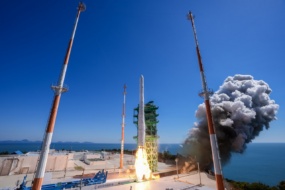
ArbaLabs Launches AI Verification Demo On South Korea’s Nuri Rocket
“In short, tons of companies are looking at the latest and greatest physical AI deployments,” ArbaLabs CEO Ashley Reeves told Payload. “Nobody is really thinking about putting some checks and balances on what these AI models are doing.”

Colorado Springs, Huntsville Team Up on Golden Dome
“It’s a transformed relationship between Colorado Springs and Huntsville,” Rep. Jeff Crank (R-CO) told Payload. “When I took office, I don’t think it was a bad relationship, but it was one where both communities were kind of looking over their shoulder at the other. That wasn’t good for America, and I don’t think it was good for Colorado Springs or Huntsville either.”
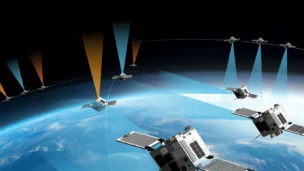
HawkEye 360 Turns its RF-Sensors to Orbital Targets
The DoD wants to better understand what’s going on in orbit. HawkEye 360 ($HAWK) has the inside scoop.

The US military has weapons in space, and—with the orbital arsenal expanding—security is becoming a top priority.
Fortastra, the CA-based startup building orbital-defense spacecraft, today announced a $30M Series A to fund its next-generation spacecraft, and meet the government’s demand for more space-based security systems.
First In led the round, which also included participation from Upfront, Space Capital, Rsquared, Side Door Ventures, and ATX Ventures as well as other new and existing investors.
Keep reading