


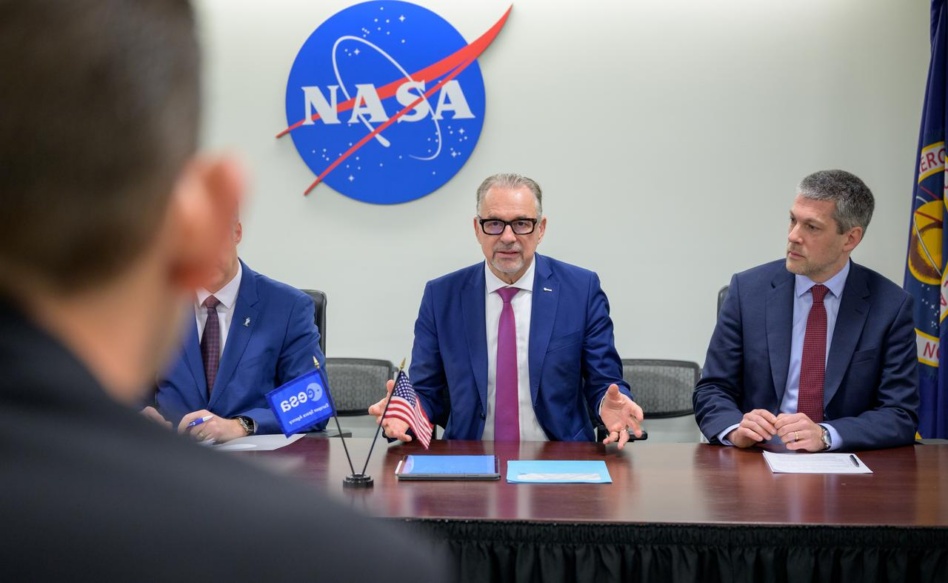
Europe has made huge strides increasing public funds to grow its space economy, but to some in the industry, enough is not enough.
“If we’re not making big changes, we will never catch up. We will always run behind [the US],” ESA Director General Josef Aschbacher told Politico at the GLOBSEC forum yesterday.
His rationale—laid out in a detailed op-ed published Monday—hinged on the idea that if Europe wants sovereign space exploration capabilities, it has to act now—before the EU finalizes its Multiannual Financial Framework for 2028-2034.
Message received: After months of tiptoeing around a direct response to NASA’s about-face changes to the Artemis program in March, Aschbacher used the op-ed to speak bluntly: “Europe has become too exposed to decisions beyond its control.”
By making the unilateral decision to pause Gateway and cancel Mars Sample Return, the US disrupted Europe’s space exploration plans, he argued. As a result, Europe needs to be the master of its own destiny—something that will require the European nations to “multiply our investment by a factor of two, at least, if not three,” Aschbacher said at the event.
But funds alone can’t bring Europe into a sovereign space future. The region also needs the “political will,” to set itself on a path of autonomous activities in space—and reduce its dependency on American space dominance.
In some ways, this willpower is already on the rise across the region.
ESA’s 2025 Council of Ministers wrapped in November, with 24 of 27 contributing nations increasing their subscriptions to the multinational agency. During the past year, multiple nations have upped their public space and defense budgets.
Uphill battles: The risk remains, however, that these budget increases don’t coalesce into a unified framework for regional sovereignty in space.
“Strength only exists if we act together,” Aschbacher said in his op-ed. “European nations must resist the temptation to look inward—forging solo paths on the Moon and beyond. In the long run, no single member state can achieve on their own what we can achieve together.”
Bad omens: Despite ESA’s budget ballooning, multiple member nations are instead directing funds to boost themselves, forgoing potential opportunities to work together.
- Germany and France have earmarked €35B and €4.2B in public funds, respectively, for their national space defense sectors.
- In March, Germany also announced a plan to spend approximately €10B on a 100-sat communications constellation to operate separate from IRIS2;
- Even Luxembourg, famously small and landlocked, has set aside €150M in a “National Defence Fund” for its local A&D industry.
Sustained political will also faces challenges from divided national budgets, which can spend big on defense while pulling funds for space science and exploration in hard financial times.
In April, the French government did just that, directing CNES Chair and CEO François Jacq to cut €320M from the agency’s budget to align with the country’s austerity measures. If other European nations fall into financial disrepair, space budgets could similarly find themselves on the chopping block.
Now or never: To get around these hurdles, Aschbacher pushed for urgency. His call to action: Lock in a decisive plan to set Europe on a path to sovereign space capabilities, and commit to the years of work necessary to get the job done.
“If we started today, it would still take us many years to build autonomous capability—we must act quickly. The cost of inaction would far outweigh the necessary investment,” Aschbacher said. “We have everything we need. What remains are the confidence and political will to act.”

Nebex Partners with Thrusters Unlimited to Unlock $700M for Mexico’s Space Ecosystem
The capital will fund EO, telecoms and other strategic capabilities, according to Nebex.
DOE Announces $400M for Frontier Science Research
The Department of Energy is super-charging research into bleeding edge energy tech.
Skyrora Shifts Orbital Launch Timeline to 2030
First-mover advantage isn’t all it’s cracked up to be—at least, that’s the thought process for UK launcher Skyrora.
Foundational Raises £8.2M for Satellite Laser Ranging
Foundational emerged from stealth today with Europe’s largest space tech pre-seed round.

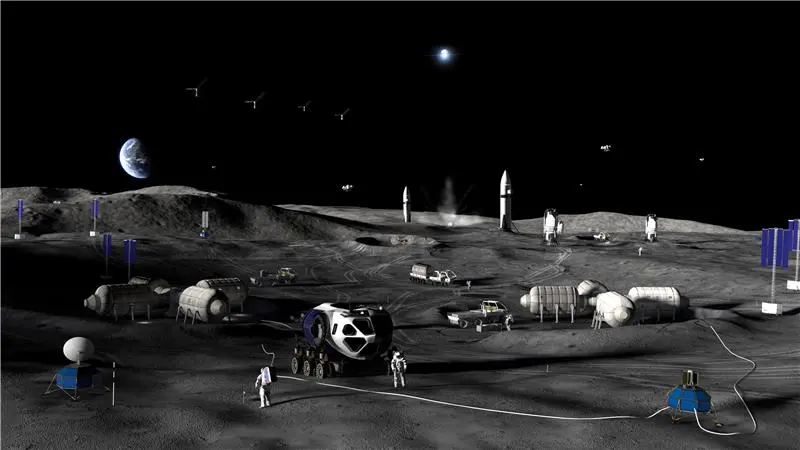
Better Moon infrastructure was the top ask of hundreds of space community members, according to a NASA ranking of space technology “shortfalls” released on Thursday.
The agency said it uses this list “as one of many inputs into decision-making.” But the ranking was made public days before a big agency event announces more details about its pivot to a Moon base on Tuesday.
Recap: Two years ago, NASA asked the space community what technical challenges are giving people the biggest headaches to help NASA prioritize its space tech investments. More than 450 stakeholders submitted feedback on 187 ideas, which were cut down to the final 32.
Keep reading