


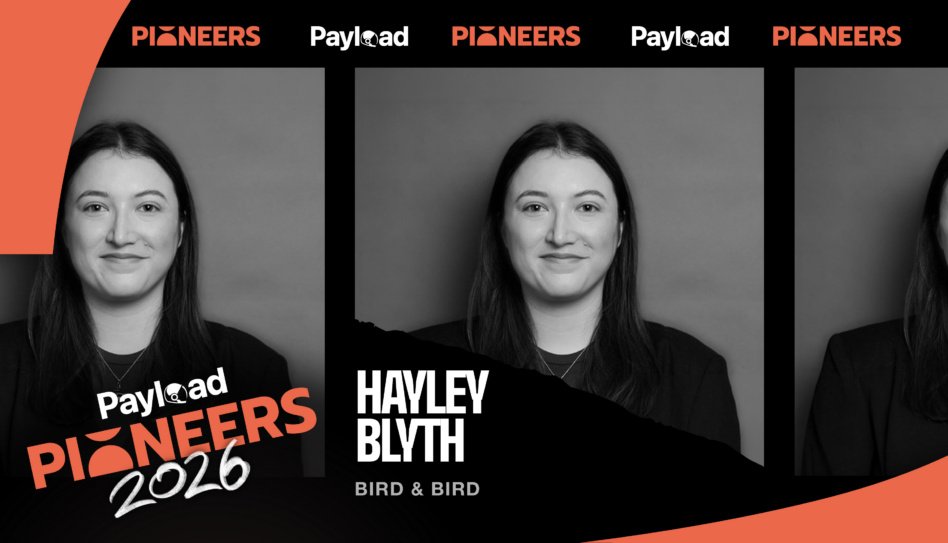
Hayley Blyth’s path into space started with a question about war: how do the rules of armed conflict apply in orbit?
She embraced the question as a law student in Canberra, Australia, writing her thesis on the intersection of international humanitarian law and space operations. The research put her in touch with the Australian Space Agency—and pulled her toward a field where the rulebook was still being written.
Both sides of the table: After about two years at a telecom law firm, Blyth joined the Australian Space Agency as in-house legal counsel, helping build the country’s regulatory framework for launches and ground stations.
Four years ago, she moved to London for a taste of a bigger space industry. After a stint at a three-person boutique firm, Blyth joined international law firm Bird & Bird, where she co-heads the global Space and Satellite practice—a role she stepped into as an associate.
Square pegs: These days, Blyth’s favorite problems are the ones the law never saw coming. Many existing regulatory frameworks were “designed at a time when that kind of technology didn’t exist,” Blyth said, leaving in-orbit servicers and orbital data centers squeezed into boxes built for something else.
Give each new technology its own rulebook, and you get a patchwork of regimes that “don’t fit together,” she said. “And then what happens when the technology goes even further, and suddenly we’ve got all these things in one?” But one broad regime has to stretch to cover everything. “It’s a bit of a puzzle,” she said.
Phone home: One of the puzzles playing out in real time is D2D. Satellite phones aren’t new, Blyth noted, but a mass commercial rollout is. As regulators were facing some of these questions for the first time, Blyth advised companies launching the first satellite D2D services in the UK and EU.
To help others keep up, she built Bird & Bird’s publicly available Satellite D2D Regulatory Tracker. Blyth also writes In Constellation—a monthly newsletter with more than 1,000 subscribers—and mentors students and young professionals interested in the sector.
To Blyth’s delight, more regulatory puzzles are on the way. “Getting legal and regulatory foundations right now shapes what the space industry can become,” she said.

Maximillian Bhatti, Basalt
Max Bhatti’s recipe for success in the space industry is one part luck, and nine parts hustle.

Robert Ihnatisin, Orbital Matter
As an expert in 3D printing for terrestrial applications, Robert Ihnatisin was surprised by how slow the in-orbit manufacturing industry was progressing. So, naturally, he started a company to solve the problem himself.

Patrick Miga, Advanced Space
In first grade, Patrick Miga saw a photo of Neptune (snapped by the Voyager 2 spacecraft).. Ever since then, his life has been directed toward space.

Muhammad Hunain, Melagen Labs
“That’s where I realized we’re stuck at a 1980s standard: still shielding spacecraft with aluminum, and rad-hardened electronics [were] too expensive to build at the scale this economy demands,” Hunain told Payload.

Dallas-based Balerion Space Ventures has surpassed its $200M target for its second fund, the firm announced Thursday. Fund II—which remains open—is more than five times the size of the firm’s debut fund, which came in at just under $40M.
Balerion had closed ~$90M as of May, according to Venture Capital Journal. Cofounder and General Partner Daniel Kleinmann chalked up the momentum since then to portfolio companies hitting milestones and raising up-rounds—which he said resonated with LPs.
The firm is also holding back capital for follow-on rounds. “These are really capital-intensive businesses,” Kleinmann told Payload. “Having the ability to reserve capital to continue supporting these businesses as they hit major technical, commercial, government milestones is really important to us.”
Keep reading