


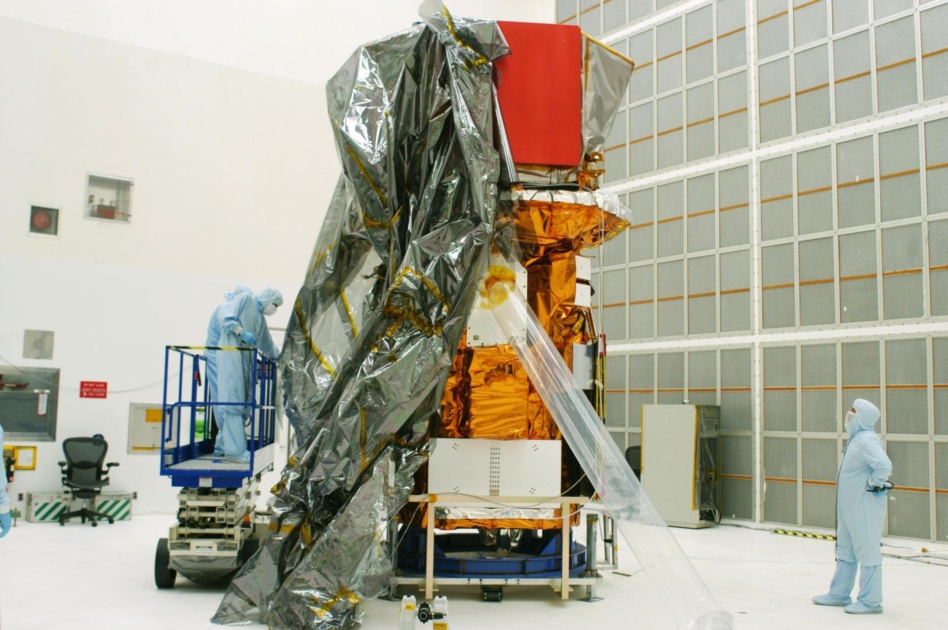
NASA hired four companies to figure out how to raise the orbit of a two-decade-old space observatory that still provides important data to scientists.
The agency is leveraging SBIR study contracts to assess the feasibility of a rescue mission that would take place in 2026. That timeline will stress supply chains and the ability to obtain regulatory approval for a potential mission.
Swift spotter: The Neil Gehrels Swift Observatory launched in 2004 to study gamma ray bursts. Its speciality is quickly focusing on fast-moving events like exploding stars and stellar flares, among other astronomical phenomena.
A recent spate of heavy sun storms is threatening to pull the observatory, which lacks propulsion systems, back into the atmosphere faster than originally expected.
Slippery, too: A key challenge for an orbit raise is that the observatory is not prepared for servicing—and lacks even a launch adapter ring. This forces companies to come up with their own plans to safely grab onto the orbiting platform. Those who think they’re up to the task include:
- Katalyst Space Technologies, which is already planning to demo a spacecraft capable of grappling another satellite in 2026.
- Cambrian Works, which has developed a product—the electric Thin Attachment Pad—that it says can “adhere to virtually any space material.” Cambrian is partnering with Astroscale, the space services company, to provide advice on in-space execution.
- Starfish Space, already at work on a mission to inspect defunct satellites for NASA, will look into using its Otter spacecraft for the job.
Another bite at the apple: In what seems like another world (2022), NASA considered a proposal from SpaceX astronaut and entrepreneur Jared Isaacman, who wanted to use a Dragon vehicle to raise the Hubble Space Telescope; the discussions with NASA ended in acrimony.
The smaller Swift observatory might make a better target for a first-time commercial-orbit-raising mission. Still, NASA isn’t committed to launching such an effort, but said the research would boost the space industry and prepare the way for orbit raises of other aging spacecraft.
This story has been updated with new information about Katalyst’s spacecraft demos.

Starfish’s First Operational Otter Heading to Orbit Next Month
During the Small Spacecraft Propulsion and Inspection Capability, aka SSPICY, mission, Otter will approach and inspect multiple US defunct satellites, whose operators have agreed to receive a visit from the spacecraft.
Exclusive: Outpost Launches In-Space Manufacturing Service
Outpost will be the first user of the Space Factory platform. The company plans to use the module to produce StarFiber, its next-gen metal fluoride optical fiber, on a mission NET 2028.
Eutelsat Taps Infinite Orbits for GEO Life Extension Mission
Eutelsat announced an agreement today tasking the Infinite Orbits with increasing the life span of at least one of its GEO sats.
Exclusive: Helogen Plans Two In-Orbit Manufacturing Missions in October
While Helogen has flown subsystems in the past, the missions will mark the first flights of the entire HEL-IOS platform.


Interstellar Technologies, the Japanese company building end-to-end space services, signed agreements with five organizations this week to launch payloads aboard the first flight of its ZERO rocket in 2027.
The passengers on the inaugural ride include:
High risk, high reward: While the launch service agreements mark the first paying customers aboard an Interstellar flight, they won’t cover the costs of the launch itself.
Keep reading