


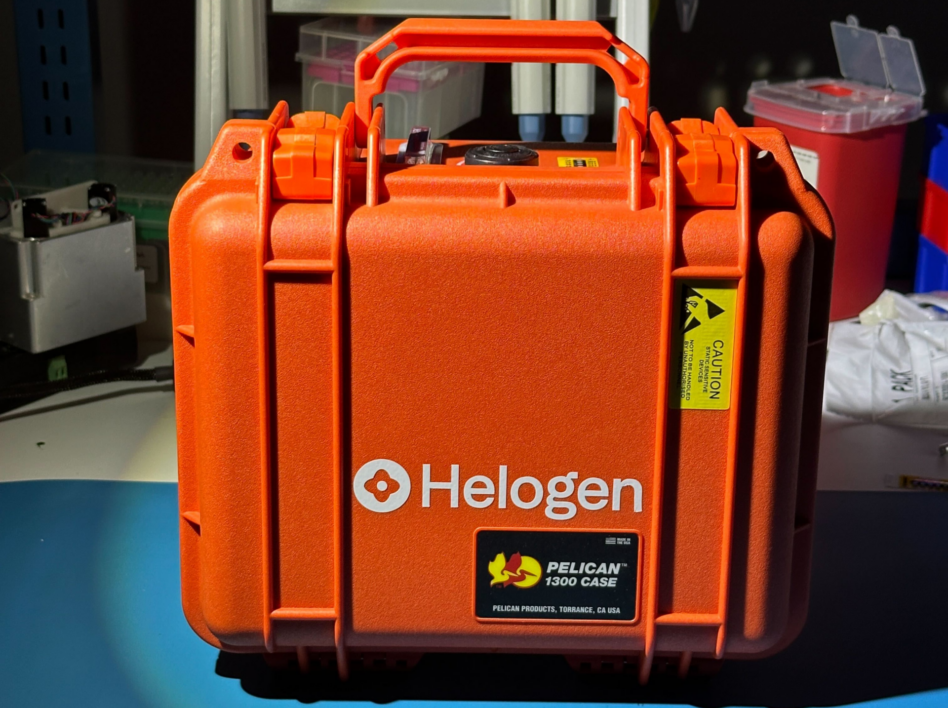
In-space manufacturing startup Helogen today announced two upcoming missions of its HEL-IOS biomaterials manufacturing platform, both scheduled to launch in October.
The missions will fly on separate SpaceX launch vehicles, and aim to demonstrate Helogen’s ability to manufacture biological materials on orbit—once for a customer, and once for Helogen’s internally developed products. While Helogen has flown subsystems in the past, the missions will mark the first flights of the entire HEL-IOS platform.
- For the first mission, Helogen will fly HEL-IOS on an as-yet unannounced reentry vehicle, and plans to develop polymers for orthopedic applications. Post-mission, Helogen will attempt to recover the manufactured biomaterials for further research study.
- For the second, Helogen has partnered with LambdaVision to fly an in-orbit demo of HEL-IOS on a D-Orbit spacecraft to prove out the creation of proteins for artificial retinas on orbit.
Both missions will push Helogen closer to its goal of in-space biological manufacturing at scale, and help the company advance toward regulatory approval for the use of in-space manufactured materials in terrestrial medical procedures.
“Each of these missions, the biggest thing is making sure that that sterility is maintained, making sure we have traceability and accountability,” Helogen CEO Shishir Bankapur told Payload. “Just like the ice cream analogy: You want to know whether your ice cream was transported frozen throughout its journey to your grocery store.
Take a knee: While many in-space manufacturers are attempting to produce drugs—or drug precursors—in orbit, Helogen is aiming at what Bankapur believes is a more immediately achievable goal: surgical implants.
- Helogen aims to create biopolymers that would be used in orthopedic surgeries as scaffolding material for procedures such as shoulder-rotator-cuff repairs or knee-meniscus repairs.
- Compared with biopolymers used today, Helogen expects its in-space alternative will be denser and longer-lasting.
Alongside its own product development, Helogen is also offering its HEL-IOS platform as a test ground—and eventual production hub—for other customers looking to manufacture biomaterials in space. Helogen’s HEL-IOS platform, which was one of ten projects to win NASA’s TechLeap prize last year, is modular, so customers can pick and choose which platform aspects they need in space, without much non-recurring engineering involved.
Mix and match: Helogen’s two missions in October are just the start. The company plans to fly eight missions in the next 12 months. Bankapur told Payload that about three-quarters of these missions will be focused on the development of internal products, while the rest will fly HEL-IOS for customer-funded product R&D.
Both mission types are revenue generating for Helogen.
- Customer-led flights, where other companies use HEL-IOS for their own purposes, have larger margins.
- Internal missions will allow Helogen to sell the made-in-space materials after splashdown, and Helogen can gather early deposits and R&D fees in the meantime.
Internal missions are set to outperform customer-led flights in the future, however, when Helogen can churn out more material—and begin selling in-space products to medical practices, instead of just researchers. Still, the company plans to fly a mix of internal and customer missions for the foreseeable future.
“Very early on, one of the things that we realized is we’ll not have all the good ideas in the world. We will run into researchers, [and] we’ll run into institutions who want to commercialize their good ideas,” Bankapur said. “Taking a leaf out of DuPont’s book, I want to not only be a manufacturer, but like I want to be an integral part in commercializing the potential [of space].”
Fortastra Raises $30M Series A to Fund its Next Security Spacecraft
The US military has weapons in space, and—with the orbital arsenal expanding—security is becoming a top priority.
Exclusive: Xona Ramps Up Production Ahead of Pulsar Launch
With FCC approval in hand and six sats ready for the pad, Xona is turning to its next challenge: building the next 250.
ArbaLabs Launches AI Verification Demo On South Korea’s Nuri Rocket
“In short, tons of companies are looking at the latest and greatest physical AI deployments,” ArbaLabs CEO Ashley Reeves told Payload. “Nobody is really thinking about putting some checks and balances on what these AI models are doing.”

Nebex Partners with Thrusters Unlimited to Unlock $700M for Mexico’s Space Ecosystem
The capital will fund EO, telecoms and other strategic capabilities, according to Nebex.

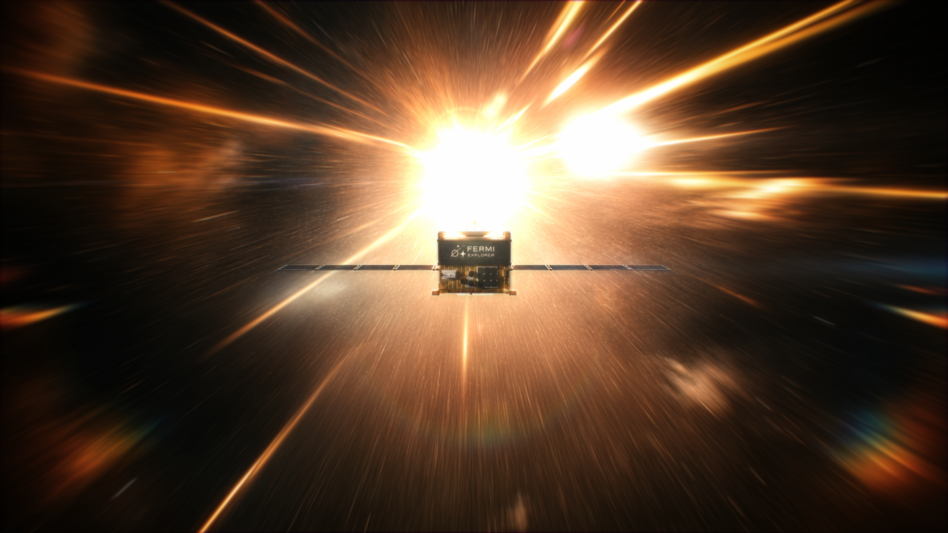
A new non-profit wants to send a spacecraft to a star for less than the cost of a first-season episode of House of the Dragon.
Today, the Starcloud cofounders announced the Fermi Explorer mission—which intends to succeed where Breakthrough Starshot struggled and launch humanity’s first mission to Alpha Centauri by 2029, on a $15M budget.
Starstruck: It began with a conversation. Starcloud CEO and cofounder Philip Johnston was speaking to another founder at a conference last year. The founder told Johnston that—after retirement—he planned to spend $1B on an interstellar probe.
Keep reading