


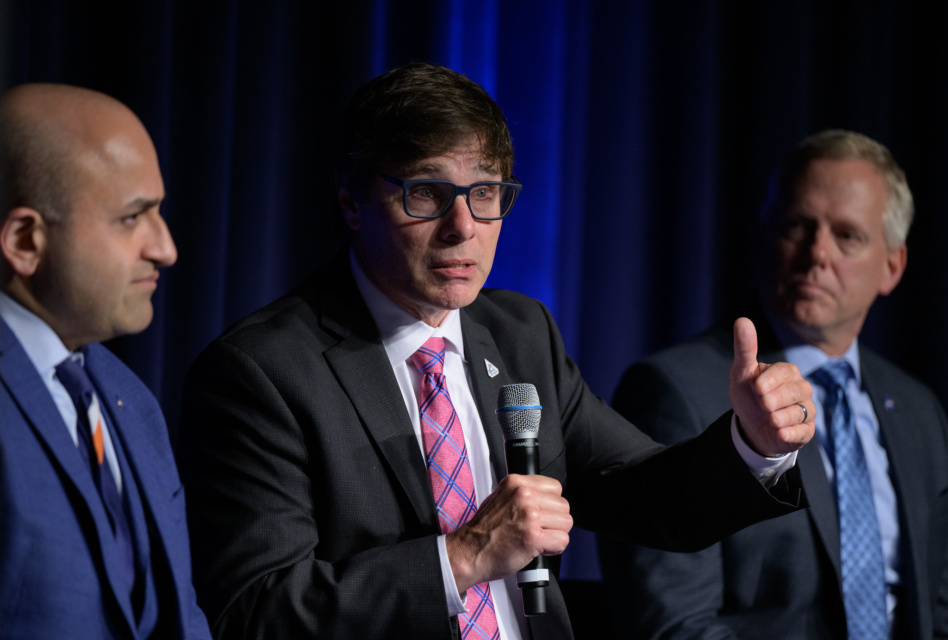
NASA leadership touted the benefits of using AI in a town hall meeting on Wednesday, but emphasized that the new tech will be used in a responsible way that won’t replace the space agency’s skilled workforce.
Administrator Bill Nelson emphasized that he takes seriously the president’s charge to integrate AI with a focus on “safety, transparency, and reliability.”
Deputy Administrator Pam Melroy was a little more succinct, quoting Spider-Man: “With great power comes great responsibility.”
AI chief: David Salvagnini, who was named the agency’s first chief AI officer this month, also participated in the town hall, laying out how he sees his new role fitting into the agency’s existing missions.
“If NASA were a symphony, I’m the conductor and I’m harmonizing the various different instruments and sections of the orchestra where we’re all rowing in the same direction,” he said.
Some of his job functions include:
- Driving the innovative use of AI at NASA
- Establishing a governance structure to make sure AI is being used responsibly
- Providing learning opportunities for NASA employees on AI
Use cases: Katherine Calvin, NASA’s chief scientist, said AI is especially good at spotting anomalies once a person trains the computer what to look for. That can include things like combing through satellite imagery to find and track smoke from wildfires or count the number of trees in a particular area.
In each case, AI is taking on mundane, repetitive tasks to free up people to do more important work, the officials said.
In the loop: One of NASA’s top messages to the workforce seemed to be that the algorithms aren’t coming for their jobs. Officials stressed that the technology will be used with humans, not to replace the workforce, especially since AI can make mistakes.
“We’re not outsourcing our thinking to the AI,” Salvagnini said.
NASA Signs Space Nuclear Pact, Says Moon Base Is Ahead of Schedule
Isaacman gave updates at the White House’s “Science: A New Golden Age Summit.”

DOT Proposes Changes to Part 450 Licensing Rules
On Tuesday, Transportation Secretary Sean Duffy announced five proposed FAA rules aiming to streamline and modernize commercial space launch and reentry regulations.

DOE Announces $400M for Frontier Science Research
The Department of Energy is super-charging research into bleeding edge energy tech.

States Campaign to Host the US Space Academy
Ever since President Donald Trump signed an executive order on Aug. 28 establishing a US Space Academy, states have been coming out of the woodwork to make the case for why the school should call it home.


NASA found that quickly disposing of spacecraft at the end of their life is one of the most cost-effective ways to prevent trash in orbit, according to a new cost-benefit analysis that compared the effectiveness of 24 different tools to mitigate space debris.
The goal of the study was to identify which debris mitigation actions decision-makers should prioritize to reduce collision risks while minimizing cost.
“By measuring everything in dollars, we can directly compare shielding spacecraft to tracking smaller debris or removing 50 large pieces of debris to removing 50,000 smaller ones,” said NASA researcher Jericho Locke.
Keep reading