


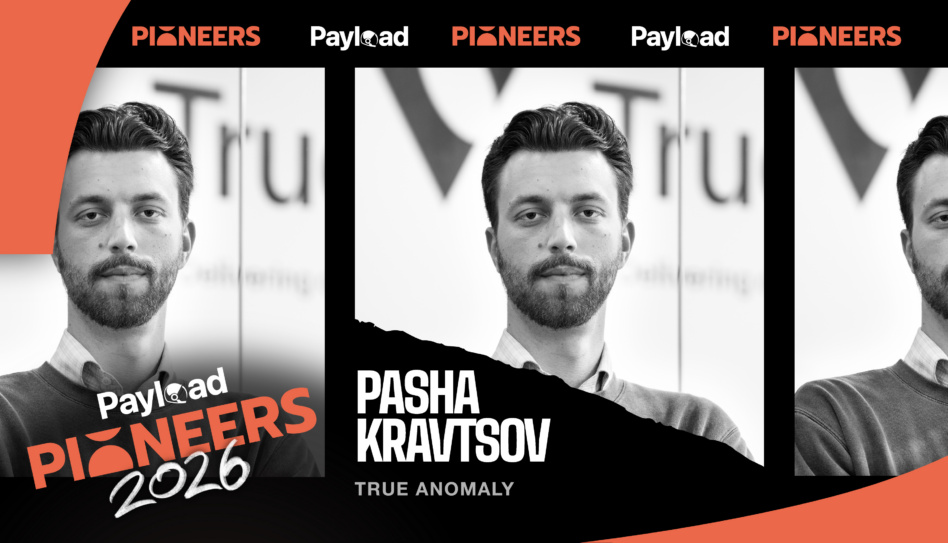
As a kid, Pasha Kravtsov was an avid gamer, and got upset when other kids cheated. “I always wanted to understand: How were they doing that?” he told Payload.
As an adult, he’s still asking that question—but now his sights are set a bit higher. As True Anomaly’s cybersecurity director, Kravtsov leads a team of 27+ people working out how to stop someone from breaking into a spacecraft.
Side quests: Kravtsov spent his teen years reverse-engineering games, finished high school early, and joined Cloudflare’s support team at age 17. His parents even had to sign the offer letter. Within a year he’d moved to security, where he worked on a bug that leaked private data from sites using Cloudflare.
He left after the company’s 2019 IPO and bounced between startups. Then, Russia invaded Ukraine, where Kravtsov’s family is from. “Commercial satellites became battlefield infrastructure overnight,” he said.
When a former colleague shared that his company was working to counter a recently-launched Russian military sat, Kravtsov wanted in.
Cheat code: He joined True Anomaly in early 2023 as its first security engineer—with no aerospace or defense background—and built the encryption for the company’s first mission. “A lot of the problems I was working on, you can’t just Google,” he said.
Commercial software can feel like “an abstraction layer on an abstraction layer,” he said. But in defense space, “it’s very, very clear what the stakes are.”
“A bad day at Cloudflare didn’t mean a physical effect,” Kravtsov said. In orbit, a hijacked satellite could go “somewhere where it’s not supposed to be,” with real consequences for national security missions.
Multiplayer mode: The team got its biggest test earlier this year. True Anomaly was one of the first companies to face NOAA’s new, stricter cybersecurity requirements for spacecraft licenses—arriving shortly before the company’s Mission X-3 launch. Kravtsov worked out a plan with the agency and led the effort to meet the requirements, all while keeping the X-3 flight test on schedule.
As the rules push the rest of the industry to increase the focus on security, he said he hopes companies drop one stubborn assumption along the way.
“What I want to see is challenging the status quo of ‘if you can’t touch it, it can’t be hacked,'” he said. “Which is not accurate.”
Maximillian Bhatti, Basalt
Max Bhatti’s recipe for success in the space industry is one part luck, and nine parts hustle.
Robert Ihnatisin, Orbital Matter
As an expert in 3D printing for terrestrial applications, Robert Ihnatisin was surprised by how slow the in-orbit manufacturing industry was progressing. So, naturally, he started a company to solve the problem himself.

Patrick Miga, Advanced Space
In first grade, Patrick Miga saw a photo of Neptune (snapped by the Voyager 2 spacecraft).. Ever since then, his life has been directed toward space.
Muhammad Hunain, Melagen Labs
“That’s where I realized we’re stuck at a 1980s standard: still shielding spacecraft with aluminum, and rad-hardened electronics [were] too expensive to build at the scale this economy demands,” Hunain told Payload.
Dallas-based Balerion Space Ventures has surpassed its $200M target for its second fund, the firm announced Thursday. Fund II—which remains open—is more than five times the size of the firm’s debut fund, which came in at just under $40M.
Balerion had closed ~$90M as of May, according to Venture Capital Journal. Cofounder and General Partner Daniel Kleinmann chalked up the momentum since then to portfolio companies hitting milestones and raising up-rounds—which he said resonated with LPs.
The firm is also holding back capital for follow-on rounds. “These are really capital-intensive businesses,” Kleinmann told Payload. “Having the ability to reserve capital to continue supporting these businesses as they hit major technical, commercial, government milestones is really important to us.”
Keep reading