


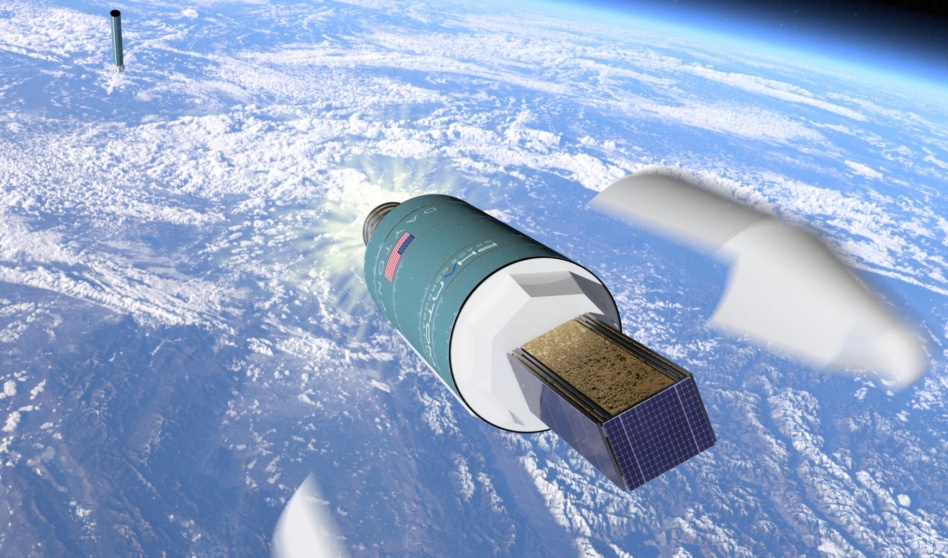
Phantom Space, an up-and-coming launch provider and satellite manufacturer, has partnered with Ubotica Technologies to bring AI processing power to orbit.
The volume of data being gathered in space is growing exponentially, and the capacity to ship that data back to Earth is increasingly constrained. That’s why more companies want to analyze their data on orbit. Phantom Space is no different.
“We think that the future in space—the future economy in space—is data. We think that to get it down, we have to use AI, so we’re going to build that capability,” Phantom Space CEO Jim Cantrell told Payload.
Unmasking the Phantom: Founded in 2019, Phantom Space has steadily built a three-pronged business model to take on the industry’s powerhouses.
- The company is constructing its own launch vehicle, Daytona. It’s a ~20 m (66 ft) two-stage rocket that will be capable of bringing 600kg (1,300lbs) to LEO for ~$6M per launch. The company expects to begin flying Daytona late next year or early 2027, and already has a Daytona II and III in the works.
- Phantom Space offers manufacturing services to build out sats ranging from 1 to 1,200 kg, either as one-off products or full constellations.
- The company also plans to build an in-house constellation—called Phantom Cloud—to solve the growing data capacity problem on orbit.
Phantom Cloud aims to reduce delays in orbital data delivery using Ubotica processors to sift through bits of data in space for analysis and then send down the necessary insights. The constellation will also provide a platform for software applications on orbit, meaning future customers won’t have to build their own sats.
“An on-board AI processing capability is increasingly being seen as a ‘must-have’ for new satellites,” Aubrey Dunne, co-founder and CTO of Ubotica, told Payload via email. “Any satellite with compatible communications can partake in the data reduction and low-latency intelligence gathering supported by the SPACE:AI workflow on Phantom simply by communicating its processing workload to the Phantom Cloud.”
Ultimately, Phantom Space expects ~40% of its future launch capacity to be taken up by its own Cloud sats, according to Cantrell.
Mutually beneficial: Phantom Space has a lot of hardware experience; combined, the company’s employees have worked on 60+ satellites and 11 launch vehicles. But for the ones and zeros, Phantom has leveraged partnerships with startups working on next-gen technologies.
Phantom Space has also tapped Secured2, a quantum encryption company, to help operate its orbital data centers. A strategic partnership with Assured Space Access will provide radio frequency payloads for the future Cloud constellation.
“We continue to plan on having other partners that can take these sorts of things on. We just want to be the Apple iPhone in space that guys can develop the apps and load them up,” Cantrell said. “We want to make space so that 95% of the world can create space applications on our constellation with a web browser and a few dollars.”

DOT Proposes Changes to Part 450 Licensing Rules
On Tuesday, Transportation Secretary Sean Duffy announced five proposed FAA rules aiming to streamline and modernize commercial space launch and reentry regulations.
ArbaLabs Launches AI Verification Demo On South Korea’s Nuri Rocket
“In short, tons of companies are looking at the latest and greatest physical AI deployments,” ArbaLabs CEO Ashley Reeves told Payload. “Nobody is really thinking about putting some checks and balances on what these AI models are doing.”
HawkEye 360 Turns its RF-Sensors to Orbital Targets
The DoD wants to better understand what’s going on in orbit. HawkEye 360 ($HAWK) has the inside scoop.

Nebex Partners with Thrusters Unlimited to Unlock $700M for Mexico’s Space Ecosystem
The capital will fund EO, telecoms and other strategic capabilities, according to Nebex.

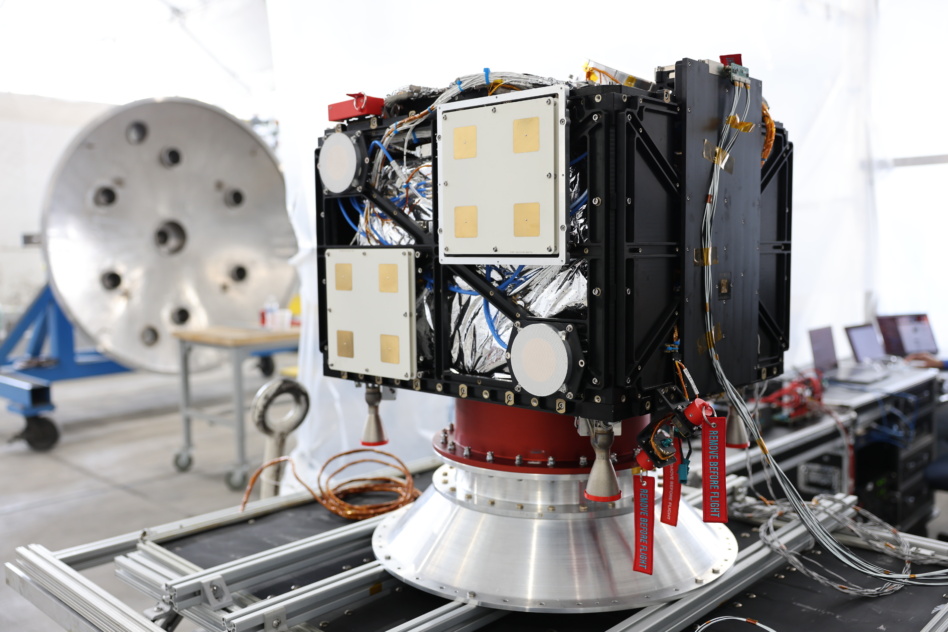
Colorado Springs, CO—AstroForge CEO Matt Gialich isn’t surprised the startup failed to reach its destination on its first asteroid mission in February. In fact, don’t be surprised if the next spacecraft, set to launch with Intuitive Machine’s IM-3 this fall, fails too. After all, interplanetary space is a tough proving ground for startups—but the company says even failure is a good pathway for future missions.
“Will we actually land on an asteroid and get these beautiful samples? Probably f—— not,” Gialich told Payload. “But do we hope to change the name of the game for access to deep space, and show people that the price point we’re doing this at is doable? I hope.”
Great success: Despite AstroForge’s Odin spacecraft not making a picturesque fly-by of its asteroid target as planned, Gialich said the AstroForge team had a lot to be proud of.
Keep reading