

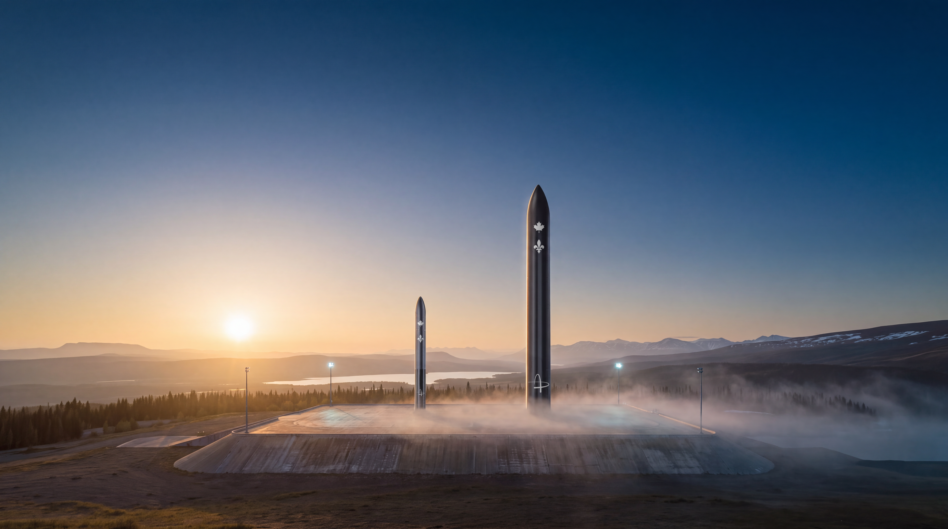
In the contest to build up commercial launch capabilities in Canada, Quebec-based startup Reaction Dynamics has entered a new weight class.
The launcher today unveiled its medium-lift rocket—called Borealis—which is targeting a debut orbital launch attempt in 2031.
Borealis’ 6,000 kg to LEO payload capacity represents a massive leap compared with the company’s ~200 kg capacity Aurora small-lift launcher—which is targeting a first orbital launch attempt in Q4 2028. But both vehicles are built on much of the same underlying technology.
State matters: For the bulk of Reaction Dynamics’ ~10-year history, the company has been developing a hybrid rocket engine reliant on a mix of solid fuel and liquid oxidizer, as part of a strategy to build a storable, deployable launch capability. However, the company pivoted last year to an entirely liquid-fueled alternative to accelerate the transition to heavier-lift launch vehicles.
“The whole decision to transition Aurora to liquid is to be able to optimize for Borealis,” Jesse Mikelberg, Reaction Dynamics’ director of business development and strategy, told Payload. “Instead of having two separate vehicle programs, two separate propulsion programs, one based on a solid fuel, one based on a liquid fuel… we are still in the process of transitioning Aurora to a development path that accelerates Borealis.”
Mikelberg explained that the transition to liquid fuel was the direct result of Canada’s increasing appetite for heavier-lift sovereign-launch capabilities. And at a time when SpaceX has signaled its intent to sunset the Transporter rideshare program, Reaction Dynamics is attempting to win some of the launch demand left in Transporter’s wake, and build a sovereign option for Canada that offers lift comparable with vehicles south-of-the-border.
Since shifting to liquid across its vehicle portfolio—within the past year, according to Mikelberg—Reaction Dynamics has completed 21 hot-fire tests of the liquid-fueled engine. The Aurora development campaign will attempt to prove out some of the hardware planned for Borealis, including the avionics, tanks, and, eventually, an upgraded heavier-lift engine.
Dollars and sense: To get Borealis to orbit, however, Reaction Dynamics is going to need a little more than engine tests. The company has raised ~$50M CDN ($35.4M), and is raising another $70M+ CDN ($349.6M+) Series B to fund the first launch of Aurora, and invest in a manufacturing capacity to churn out eight Auroras annually.
Beyond Aurora, Mikelberg estimated the company would need an additional $200M+ CDN ($141.8M+) to support the transition to Borealis.
Altogether, the new capital will support the company’s plans to up its headcount fivefold—from 68 to 350+ by 2031—and fund a new 375,000 sq. ft. manufacturing and integration facility in Quebec that can produce 24 annual Borealis rockets.
RATLOG Wants to Cut ~90% of a Rocket Engine’s Parts
The heavy-lift rocket startup debuted on Y Combinator as part of the Fall 2026 batch.
Reflect Orbital Buys Two Skyroot Aerospace Launches
Reflect Orbital announced the purchase of two launches today from Indian launcher Skyroot Aerospace.
Europe’s Space Defenses Fall Just Shy of Weaponization
Europe doesn’t have any weapons in space—but that doesn’t mean the region is comfortable flying around in orbit defenseless.

DOT Proposes Changes to Part 450 Licensing Rules
On Tuesday, Transportation Secretary Sean Duffy announced five proposed FAA rules aiming to streamline and modernize commercial space launch and reentry regulations.

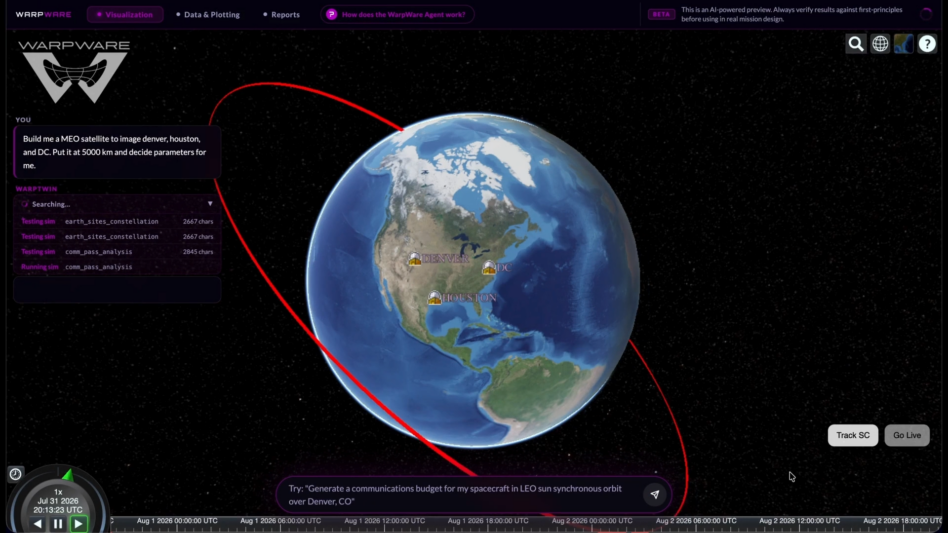
For spacecraft software teams, every new program can feel like Groundhog Day.
CO-based WarpWare closed its $1.2M pre-seed round today to expand what it calls an AI-enabled engineering platform for space missions.
The round—raised through SAFEs—was primarily angel-funded. Angel groups including the Rockies Venture Club, Cowtown Angels, and the Aggie Angel Network joined individual angels and two space-focused early-stage funds, Vesper Alpha and Marlboro Lane Ventures.
Keep reading