


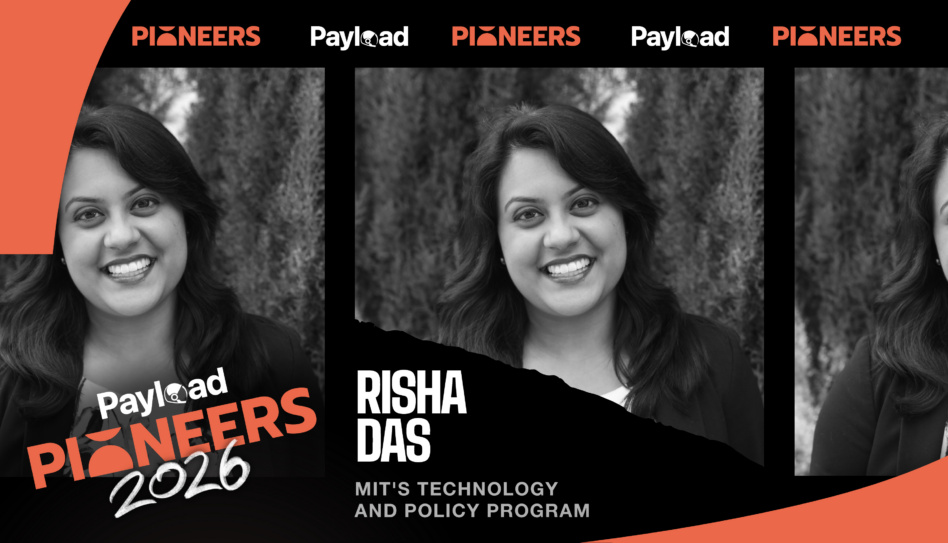
Space is now widely viewed as the newest warfighting domain. Ritisha (Risha) Das is working to make sure it can be used for peace as well.
Das highlighted how EO data can help with humanitarian crises—but noted that defense and national security applications still get priority in terms of use and investment.
“Aerospace is focused on a lot of really cool applications and innovations—figuring out how to get a lunar base on the Moon and getting to Mars…Those are all really interesting things to me,” she said. “But I think that we have an untapped sector of the aerospace economy right now, where we’re not really thinking about how we get incentivized—or invest in—humanitarian applications.”
Day job: Das enrolled in MIT’s dual masters and doctorate program that covers technology and policy, as well as aeronautics and astronautics, with the goal of answering one question—”Could satellites do more to prevent and respond to conflict than the world currently asks of them?”
While pursuing her degrees, Das is also working part-time as a satellite engineer at Airbus US Space & Defense.
Her goal is to make sure that top engineers have choices when entering the space industry—especially after finding that her job choices were limited to defense companies after previously graduating from Arizona State University, with a double major in mechanical engineering and mathematics.
“I want to create pathways and opportunities so people in my position can look at the industry and go, ‘There is a job that I do want to contribute to, and it’s in this world that’s not morally ambiguous,’” she said. “I want to create more options for us.”
In the heavens: To further her work, Das participated in the Vatican’s Satellites for Peace conference in June. She was selected to pull together a document that summarizes the event’s recommendations, to be referenced by aerospace and humanitarian stakeholders.

James Shin, K2 Space
“As I begin to understand how much [impact]…things like cellular telecommunications, imaging, climate [research]…have globally—once I started to understand that, I was like, ‘Okay, this is definitely the industry that I want to work in,’” Shin told Payload.

Robert Ihnatisin, Orbital Matter
As an expert in 3D printing for terrestrial applications, Robert Ihnatisin was surprised by how slow the in-orbit manufacturing industry was progressing. So, naturally, he started a company to solve the problem himself.

Patrick Miga, Advanced Space
In first grade, Patrick Miga saw a photo of Neptune (snapped by the Voyager 2 spacecraft).. Ever since then, his life has been directed toward space.

Muhammad Hunain, Melagen Labs
“That’s where I realized we’re stuck at a 1980s standard: still shielding spacecraft with aluminum, and rad-hardened electronics [were] too expensive to build at the scale this economy demands,” Hunain told Payload.


Dallas-based Balerion Space Ventures has surpassed its $200M target for its second fund, the firm announced Thursday. Fund II—which remains open—is more than five times the size of the firm’s debut fund, which came in at just under $40M.
Balerion had closed ~$90M as of May, according to Venture Capital Journal. Cofounder and General Partner Daniel Kleinmann chalked up the momentum since then to portfolio companies hitting milestones and raising up-rounds—which he said resonated with LPs.
The firm is also holding back capital for follow-on rounds. “These are really capital-intensive businesses,” Kleinmann told Payload. “Having the ability to reserve capital to continue supporting these businesses as they hit major technical, commercial, government milestones is really important to us.”
Keep reading