


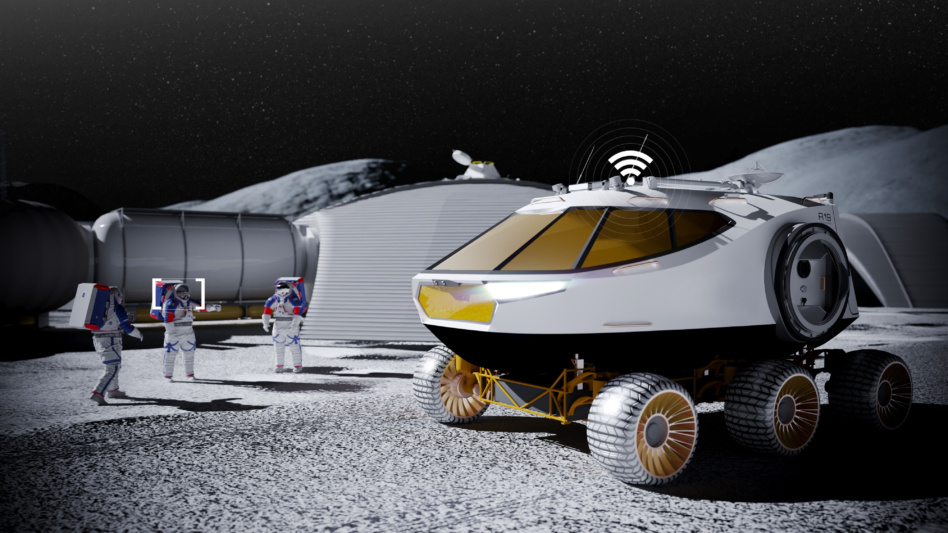
NASA has tapped Solstar Space to build a WiFi network on the Moon, to connect wireless hardware that’s expected to be part of the future lunar economy.
The space agency awarded the space communications firm a $150,000 SBIR Phase 1 contract to design a lunar WiFi access point to support CLPS and Artemis missions.
Roughing it: Getting online on the Moon isn’t as easy as bringing your router to the lunar surface, Solstar founder and CEO Brian Barnett told Payload. The tech faces many challenges in deep space, including surviving extreme temperatures, encountering lunar dust that gets into every crevice of electronics, and dealing with high levels of radiation.
If the WiFi faces any issues, there’s no option to just unplug the router to reset it. As a result, Solstar is designing a proprietary operating system to allow for long distance IT fixes.
“They have to work 238,000 miles away, and within those extreme environments,” Barnett said. “We have to be able to troubleshoot from Earth.”
Use cases: Much of the future lunar architecture will rely on WiFi, according to Barnett. Wireless internet access will enable things like landers, rovers, spacesuits, sensors, astronauts’ tablets, and scientific experiments, in addition to providing connectivity to laptops and phones for astronauts in habitats.
“You need to be able to communicate amongst things on the base, and of course inside the lunar habitats,” he said. “The harsh environment of the Moon means that WiFi is really handy for communicating amongst things to reduce your time outside.”
Barnett said the company will design two versions of the WiFi access point: One for two-week CLPS missions, and the other to last up to five years to support long duration Artemis missions.
Flight heritage: Solstar has some experience connecting people off Earth. In 2018, the company flew tech on a Blue Origin New Shepard mission, sending the first commercial tweet from space.
Solstar is also teaming up with Momentus in 2026, aiming to demonstrate what they say is the first commercial WiFi hotspot in LEO.
Exclusive: City Labs Plans Second Nuclear Demo
Following the success of City Labs’ first nuclear-powered betavoltaic demo, City Labs is planning a demo of its radioisotope heating unit.
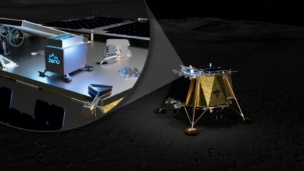
Zeno Power Books its First Nuclear Mission to the Moon
Zeno Power is ready to pull its first all-nighter. On Wednesday, the nuclear-energy startup announced a commercial payload agreement with Firefly Aerospace ($FLY) to send a radioisotope heating unit (RHU) on a Firefly mission launching to the Moon NET 2028. The mission—flying on Firefly’s CS-8 CLPS mission—aims to demonstrate Zeno’s ability to keep a 5W…
NASA Opens Call on Moon Base Health Research
NASA’s Human Research Program is asking researchers what they want to know as the agency transitions to long-term stays at a Moon Base.
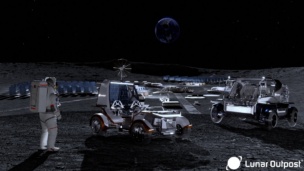
Lunar Outpost Plans to Fly NVIDIA Chips to the Moon
The chip race and the race back to the Moon race have just crossed paths.

Through unrivaled infrastructure, reliable ground station services, and unwavering support, KSAT enables operators to scale seamlessly as constellations set the course for the next era of space.
The boom in small-sat launches is reshaping the economics of space. Imaging, IoT, and comms constellations are coming online at breakneck speed. But every mission still relies on a ground backbone to operate, connect, and deliver insights from space.
Ops Made Simple
Keep reading