


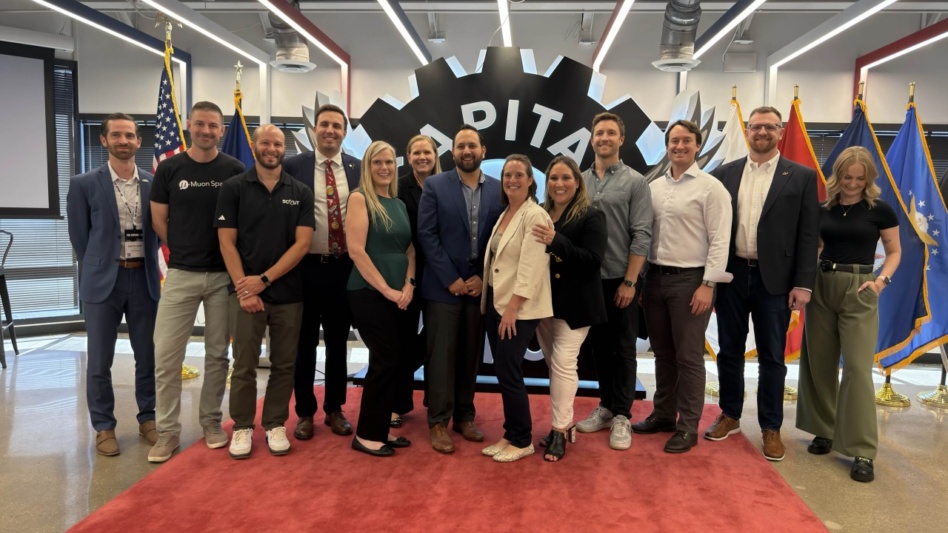
For 11 space startups, the “valley of death” just got a little more navigable.
At the Fed Supernova conference on Thursday, SpaceWERX named the newest recipients of its Strategic Funding Increase (STRATFI) program—money meant to help bridge the notorious gap where promising SBIR/STTR Phase II prototypes go to die before they ever scale into Phase III.
“STRATFI is a critical tool for the Space Force to signal demand to industry and private investors, de-risk innovative technologies, and empower non-traditional and small businesses to scale game-changing capabilities faster, more affordably, and at the speed required to maintain space superiority,” said SpaceWERX director Arthur Grijalva in a statement.
Money matching: The STRATFI and Tactical Funding Increase (TACFI) programs match SpaceWERX dollars with outside investments—strengthening ties between the Space Force and the private sector.
For 2026, the STRATFI program awarded $562.5M—including funds from SpaceWERX, program offices, and non-traditional businesses and private capital. $245M was matched by private capital in this year’s cycle.
Prior to the recent awards, over $700M has been awarded through STRATFI/TACFI to innovative space startups, matched by $1.9 billion in private funds.
Previous STRATFI recipients have subsequently gone on to raise major funding rounds including Impulse Space, K2 Space, Apex, True Anomaly, and Astranis.
Winner’s circle: This year’s STRATFI awardees cover capabilities ranging from orbital energy grids to debris removal:
- Agile Space Industries: In-space propulsion, including engine design, testing and manufacturing.
- Antares Nuclear: Compact nuclear microreactors for mission-critical systems.
- EO Solutions: Directed-energy and SDA systems, plus satellite and debris tracking.
- Hydrosat: Thermal-infrared EO and data analytics for water and agriculture.
- Kall Morris Inc.: Active debris removal and orbital logistics.
- Method Security: Full-spectrum security products for cyber operators.
- Muon Space: LEO satellite constellations for climate monitoring and national security.
- Scout Space: Sensors and autonomy software for dynamic space operations.
- Sedaro: Cloud-based simulation software for defense and intelligence missions.
- Star Catcher: Orbital power grid that beams solar energy to satellites.
- ThinkOrbital: In-space assembly and orbital-platform construction.
The awards are just the starting line for each of these companies. Now, they must work with the Space Force and SpaceWERX to finalize contract terms, hit program milestones, and mature their technologies to cross the same “valley of death” STRATFI aims to bridge.
Exclusive: EraDrive Lands $13M DoD Award For Autonomy Module
EraDrive won a $13M DoD award, under which the Space Force will buy an undisclosed number of the company’s Era-Node vision-based autonomy modules.
WarpWare Closes Pre-Seed to Bring Agentic Tools to Flight Software
CO-based WarpWare closed its $1.2M pre-seed round today to expand what it calls an AI-enabled engineering platform for space missions.
RATLOG Wants to Cut ~90% of a Rocket Engine’s Parts
The heavy-lift rocket startup debuted on Y Combinator as part of the Fall 2026 batch.

Seraphim Space Investment Trust Doubled its Value in 2026
Seraphim’s major holdings—ICEYE, ALL.SPACE, D-Orbit, HawkEye 360, and Xona Space Systems, which together represent more than 75% of the firm’s portfolio—all had a great year, and that success has trickled upwards.

Daniel Biedermann is a partner at NewSpace Capital.
Before SpaceX, the biggest hurdle to the development of the space sector was our ability to get payloads into space reliably and inexpensively. Each launch was expensive, with the cost often running into the tens of thousands of dollars per kg, and most of the rocket itself was discarded after being launched. Moreover, there were relatively few opportunities to launch each year, and delays were common.
But the creation of reusable first-stage boosters by companies like SpaceX began to chip away at that high price tag. The rate of launch increased to the point where it became routine rather than exceptional. Rideshare missions—where many small satellites rode into orbit on the same rocket—became possible. And the development of the SpaceX Starlink fleet forced manufacturing and launch to speed up.
Keep reading