


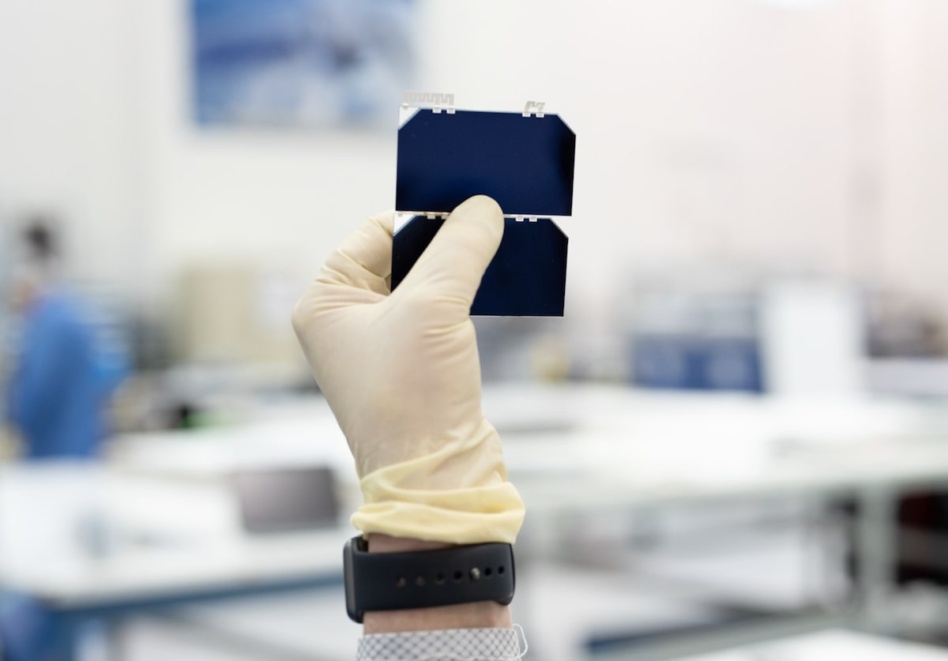
Rocket Lab and the Department of Commerce have reached a preliminary agreement to provide the company with $23.9M from the CHIPS Act to expand production of its advanced solar cells.
The plan, which also includes $25M in incentives from the state of New Mexico and capital investment from Rocket Lab, would create 100 manufacturing jobs at the company’s facility in Albuquerque, which the US-New Zealand firm acquired when it bought SolAereo in 2022.
After a due diligence process, Rocket Lab and the government will need to agree on a final term sheet later this year. If all goes as expected, construction could start early in 2025, Rocket Lab VP for Space Systems Brad Clevenger told Payload.
Why does Uncle Joe want in? Rocket Lab is one of three major players in the Western market that builds space-grade solar panels, and the investment will grow production 50% in the next three years. These cells are already on board the JWST, the Ingenuity Mars Helicopter, and OneWeb’s internet satellites, for a few examples.
The CHIPS and Science Act, which became law in 2022, is designed to increase manufacturing of advanced technology in the US, particularly to protect supply chains for components that are seen as vital to national security—an area where China often has an edge over the US. The SDA is particularly concerned about parts for spacecraft used by military and intelligence agencies.
What kind of chips are these? Most semiconductor uses, including microprocessors and photovoltaics, rely on silicon because it is cheap and widely available, but compound semiconductors made of multiple elements are more flexible for speciality applications such as in space.
The semiconductors made by Rocket Lab can withstand high doses of radiation and UV light, and generate more electricity in space than silicon equivalents.
“Every investment that they make here is dual use,” Clevenger says. “It helps the US space economy, and our ability to service commercial customers, and make sure that national security space has a place to have their needs met.”
Clevenger says that one of the reasons Rocket Lab won its $515M prime SDA contract was because of access to critical components like these solar cells.

State Department Taps Trio for $5M Space Diplomacy Push
At last week’s second annual US Space Forum, the US Mission to the International Organizations in Vienna launched Project Constellation, a $5M effort to build international space partnerships.
BlackSky Renews HEO Deal, Adds Gen-3 Imagery for Space Domain Awareness
BlackSky Technology inked a seven-figure deal to extend its partnership with Australian non-Earth imaging (NEI) provider HEO for another year.
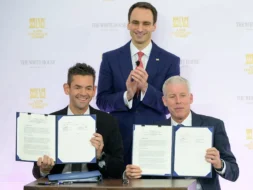
NASA Signs Space Nuclear Pact, Says Moon Base Is Ahead of Schedule
Isaacman gave updates at the White House’s “Science: A New Golden Age Summit.”

DOT Proposes Changes to Part 450 Licensing Rules
On Tuesday, Transportation Secretary Sean Duffy announced five proposed FAA rules aiming to streamline and modernize commercial space launch and reentry regulations.


(Ed. note: This is Payload Research analysis. You can sign up for our Research newsletter here.)
Late last year, the World Radiocommunication Conference (WRC-23) approved a proposal to review EPFD (Equivalent Power Flux Density) limits, a critical juncture in rights negotiations between GEO and LEO operators that sets the stage for regulatory action by 2027 or 2031.
EPFD 101: At its core, EPFD measures the strength of satellite radio signals to ensure that the thousands of LEO birds don’t interfere with GEO systems.
Keep reading