


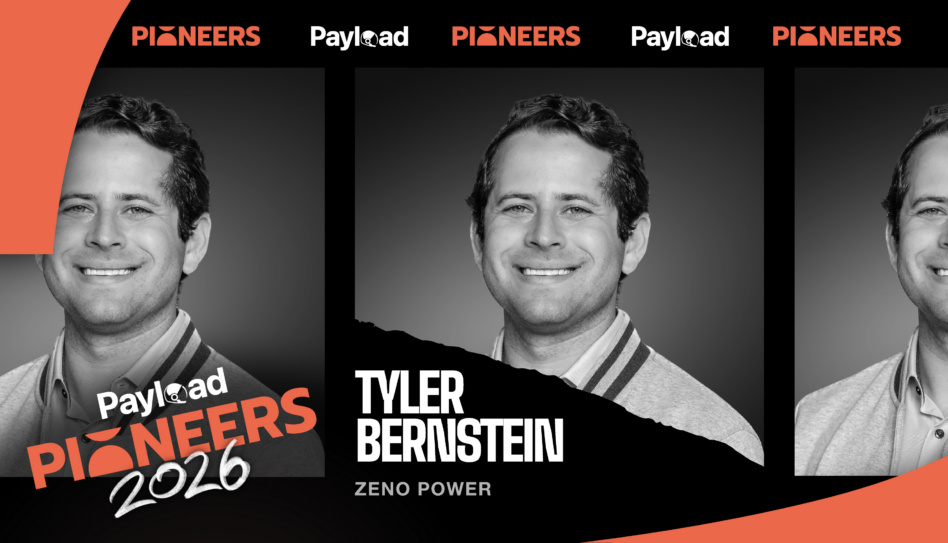
Growing up, Tyler Bernstein’s favorite NASA missions—from Mars rovers to Voyager’s interstellar journey—all had one thing in common: They all ran on nuclear batteries.
Now, Bernstein is CEO of Zeno Power, where he works on nuclear-battery technology to power NASA’s return to the lunar surface—and anywhere else humans want to explore, where solar panels won’t work and diesel can’t reach.
Origin story: Bernstein caught “the bug for building” in a high-school computer-science class, and went to Vanderbilt University expecting to end up at Google or Amazon. Then, in his sophomore year, he and a friend wrote a paper on flying a Boeing 777 on nuclear power.
“We had zero business looking into putting a nuclear reactor in a Boeing Triple Seven, but that changed the direction of our lives,” he said.
In 2018, Bernstein and his cofounders launched Zeno Power. With support from the university and NSF, the idea shifted from airliners to drones, then to something bigger—the deep sea, the Arctic, and space were becoming contested, and none of them had reliable power. The Zeno team immediately began talking to as many people as they could, from four-star generals to members of Congress.
“This was really curiosity and grit that brought us into a lot of conversations, and over time, the passion has grown,” Bernstein said. He eventually took leave from Vanderbilt to run the company full time, also earning a spot in the competitive Thiel Fellowship.
Tech deep dive: Nuclear batteries aren’t new. But each unit has been built one at a time, fueled with one of the world’s rarest materials. Zeno wants to build hundreds a year, using more abundant fuel.
“That model worked when demand was one spacecraft going to Pluto,” Bernstein said. “It doesn’t work now that NASA has announced a permanent Moon Base.” In June, Zeno established its nuclear battery manufacturing facility at the Vallecitos Nuclear Center in Sunol, CA.
The company has since grown to 100+ employees, landed contracts with NASA and the Pentagon, and has its first Moon mission coming up in 2028. With Moon Base, the lunar market Bernstein envisioned years ago has arrived. Now, it’s on him and his peers to deliver.
“Government has done its job. The financial community has done its job. It’s on industry to execute,” he said. “What keeps me up at night is that it could go away if we don’t deliver, which means that we must.”
Maximillian Bhatti, Basalt
Max Bhatti’s recipe for success in the space industry is one part luck, and nine parts hustle.
Robert Ihnatisin, Orbital Matter
As an expert in 3D printing for terrestrial applications, Robert Ihnatisin was surprised by how slow the in-orbit manufacturing industry was progressing. So, naturally, he started a company to solve the problem himself.

Patrick Miga, Advanced Space
In first grade, Patrick Miga saw a photo of Neptune (snapped by the Voyager 2 spacecraft).. Ever since then, his life has been directed toward space.

Muhammad Hunain, Melagen Labs
“That’s where I realized we’re stuck at a 1980s standard: still shielding spacecraft with aluminum, and rad-hardened electronics [were] too expensive to build at the scale this economy demands,” Hunain told Payload.

Dallas-based Balerion Space Ventures has surpassed its $200M target for its second fund, the firm announced Thursday. Fund II—which remains open—is more than five times the size of the firm’s debut fund, which came in at just under $40M.
Balerion had closed ~$90M as of May, according to Venture Capital Journal. Cofounder and General Partner Daniel Kleinmann chalked up the momentum since then to portfolio companies hitting milestones and raising up-rounds—which he said resonated with LPs.
The firm is also holding back capital for follow-on rounds. “These are really capital-intensive businesses,” Kleinmann told Payload. “Having the ability to reserve capital to continue supporting these businesses as they hit major technical, commercial, government milestones is really important to us.”
Keep reading