


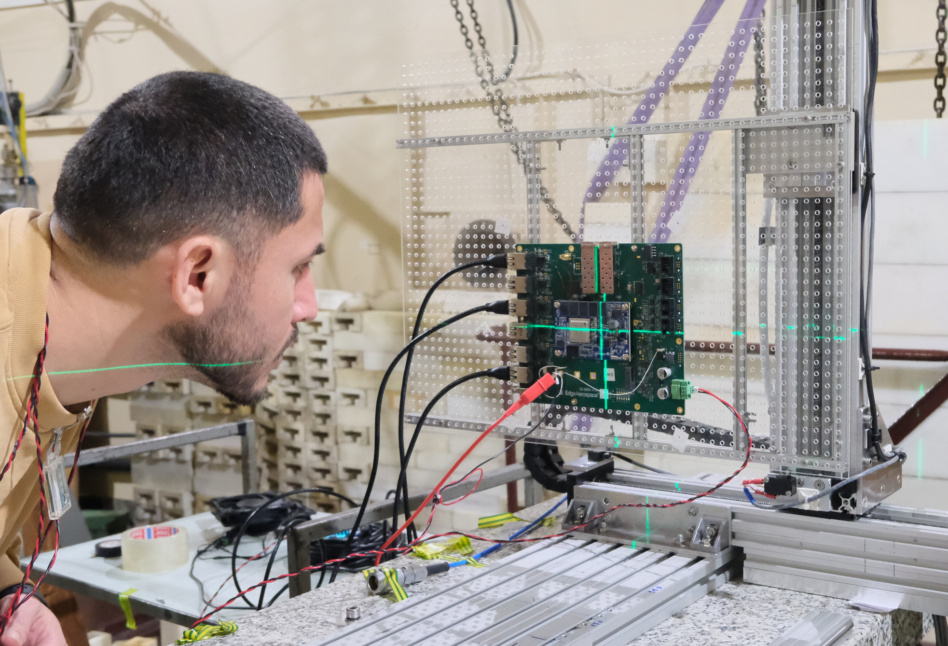
In-space computing startup Edge Aerospace landed a contract under ESA’s Space Cloud program to study the future of orbital data centers.
Under the agreement, announced today, the Luxembourg-based company will develop an architecture and use-case road-map for orbital data centers. The company will:
- Study the commercial viability of orbital-compute power;
- Uncover ways Europe can leverage the new capability for commercial, civil, and defense applications.
“The first goal of ESA—and also our goal—is to find out in a structured, very analytical way if [orbital data centers] make sense, and if so, in what way it could be useful and how it could be commercial,” Edge CEO Jarosław Jaworski told Payload. “Europe was very often late with reusable launchers or telecom constellations, [so] one of our goals is that when it comes to orbital data centers, Europe will also be moving fast.”
Meet Edge: Founded in September 2024, Edge has spent the last year and half in a rapid ramp-up phase.
- Edge signed an additional four contracts with ESA, the European Defence Fund, the Luxembourg Space Agency, and the Luxembourg MoD.
- In March, Edge launched its first demonstration mission onboard SpaceX’s Transporter-16 rideshare mission, validating the company’s ability to operate data-processing systems in-orbit.
- Edge finalized its incorporation of a US subsidiary this month. In June, it plans to open a facility in the US, where the company has seen 90% of its commercial contracts to date, according to Jaworski.
Managing expectations: While some orbital-data-center startups have crafted lofty visions of space’s ability to compete with terrestrial data centers, Edge is more measured in its expectations. Jaworski says short-term opportunities lie in processing data collected on-orbit to reduce the downlink bottleneck.
Edge is focused on distributed networks of orbital-compute power, in an effort to offer speed and global reach to customers willing to pay a premium to access their data. The math of orbital data centers has yet to be fully fleshed out, according to Jaworski.
“We think that only SpaceX, through its extreme vertical integration, would be able to do what most of the folks from ODC claim—which is to move part of AI training to space,” Jaworski said. “We rather think that the power of orbital data centers lies in location—being above everything, or being very close to the rest of the satellite infrastructure.”

Exclusive: DoD Taps Orbital Operations for Cryogenic Spacecraft Demo
The Long Beach, CA, startup has won up to $35M from the DoD under a prototype Other Transaction Agreement to fly a full-scale, in-orbit demo of Astraeus—its cryogenic-maneuvering vehicle.

Inside Starburst’s First Flight, and Portal’s New Bothell Office
“I feel like 80% success now,” CEO Jeff Thurnburg said. “But honestly, to get this far this fast, I’m tempted to call it 100%.”

European MNOs Join Forces to Explore Joint MSS Spectrum Bid
Deutsche Telekom, Telefónica, Orange, and Vodafone plan to establish ground network infrastructure across Europe, and partner with an as-yet undetermined satellite operator for the D2D connection.
Xona Raises $250M Series D to Scale Commercial GPS Constellation
Xona’s long-term plan is to build a ~258-sat constellation to offer an upgraded commercial alternative to government GPS networks.


Lt. Gen. Douglas Schiess was nominated to serve as the next chief of the Space Force, the service announced on Friday.
If confirmed, Schiess will be just the third person to serve as the chief of space operations since the Space Force was established in 2019, following in the shoes of Gen. Jay Raymond and Gen. Chance Saltzman, who is expected to retire this year.
“The Space Force has made tremendous progress in a short time, and our mission has never been more important,” Schiess said in a statement. “If confirmed, I will focus on sharpening our lethality and accelerating the delivery of space capabilities to the warfighter, keeping the Space Force ahead against any adversary.”
Keep reading