

Historically, deploying a new capability in space required significant time, investment, and technical expertise. Companies often had little choice but to build nearly everything themselves—from spacecraft and payload integration to ground infrastructure and mission operations.
Today, the space industry offers a different model: hosted payloads.
“We’re seeing companies looking for the fastest, most economical way to get their capabilities into space, and their data back down to Earth,” said Beau Jarvis, Chief Revenue Officer at Kepler Communications.
Rather than building and operating a complete spacecraft, hosted payloads allow organizations to place sensors and mission hardware aboard an existing platform, while relying on the host provider for power, communications, and operations.
Speed for Need
Hosted payloads lower barriers to entry, accelerate deployment timelines, and create new opportunities for both commercial and government customers. For emerging companies, that speed can be critical.
“Every day that a company isn’t generating revenue, it’s spending money,” said Jarvis.
By reducing the complexity associated with deploying a space mission, hosted payloads allow organizations to focus on the technologies and services that differentiate them, while shortening the path from concept to orbit.
Hosted payloads also create opportunities for governments seeking to strengthen sovereign space capabilities without developing every component of a space architecture themselves.
Beyond the Ride to Orbit
Getting a payload into orbit solves only part of the challenge.
As more organizations rely on space-based data, access to that information is just as important as collecting it.
Traditional satellite architectures depend on scheduled contacts with ground stations, limiting how frequently operators can retrieve data or communicate with their spacecraft. For applications that depend on timely information—whether monitoring wildfires, tracking maritime activity, supporting weather forecasting, or enabling national security missions—delays reduce the value of the data.
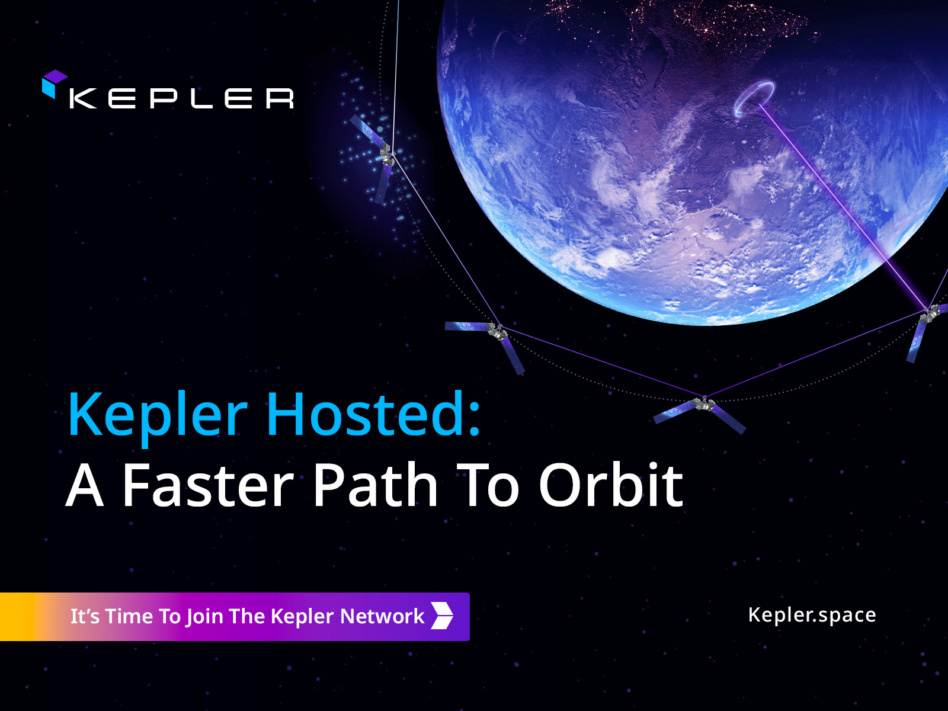
Kepler combines hosted payload services with its optical data relay network, allowing customers to move larger volumes of data more frequently, and with lower latency.
“It’s not just the fact that you can get data more often,” said Jarvis. “You can get much more of it.”
That capability becomes increasingly valuable as organizations seek to extract more insight from the data they collect. Larger volumes of information support advanced analytics, machine learning models, and faster operational decision-making.
Kepler’s satellites also incorporate on-orbit compute resources, allowing customers to process information closer to the source, rather than transmitting raw data to the ground for processing.
Proof of Concept
OroraTech’s four SAFIRE Gen4 thermal sensors recently achieved first light aboard the Kepler Network’s Tranche 1 satellites. The milestone advances OroraTech’s effort to build a continuously connected thermal monitoring capability that supports persistent thermal intelligence, with near-real-time access to data from orbit.
“This milestone validates not just the performance of our sensors, but the scalability of our hybrid constellation strategy, combining owned and hosted payloads to accelerate global coverage,” said Ignacio Zuleta, Chief Technology and Product Officer of OroraTech, in the first-light announcement on OroraTech’s website.
OroraTech also reported detecting a short-duration fire that other LEO satellites did not observe. While only a single example, it illustrates how additional sensors, continuous connectivity, and faster data delivery can help operators identify events on Earth that might otherwise go unnoticed.
For applications such as wildfire monitoring, those advantages can directly influence outcomes. More sensors, more data, and faster delivery improve situational awareness—and support earlier response efforts.
The Future of Space Infrastructure
As demand for space-based intelligence, monitoring, and Earth observation grows, customer expectations continue to evolve.
Jarvis believes low-latency connectivity will soon become a baseline requirement rather than a premium capability.
“If your competitor is delivering data in real time, and you’re still relying on traditional downlink approaches, you’re going to struggle to compete,” he said.
That expectation is already influencing procurement requirements across government and commercial markets, where access to real-time or near-real-time information is becoming increasingly important.
Hosted payloads represent one part of a broader transformation in how organizations access and operate in space. Just as cloud computing reduced the need for organizations to build and maintain their own IT infrastructure, commercial space services now allow companies and governments to access orbit without building every component themselves.
For mission owners, that means spending more time developing the capabilities that create value—and less time managing the infrastructure required to support them.
Kepler invites organizations in Intelligence, Surveillance and Reconnaissance (ISR), Space Domain Awareness, environmental monitoring, or emerging space technologies, to submit payload concepts for competitively priced hosted opportunities on upcoming Kepler missions.
Visit the Kepler Call for Payload webpage to learn more and to submit interest.

The Lunar Economy Could Be Worth $566B by 2050. First, We Have to Build It.
The return to the Moon is an infrastructure story, and Deloitte has created numbers to back it up. The number: A new report from Deloitte, Building the Lunar Economy: How a Sustained Presence on the Moon Could Transform Life, Industry, and Infrastructure on Earth and Beyond, puts the lunar economy’s cumulative economic value through 2050…
The Commercial-First Shift in National Security Space
For decades, the model for building national security space systems was relatively straightforward. The government defined a mission, established requirements, funded a spacecraft designed specifically to meet them, and ultimately owned and operated the resulting capability.
The New Middle Ground in Spacecraft Development
For years, the commercial space industry has focused on making spacecraft more affordable and accessible. Today, a new wave of customers want to build their own hardware to gain full ownership of the systems that define their mission.
Mass Is the Easy Part, Coordination Is The Hard Part
Ukraine rewrote the economics of conflict. When an adversary can field cheap drones by the thousand every month, you can’t answer them with million-dollar interceptors and exquisite platforms, you answer mass with mass. The U.S. has absorbed the lesson and is building autonomous, disposable systems faster than it ever has, led by a new generation…

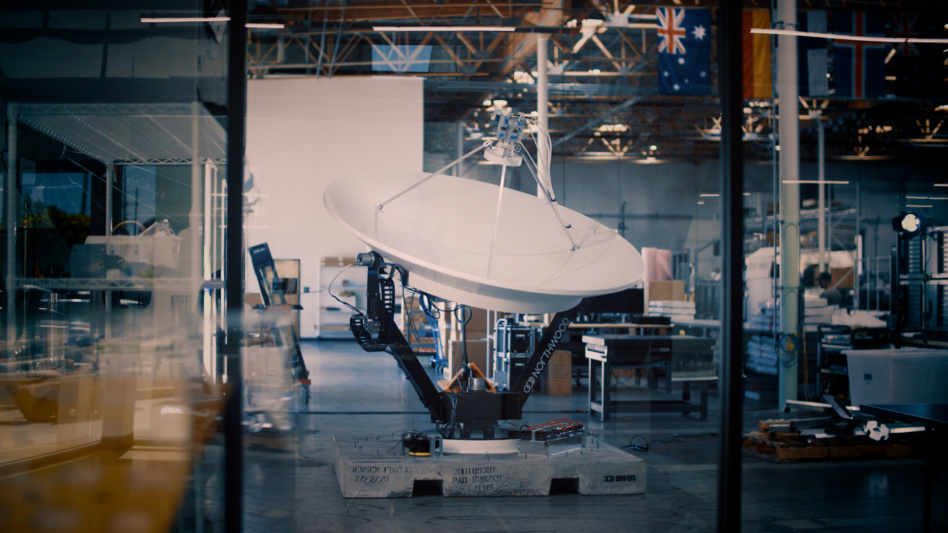
Northwood Space unveiled a new satellite ground antenna today—called Prism—as part of an effort to significantly increase its ground station network capacity over the coming years.
The new hardware comes amid Northwood’s rapid global expansion of its physical ground station footprint, and will allow the company to support more data downlinks over a wider range of frequencies.
“We need to treat the future of space like the internet, where you’re talking about very intense data loads, you’re talking about high levels of reliability, and treating space like a high-utilization resource,” CEO Bridgit Mendler told Payload.
Keep reading