


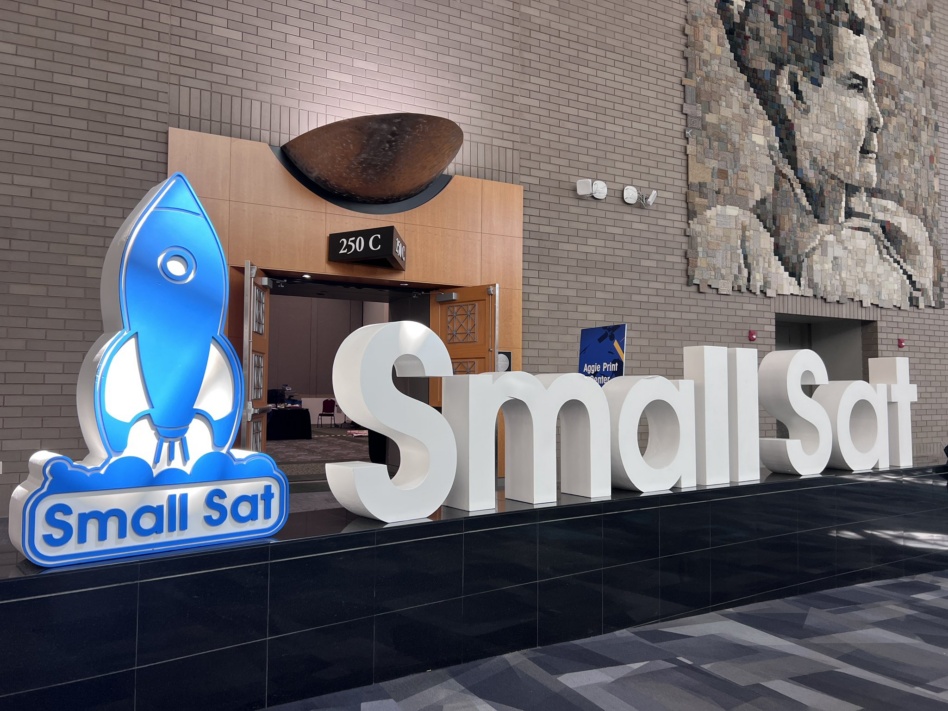
SALT LAKE CITY, UT — There was a lot to celebrate at this year’s Small Satellite Conference in Utah—new payload technologies, next-gen satellite platforms, a slew of collaborative contracts, and a more favorable funding market than any year in recent memory. So why did it feel like everyone was on edge?
Looming over all of this progress was a general understanding that unless something changes in the launch market—and soon—the space industry might be running 100mph into a brick wall—is that a tunnel ahead, or is it just painted on?
New kids on the block: As a result of growing fears that SpaceX rideshares might be going the way of the Northrop Grumman Pegasus, exhibitions operated by Exolaunch and SEOPS—two launch integrators who have purchased Falcon 9s to run their own rideshare programs—were packed to the gills.
And launch integrators weren’t the only ones attempting to build up new rideshare opportunities to capitalize on the shortage.
On Monday, French launch broker RIDE! announced a deal with MaiaSpace to utilize excess capacity on the new launcher vehicle once it begins commercial operations. While RIDE! declined to share specifics of the agreement, the company expects to offer capacity on up to six flights beginning in 2028, according to CEO Valentin Benoit.
Hope for the best: Despite the launch uncertainty, satellite and payload operators aren’t stepping off the gas. Many of the announcements at SmallSat pointed to a future where spacecraft are more capable, more agile, and better connected to operators on the ground.
This trend was best highlighted through The Aerospace Corporation’s updates on DiskSat, the company’s new flat-satellite design, which is built to maximize the number of spacecraft that can fit in a typical rocket faring.
Four commercial partners are already looking to use the new platform for their own businesses:
- Satlyt plans to use DiskSat to build its in-orbit data center network.
- Orbotic Systems will use DiskSat to offer missions from remote sensing to SDA.
- Sarmony will build its SAR network on DiskSat buses.
- Neumann Space has developed a propulsion system to power DiskSat.
No vacancy, no latency: SmallSat 2026 also highlighted the technical advancements to reduce the time it takes for data to get from orbit to the ground. Companies used the event to highlight their progress on real-time communications.
- Astrolight, the Lithuanian optical-comms-terminal manufacturer, announced a deal with ATMOS Space Cargo to provide laser comms during the reentry phase of future ATMOS missions.
- KSAT provided details on its work with Norway’s maritime domain awareness network, highlighting the strength of KSAT’s ground network in enabling low-latency insights for military applications.
- Viasat announced a deal with Addvalue to reduce latency for US government customers through new inter-satellite links.
Compute this: The conference also featured updates from companies building new, higher-power compute systems for the ever-increasing data needs of spacecraft. Large announcements included:
- Luxembourg-based Edge Aerospace tapped Redwire to manufacture its data processing units in the US.
- KSAT and Unibap announced an agreement to bring edge-computing capabilities to two KSAT demo satellites launching NET late 2027.
- Cesium Astro acquired 1Aardvark to expand Cesium’s autonomous mission capabilities.
BlackSky Renews HEO Deal, Adds Gen-3 Imagery for Space Domain Awareness
BlackSky Technology inked a seven-figure deal to extend its partnership with Australian non-Earth imaging (NEI) provider HEO for another year.

Nebex Partners with Thrusters Unlimited to Unlock $700M for LATAM Space Ecosystems
The capital will fund EO, telecoms and other strategic capabilities, according to Nebex.

Exclusive: Meridian Space Spins Out from SpinLaunch
“Meridian will carry forward the satcom infrastructure business… SpinLaunch will continue to build on its vision for a lower-cost approach to launch, with further applications in hypersonics to support the Golden Dome program and in the lunar economy,” Meridian Space CEO Massimiliano Ladovaz told Payload.
Rocket Lab CFO Adam Spice Predicts More M&A Deals on the Horizon
Iridium shareholders voted overwhelmingly to approve the company’s acquisition by Rocket Lab. According to Rocket Lab CFO Adam Spice, there’s more M&A on the horizon.

Think you had a busy week? ICEYE has you beat.
The Finnish SAR satellite manufacturer opened three new international offices this week—in the Netherlands, Korea, and India—to capitalize on the growing demand for sovereign satellite capabilities from national governments and MoDs.
The new offices signal a huge predicted surge of demand for ICEYE’s SAR satellites. Having a footprint in more nations will also help ICEYE preposition itself to meet this expected demand, while maintaining the sovereign goals of national militaries.
Keep reading