

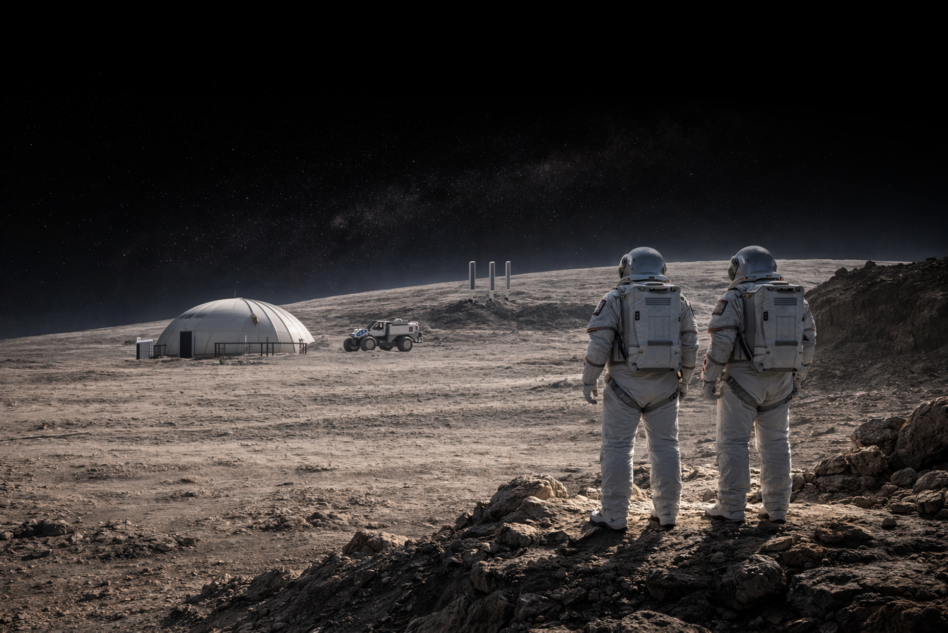
The return to the Moon is an infrastructure story, and Deloitte has created numbers to back it up.
The number: A new report from Deloitte, Building the Lunar Economy: How a Sustained Presence on the Moon Could Transform Life, Industry, and Infrastructure on Earth and Beyond, puts the lunar economy’s cumulative economic value through 2050 at $343B under a conservative scenario, rising to $566B under an accelerated one. The estimate covers two things: the infrastructure required to operate on the Moon, and the markets that infrastructure could unlock once it exists.
“This report started as a search for answers that we couldn’t find anywhere else,” said coauthor Raquel Buscaino, Head of Novel & Exponential Technologies (NExT), Deloitte Consulting LLP. “What we found is that this is primarily a story about infrastructure. But what kind of commercial and adjacent markets might that infrastructure ultimately enable in the years to come? Well, that’s the exciting part.”
Why now: Lunar activity is increasing across government and commercial programs, with more than 400 missions planned over the next two decades. Competition is driving as much of it as economics.
Governments are racing to establish a lasting foothold on the Moon, driven less by scientific ambition than by national security and strategic positioning. Commercial players are pursuing a different prize: the infrastructure contracts and new markets a sustained lunar presence could unlock.
Layer falling launch costs and new public-private procurement models on top of that, and the economics of sustained lunar operations start to look fundamentally different than they did a decade ago.
The foundation comes first: The report’s math breaks into two stages: what infrastructure it takes to get a lunar presence up and running, and what that infrastructure could eventually create.
The first part covers six infrastructure markets that form the foundation: transportation, energy and power, communications and navigation, surface mobility, construction, and life support. Together, they could potentially generate $282B in economic value through 2050 under the accelerated-growth scenario, with transportation dominating the picture, accounting for roughly 73% of the six core infrastructure markets.
Much of the early buildout is expected to concentrate near the lunar South Pole, where water ice deposits and nearby ridges with prolonged sunlight could support long-term operations. NASA and other agencies are increasingly acting as anchor customers rather than sole operators, seeding commercial markets through service-based procurement rather than traditional contracting.
Part two explores the potential downstream value that might emerge. Once that foundation is in place, it could unlock a set of new markets: lunar data, national security applications, resources such as helium-3 and lunar-derived propellant, and manufacturing to support space-based compute.
Some markets, such as lunar data and national security services, may be able to develop before a fully mature lunar ecosystem is in place. Others, including resource extraction and lunar manufacturing, depend on capabilities and demand that are still emerging.
Together, these markets could potentially generate up to US$284 billion in cumulative economic value through 2050 under the accelerated-growth scenario.
The potential impact goes beyond market activity. The report separately considers broader societal benefits like innovation, scientific discovery, and human inspiration, which could represent an additional $541B in value.
Why this is everyone’s business: The companies positioned to benefit may not all look like space companies. Building and operating on the Moon draws on expertise from energy, telecommunications, robotics, logistics, advanced manufacturing, materials, construction, autonomy, medicine, and data infrastructure, making this as much an industrial story as an exploration one.
Additionally, the technologies developed for lunar operations could find a second life on Earth, particularly in remote or resource-constrained environments where conditions echo the Moon’s own extremes.
Reality check: For all the momentum, the report is careful not to oversell the timeline. It calls a thriving lunar economy “far from inevitable,” citing engineering hurdles, long development cycles, regulatory uncertainty, and commercial demand that remains largely unproven.
Near-term revenue still depends heavily on government funding, and some of the most valuable applications may come from innovations the industry cannot yet predict. The $343B to $566B range itself is meant to capture that uncertainty, reflecting how much still hinges on the pace of infrastructure buildout, commercial adoption, and policy clarity.
Who’s talking: To understand where the lunar economy is headed, the report draws on perspectives from the people building, funding, studying, and shaping it.
“Whether we realize it or not, we all have a role to play in the growing space industry,” Buscaino said. “The question I’d be asking right now is, ‘How might my company, my organization bring the best of what we do on Earth and apply it to space?’ If you’re not asking that question, you might be missing out on a dynamic, growing market – one that could be as economically fruitful as it is inspiring.”
The takeaway: The funding decisions, infrastructure investments, and technical standards being set today will help determine who participates in the lunar economy—and who captures the value it creates. And the implications will not stop at the Moon. As lunar activity expands, its effects could reach industries on Earth sooner than the physical distance suggests.
The full report is available on Deloitte’s site here.
As used in this article, “Deloitte” means Deloitte Consulting LLP, a subsidiary of Deloitte LLP. Please see www.deloitte.com/us/about for a detailed description of our legal structure. Certain services may not be available to attest clients under the rules and regulations of public accounting.
Copyright © 2026 Deloitte Development LLC. All rights reserved.
The Commercial-First Shift in National Security Space
For decades, the model for building national security space systems was relatively straightforward. The government defined a mission, established requirements, funded a spacecraft designed specifically to meet them, and ultimately owned and operated the resulting capability.
The New Middle Ground in Spacecraft Development
For years, the commercial space industry has focused on making spacecraft more affordable and accessible. Today, a new wave of customers want to build their own hardware to gain full ownership of the systems that define their mission.
A Faster Path to Orbit: How Hosted Payloads Are Changing Access to Space
Historically, deploying a new capability in space required significant time, investment, and technical expertise. Companies often had little choice but to build nearly everything themselves—from spacecraft and payload integration to ground infrastructure and mission operations. Today, the space industry offers a different model: hosted payloads. “We’re seeing companies looking for the fastest, most economical way…
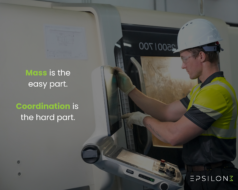
Mass Is the Easy Part, Coordination Is The Hard Part
Ukraine rewrote the economics of conflict. When an adversary can field cheap drones by the thousand every month, you can’t answer them with million-dollar interceptors and exquisite platforms, you answer mass with mass. The U.S. has absorbed the lesson and is building autonomous, disposable systems faster than it ever has, led by a new generation…

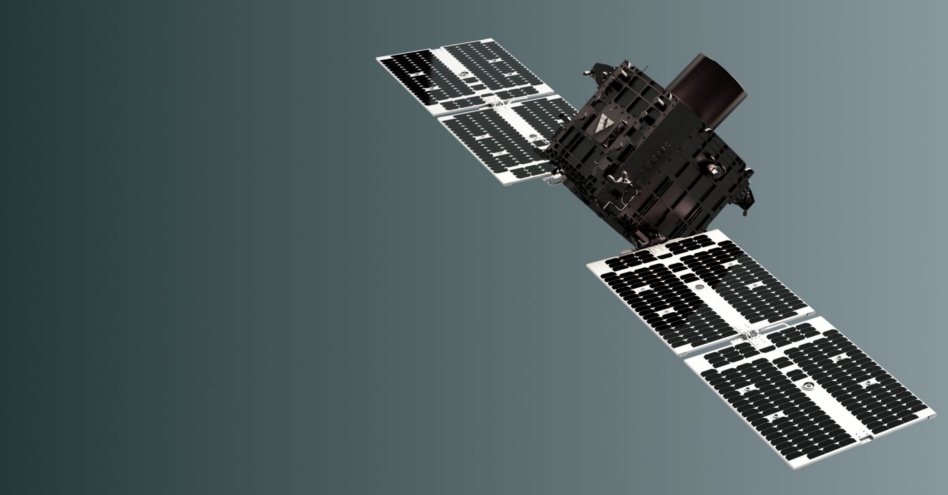
The Space Force wants to know what goes bump in geosynchronous orbit.
On Friday, the Defense Innovation Unit (DIU) and Space Systems Command (SSC) announced GHOST-R, a joint effort to bring low-cost reconnaissance to GEO under SSC’s RG-XX program—the program of record for the Space Force’s proliferated in-space reconnaissance layer.
Slated for launch in 2028, GHOST-R aims to leverage commercial space vehicles, buses, and electro-optical payloads to characterize resident space objects, provide battle-damage assessment, and enhance positive identification.
Keep reading