

For decades, the model for building national security space systems was relatively straightforward. The government defined a mission, established requirements, funded a spacecraft designed specifically to meet them, and ultimately owned and operated the resulting capability.
That model isn’t disappearing. But the environment has changed.
Lower launch costs, proliferated low Earth orbit (LEO) architectures, private investment, and advances in sensors, computing, and manufacturing have created a commercial space ecosystem capable of putting sophisticated technology on orbit faster than traditional acquisition cycles can move.
In a recent blog post, space industry veteran and Muon Space CEO Jonny Dyer described the larger transformation as one in which “space and terrestrial infrastructure are converging into a single global system.” As commercial space becomes infrastructure for communications, Earth observation, environmental monitoring, and more, those same capabilities can serve national security missions.
Government customers have begun to ask: If industry has already built most of the capability needed for a mission, does the government need to build and own the entire system itself?
“In many of the government’s recent acquisition documents and transformation directives, we’re seeing a commercial-first approach,” said Tracy Morgan, senior vice president of growth at Muon Space.
Leveraging the Private Sector
“The government wants to access proven capability that is available from commercial vendors,” Morgan said. “They don’t have to make the upfront investment. They’re leveraging and benefiting from other investments that have been made.”
Muon’s recently closed $250 million Series C is a clear illustration of this model. The company is using the private capital to accelerate production, expand its dual-use spacecraft platforms, and invest in differentiated mission capabilities, including advanced payloads.
This reflects a broader change in acquisition thinking. In a recent manifesto on Air Force acquisition, Lt. Gen. Luke Cropsey put the imperative succinctly: “We must start with the mission.” Most notably for commercial providers, he argues that “incremental delivery, now, beats almost anything later.”
The objective is to determine what architecture and acquisition model can deliver the required mission outcome at the necessary speed, scale, performance, and cost.
From Wildfires to National Security
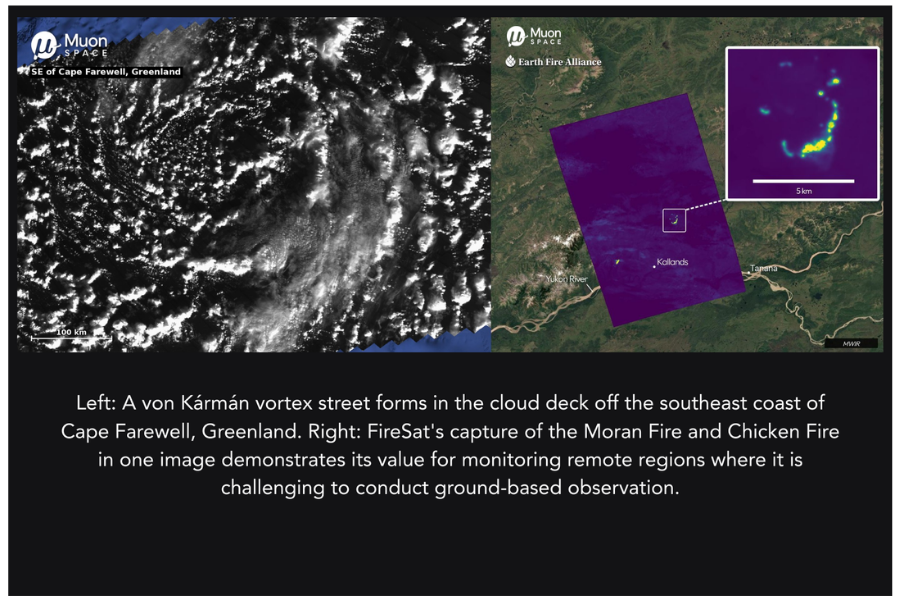
Muon’s award-winning work on Earth Fire Alliance’s FireSats shows how that process can work. FireSats detect and monitor wildfires from LEO. Muon designed the satellites’ Quickbeam infrared payload around the needs of fire operators. But as a multispectral sensing platform, its underlying capability has applications beyond wildfire monitoring.
The US Space Force began evaluating whether an adapted version of the Quickbeam architecture could help meet space-based environmental monitoring (SBEM) requirements, including cloud characterization and theater weather imagery. Rather than commission an entirely new payload, the government worked with Muon through the Small Business Innovation Research (SBIR) program to evaluate and adapt the existing technology.
“That is a commercial-first approach,” Morgan said.
Within two years, the work progressed from an initial feasibility study to a Phase III agreement for three prototype demonstration satellites using a new variant of Muon’s Quickbeam platform, for further commercial environmental monitoring Data as a Service (DaaS) integration and evaluation. Building upon FireSat and the SBIR programs further led to the announcement of a STRATFI award. Private investment matured the architecture, while government investment adapted it to particular mission requirements.
These public-private partnerships also help build something critical to national security: trust.
Delivery Builds Trust
New entrants to the defense market compete against companies that have worked with government customers for decades. Promising technology alone doesn’t erase that institutional advantage. But delivery does.
“Speed of delivery at needed performance is critical to our customers,” Morgan said. “Actually having delivered is what matters.”
Government programs facilitate that progression: investment leads to demonstration, demonstration creates flight heritage, delivery builds credibility, and credibility creates opportunities for deeper integration into government architectures.
Lt. Gen. Cropsey makes the same point from the government side: “Credibility with our teammates is the coin of the realm.”
Choosing the Right Model
Commercial and government requirements still diverge in important areas. National security spacecraft may require specialized encryption, additional system protection, or operational authorities, to name a few.
But other requirements converge. Earth observation, environmental intelligence, RF sensing, maritime domain awareness, and space domain awareness all have potential commercial as well as government applications. Proliferated constellations can also provide something both markets value: resilience.
Clayton Swope of the Center for Strategic and International Studies identifies four possible owner-operator models:
● GOGO: government-owned, government-operated;
● GOCO: government-owned, contractor-operated;
● COGO: contractor-owned, government-operated;
● COCO: contractor-owned, contractor-operated.
The government’s growing emphasis on leveraging commercial constellations and buying mission outcomes, rather than owning the underlying hardware, is also accelerating the shift toward contractor-owned, contractor-operated (COCO) and data-as-a-service models.
The shift toward commercial models does not make government ownership obsolete. Rather, it gives agencies greater flexibility to choose the ownership and operating structure that best fits each mission.
Building for Speed and Scale
Taking advantage of those options also requires commercial companies to build differently.
Muon’s Mission Foundry provides modular spacecraft platforms, common technology building blocks, and an integrated process spanning spacecraft and payload development, manufacturing, testing, launch, and operations.
“Having repeatable manufacturing processes drives down your costs,” Morgan said. “It really cuts your production time which is how we’ve delivered spacecraft in under a year from design to launch.”
Muon also brings much of that process in-house. Its manufacturing facility is designed for high-mix production across multiple spacecraft platforms, while capabilities such as electric propulsion have been vertically integrated to reduce reliance on long-lead suppliers.
“Design decisions are largely based on how we can leverage the same platform and the same types of technologies across multiple customers,” Morgan said.
Muon’s manufacturing approach mirrors what government acquisition leaders are asking for. Lt. Gen. Cropsey argues that manufacturability should be a key acquisition attribute and that “modular, open systems” enable production at speed and scale. “We can do anything once,” he wrote. “The trick is to do it 1,000 times and do it faster than your enemy can react.”
For commercial constellation providers, scalability therefore becomes part of the mission requirement.
Because in national security, Morgan said, “Nothing matters if you deliver it two years late.”

The Lunar Economy Could Be Worth $566B by 2050. First, We Have to Build It.
The return to the Moon is an infrastructure story, and Deloitte has created numbers to back it up. The number: A new report from Deloitte, Building the Lunar Economy: How a Sustained Presence on the Moon Could Transform Life, Industry, and Infrastructure on Earth and Beyond, puts the lunar economy’s cumulative economic value through 2050…
The New Middle Ground in Spacecraft Development
For years, the commercial space industry has focused on making spacecraft more affordable and accessible. Today, a new wave of customers want to build their own hardware to gain full ownership of the systems that define their mission.
A Faster Path to Orbit: How Hosted Payloads Are Changing Access to Space
Historically, deploying a new capability in space required significant time, investment, and technical expertise. Companies often had little choice but to build nearly everything themselves—from spacecraft and payload integration to ground infrastructure and mission operations. Today, the space industry offers a different model: hosted payloads. “We’re seeing companies looking for the fastest, most economical way…
Mass Is the Easy Part, Coordination Is The Hard Part
Ukraine rewrote the economics of conflict. When an adversary can field cheap drones by the thousand every month, you can’t answer them with million-dollar interceptors and exquisite platforms, you answer mass with mass. The U.S. has absorbed the lesson and is building autonomous, disposable systems faster than it ever has, led by a new generation…


The US has flown one nuclear reactor in space—SNAP-10A in 1965. More than sixty years later, Antares would like to make it two.
The nuclear microreactor startup announced today that it won a $161M DoD contract to advance nuclear power for space—which Antares says is the largest current DoD space nuclear award.
Antares and its Mark-0 microreactor made history in June, becoming the first private company to bring an advanced reactor to criticality—when a nuclear fission chain reaction becomes self-sustaining—under the Department of Energy’s Reactor Pilot Program.
Keep reading