



Seraphim Space Investment Trust ($SSIT) published its FY26 financials yesterday, revealing a valuation of £605.5M (€716.3M)—more than double its value in June 2025.
Seraphim’s major holdings—ICEYE, ALL.SPACE, D-Orbit, HawkEye 360, and Xona Space Systems, which together represent more than 75% of the firm’s portfolio—all had a great year, and that success has trickled upwards. However, Seraphim has also benefitted heavily from a favorable macroeconomic environment, as government spending on space continues to increase and VC interest in the sector grows.
“When we started in 2016, our thesis was that space will become a critical infrastructure, and that there’ll be a handful of category leaders that create disproportionate amounts of value as the sector matures,” Seraphim Space CEO Mark Boggett told Payload. “We’ve been carefully trying to pick those companies, and this is the year that it’s starting to really be validated.”
The winners: The investment strategy behind Seraphim’s portfolio is one focused on the digital infrastructure underlying the space industry. The strategy has kept Seraphim away from investing in some verticals—such as traditional launch capabilities—while focusing instead on the companies that can build a vertically integrated, IP-protected business leveraging space.
SSIT’s main holding—ICEYE, representing 54% of the total portfolio—is the blueprint of this strategy, according to Boggett.
- In December, ICEYE landed a €1.7B contract with the German Bundeswehr, in partnership with Rheinmetall, to provide the German military with SAR sats and imagery.
- In June, ICEYE raised a €450M Series F at a €10B valuation, driven largely by its growth as a provider to world governments of sovereign SAR systems and data.
- This month, ICEYE announced a partnership with Nokia to deliver sovereign satcom systems to national governments.
“ICEYE [is] now sort of seen as a safe pair of hands. They’re stepping into this sort of role of being a neo-prime, whereby they can move outside of their sort of standard areas…because they’ve got a reputation about being able to build at scale satellites—and launch and operate them—and they work,” Boggett said. “I can look at our portfolio companies right the way through our top 10 and beyond, where I can sort of provide a similar story.”
The long tail: The total value of SSIT isn’t just reflective of the booming valuations across the space industry, however, and Boggett pointed to multiple metrics to show the staying power of the businesses that make up the portfolio, including a 237% revenue growth among the top 10 holdings, and a nearly 50% increase in headcount across the board.
“These companies are going through a revolution. They are all accessing material amounts of capital that allows them to start delivering against these big ambitions. But the companies that are getting serious amounts of capital have largely proven themselves that they are capable stewards of that capital,” Boggett said.
Boggett also told Payload that the value of the portfolio is representative of an early-stage market for the space industry overall. With projections of the total number of satellites in orbit often reaching 100,000 by 2030, the industry has a lot of room left to grow. And Seraphim says it is uniquely exposed to capitalize across the market, with its ability to invest in both early-stage and growth-stage companies.
What’s next: For early-stage opportunities, Seraphim is starting to look into companies that can capitalize on the large infrastructure being planned in orbit, which is “undoubtedly the next generation of opportunity in space,” Boggett said.
Through its accelerator programs, Seraphim is looking to back companies that can create new biotech businesses and materials-manufacturing systems to create a similarly IP-protected business that has benefited the portfolio to date. The goal is to leverage anywhere that space can provide added value to other nascent capabilities.
“We like space quantum, we like space nuclear, we like space robotics, we like space biotech,” Boggett said. “Anything that’s frontier where it crosses with space, we’re there and investing because this is again where the earlier companies can capture the intellectual property, and do something permanently differentiated.”
But Seraphim is also investing in growth-stage businesses, and looking to capitalize on the disruption in the satcom industry, which is opening the door for space-based technologies to take over market share—from mobile-network operators and transition-critical communications pipelines to orbit, according to Boggett.
“The next five or 10 years is really about scaling up our AUM [assets under management] to be able to have a large enough AUM to be able to lead some of these ever increasing round sizes,” Boggett said.
UKSA Taps ClearSpace for Country’s First Debris Removal Mission
The UK Space Agency is dressing up as a waste-management company for Halloween.
Exclusive: In Orbit Aerospace Pivots From Re-entry Vehicles to Spacecraft Autonomy
In Orbit has won new government contracts for its onboard AI system, which the company says can run a spacecraft’s operations without waiting on ground control.
Reflect Orbital Buys Two Skyroot Aerospace Launches
Reflect Orbital announced the purchase of two launches today from Indian launcher Skyroot Aerospace.
Europe’s Space Defenses Fall Just Shy of Weaponization
Europe doesn’t have any weapons in space—but that doesn’t mean the region is comfortable flying around in orbit defenseless.
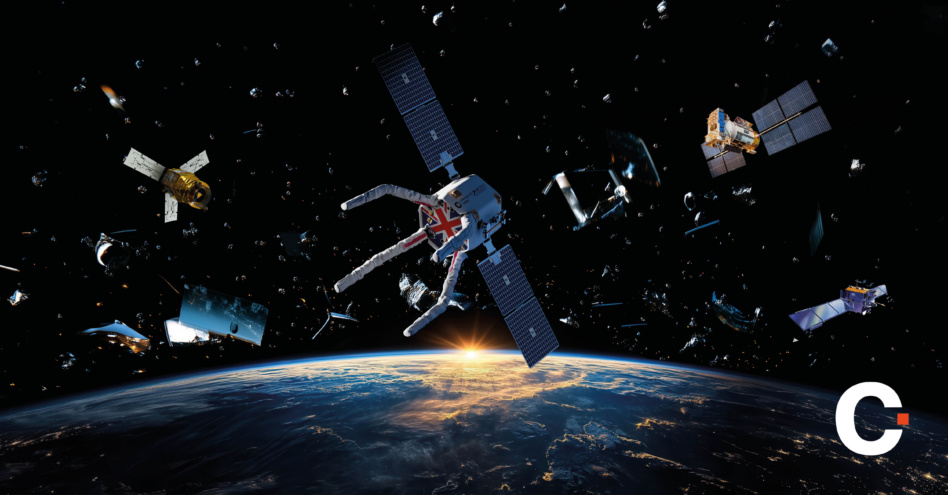
The UK Space Agency is dressing up as a waste-management company for Halloween.
Yesterday, the agency announced its selection of ClearSpace, the in-orbit servicing startup with offices in the UK, to act as the prime contractor for UKSA’s first active-debris removal (ADR) mission launching NET 2029.
Under the contract worth ~£61M ($81M), ClearSpace will attempt to remove two UK-registered defunct satellites from LEO using giant robotic claws. The mission will require ClearSpace to demonstrate new capabilities including in-orbit inspection, proximity operations, and the capture and relocation of unprepared objects.
Keep reading