


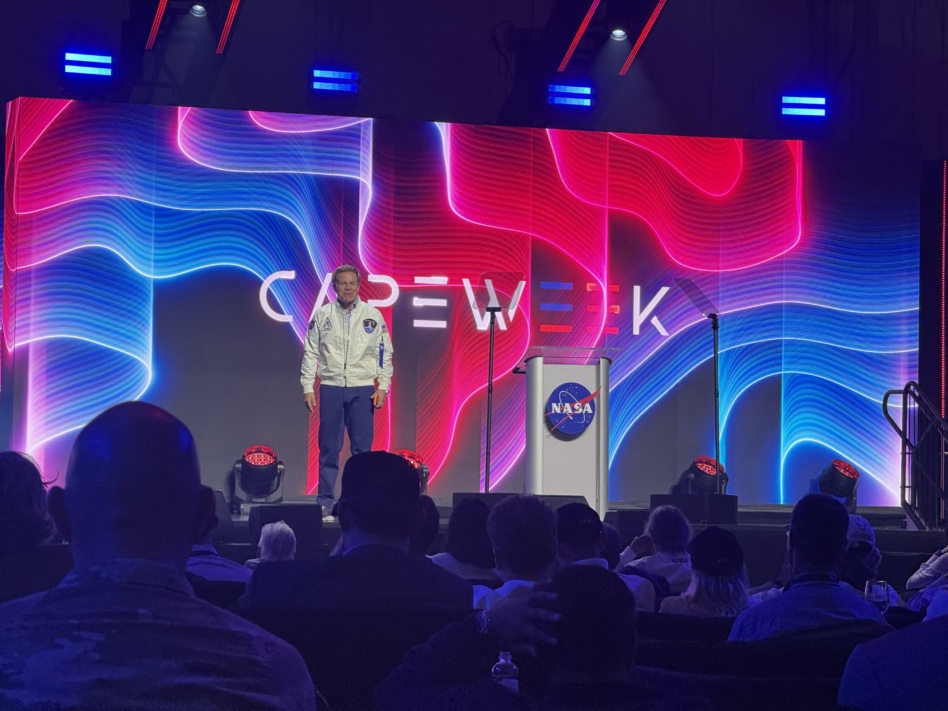
CAPE CANAVERAL, FL—Rep. Mike Haridopolos (R-FL) survived the Blue Wave—and he’s optimistic bipartisan support for NASA’s Artemis program means the program will survive the political upheaval on Capitol Hill as well.
The space subcommittee chair spoke with Payload on the sidelines of the UP.Summit at KSC about why he thinks NASA’s funding and the Artemis schedule can weather a Democratic House, and why he isn’t sweating a launch crunch.
This transcript has been edited for length and clarity.
How are you feeling after this week’s election?
I feel really bad because I think some really outstanding members of Congress lost. I think you’re going to see a real rebound in two years. But the American public’s very frustrated right now, and they let it out. In my opinion, they voted out some members who are really doing some great work in Congress.
But this is what democracy is about, and I accept the verdict. At least in our world, where I chair the space committee, we’ve got great bipartisan relationships with the Democrats, and we hope we can continue that trend to make sure we win this new space race.
Looking back at the previous term, what are you most proud of?
Being the chair of the space committee, what I’m most proud of is that we secured record funding for NASA. When the president first came back in office, there was potential for a 40% cut to NASA. We did not have a cut at all. We restored all those potential cuts. We worked across the aisle and got that done. And in the big bill that we passed last July [the One Big Beautiful Bill Act], we actually increased NASA spending by about $9.9B.
So we have made the investment in space, and [NASA Administrator] Jared Isaacman has really taken the helm and shown that investment is really paying off. I would argue that 2026 is probably the best year at NASA since 1969.
After two years of back-and-forth over NASA’s budget, do you expect the same fight next year?
This Congress has shown the commitment to space, and this is a bipartisan issue. The rub has been a bit where the Democrats [on] the science committee want to spend a little bit more on environmental programs. We want to spend it more on aerospace and space programs—tangible versus maybe scientific research.
We’re in the middle of a space race right now with China. We’re both trying to get to the [Moon’s] South Pole first. There’s the water there, potentially, and the sunlight that hits it allows you to have an immediate energy source on the Moon. We’re afraid that if the Chinese get there first, they might try to make some territorial claims despite the [Outer] Space Treaty of 1967.
What does this week’s blue wave mean for space?
Put it this way: If we can’t work out a deal, you’re going to have what’s called a continuing resolution—which is the current budget—and we can live with the current budget. [NASA Administrator] Jared [Isaacman] has been very economical about how he is using these dollars to make sure that we meet the mission.
The space reauthorization bill is another thing we would like to see, and included there is what’s called the Space Ready Act. That’s where we can make investments in these different NASA facilities, just like [we] investment in the Department of War. That’s a long-term venture that keeps us in the lead on the space race, and that doesn’t mean just Kennedy Space Center. So if the private sector wants to accelerate, where they don’t have to wait on government timelines, they can build those launch pads or the infrastructure needed at these different facilities.
Do you expect any major changes to Artemis or its schedule?
These schedules are not something we could turn on a dime. With the success that we’ve had with both [Artemis] I and II, we’re scheduled to have III and IV by 2028. We can’t throw a monkey wrench into it.
Obviously, [Democrats] might not love the politics of [SpaceX CEO] Elon Musk, but the Artemis program is not about the politics of Elon Musk. We hope SpaceX and/or Blue [Origin] are successful in building those landers, so we can get back to the Moon. I was just at Blue Origin two or three weeks ago and saw the next craft that will be landing on the Moon without astronauts, and I couldn’t be more thrilled.
Are you worried about a possible “launch crunch” as SpaceX transitions to Starship?
Look at all these new companies coming online, from Stoke Space to Relativity to Blue Origin. You have people who recognize that money can be made by launching satellites, and as this launch crunch—as you put it—takes place, I think the marketplace will fill that void. You have some great launch systems, whether it be [Blue Origin’s] New Glenn or others, that have proven that they can be successful. I’m pretty confident that our goal of having 1,000 launches a year is going to be met.

Election 2026: Space Winners, Losers, and What’s Next
Forget the blue tsunami. Tuesday night’s election was a blue supernova.
What to Watch on Election Night
Here are the top things I’ll be paying attention to over my election-night pizza—a cheat sheet of what to watch as it relates to space.

NASA, Agriculture Department Partner On Space Data Sharing
The MoU is the second this month signed by the space agency to boost collaboration among government agencies.

Congress Seeks Answers On Starlink Disruptions in Ukraine
“The United States government has a fundamental obligation to protect American personnel serving overseas,” the senators wrote. “The possibility that American personnel were endangered by preventable disruptions, inadequate coordination, or decisions made by their own government demands immediate scrutiny and accountability.”


CA-based startup Lyra Systems emerged from stealth on Tuesday, announcing an agreement with the Pentagon aimed at helping early-stage technologies traverse unscathed across the Valley of Death.
Under the five-year Cooperative Research and Development Agreement (CRADA) with AFRL, Lyra Systems will aim to use its AI-enabled mission-integration software to help new tech get demo opportunities in orbit faster. The agreement aims to create “a repeatable integration pathway for nontraditional vendors to gain flight heritage,” according to SpaceWERX Senior Engineer Marcus Bracey.
The problem: As an industry term, the Valley of Death describes the final resting place for promising technologies that never progressed to demonstration missions or commercial sales. Traditionally, tech development has stalled out mainly due to lack of funding opportunities—but Lyra founder and CEO Tanmayi Sai says the money isn’t the problem anymore.
Keep reading