


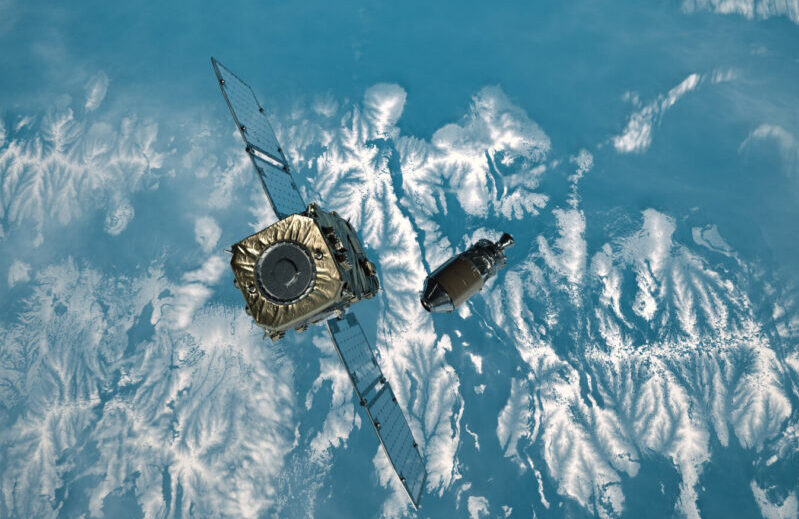
Astroscale Japan selected Germany’s Isar Aerospace to launch its ADRAS-J2 mission—which aims to be the first spacecraft to capture and remove a piece of large orbital debris.
The mission is slated to fly during Japan’s FY2027 (April 2027 to March 2028) on Isar’s Spectrum rocket, from the launcher’s pad at Norway’s Andøya Space spaceport.
ADRAS-J2 builds on the success of its predecessor, ADRAS-J, which demoed autonomous RPO around a non-cooperative object in 2024. The mission photographed a Japanese H-IIA upper stage left in LEO after the 2009 launch of the GOSAT greenhouse-gas monitor.
“ADRAS-J2 is an important step toward demonstrating that debris removal can become a repeatable, commercial service,” an Astroscale spokesperson told Payload via email. “Our goal is to build on the mission’s capabilities and pursue future removal missions with government customers who have a need to responsibly remove large debris from orbit.”
Unfinished business: Unlike some missions that showcase RPO tech with a dummy piece of debris launched just to carry out the demo, ADRAS-J2 will fetch space debris that was never designed for removal:
- ADRAS-J2 will target the same upper stage photographed by the previous RPO mission, which is roughly 11 m long and 4 m in diameter, and weighs about 3 tons.
- ADRAS-J previously inspected the payload attach fitting—the planned capture interface for ADRAS-J2—on that upper stage, confirming no significant damage.
- The spacecraft will then combine Astroscale’s RPO capabilities with its in-house robotic arm tech to remove the non-cooperative upper stage from orbit.
ADRAS-J2 is being developed under Phase II of JAXA’s Commercial Removal of Debris Demonstration (CRD2) project. The government initiative seeks to promote a commercial active-debris removal (ADR) market by partnering with private companies to capture and remove Japanese-originated debris objects. The 2024 ADRAS-J mission marked Phase I of the program.
Astroscale’s CRD2 contract is valued at approximately ¥13.2B (~$82M). Neither Astroscale nor Isar disclosed the value of the launch agreement.
Ride pending: Isar has yet to reach orbit. Spectrum’s debut test flight in March 2025 was lost 30 seconds after liftoff, and the company has yet to confirm a new date for the second flight test following a June scrub.
The German launch startup intends to launch Spectrum multiple times for further reliability enhancements before flying ADRAS-J2. Astroscale told Payload that the company was confident that Isar can meet the agreed upon schedule needs, noting that the precise orbital insertion capability offered by Spectrum is important for ADRAS-J2.
ADRAS-J2 is Astroscale’s second Isar mission. Astroscale’s UK subsidiary signed an agreement with Isar in March to launch the ELSA-M in-orbit demonstration mission aiming to capture satellites fitted with magnets to enable their capture. ELSA-M is scheduled to launch during Astroscale’s 2028 fiscal year.
BlackSky Renews HEO Deal, Adds Gen-3 Imagery for Space Domain Awareness
BlackSky Technology inked a seven-figure deal to extend its partnership with Australian non-Earth imaging (NEI) provider HEO for another year.

Nebex Partners with Thrusters Unlimited to Unlock $700M for Mexico’s Space Ecosystem
The capital will fund EO, telecoms and other strategic capabilities, according to Nebex.
Exclusive: Meridian Space Spins Out from SpinLaunch
“Meridian will carry forward the satcom infrastructure business… SpinLaunch will continue to build on its vision for a lower-cost approach to launch, with further applications in hypersonics to support the Golden Dome program and in the lunar economy,” Meridian Space CEO Massimiliano Ladovaz told Payload.
Rocket Lab CFO Adam Spice Predicts More M&A Deals on the Horizon
Iridium shareholders voted overwhelmingly to approve the company’s acquisition by Rocket Lab. According to Rocket Lab CFO Adam Spice, there’s more M&A on the horizon.

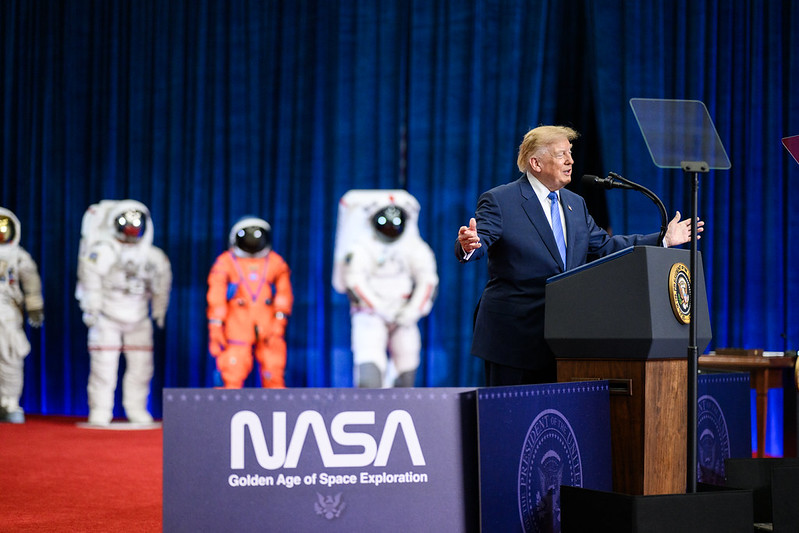
Is the US about to add a new service-academy rivalry to college football Saturdays?
President Donald Trump signed an executive order on Friday calling for the establishment of a US Space Academy, modeled after the US service academies for military branches. The administration can’t open up a school on its own—that will take action from Congress—but Trump did set up a commission to study the idea and consider some big questions, including the curriculum focus and service requirement for grads.
“American superiority in space depends on the strength, skill, and character of those who explore, secure, and build the industries critical to it,” the executive order reads. “To continue to lead the world in space exploration and technology, while securing and defending our national interests in space, the nation must prepare the next generation of astronauts, scientists, engineers, operators, entrepreneurs, civil servants, and warfighters and ensure that they are capable of advancing American interests in space.”
Keep reading