


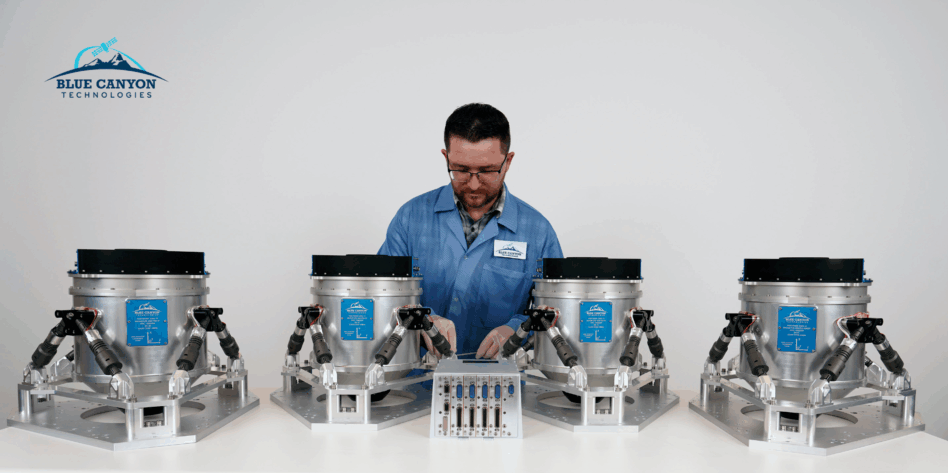
Blue Canyon Technologies, RTX’s small satellite subsidiary, is putting a new spacecraft bus on the market in response to demand for larger orbital platforms—particularly from national security customers.
Go big or go home: The Saturn-400 can fly payloads—including sensors, processors, and comms gear—weighing between 400 kg and 600 kg, depending on launch configuration, according to Blue Canyon’s director of business development, Elvis Silva. The company’s previous offering maxed out at 200 kg of payload.
The vehicle, which can also fly missions with high-power requirements, is intended to fill out the Pentagon’s vision of thousands of new missile-defense spacecraft.
“That’s the point of the Saturn-400,” Silva told Payload. “Golden Dome is going to need more capability. This product will support more mass and more power, so that a lot of those defense payloads can be carried on the spacecraft.”
Field of dreams: With a crowded field of satellite bus makers and few clear requirements for Golden Dome-specific contracts, spacecraft-makers are trying to figure out the right form factor for future networks of sensing, communication, and intercept vehicles.
Most merchant satellite builders offer vehicles that carry less than 400 kg of payload, or more than a metric ton, leaving something of a missing middle. Besides Blue Canyon’s Saturn-400, only Terran Orbital, Rocket Lab, and Apex offer LEO spacecraft in the class.
“The biggest demand is in LEO, where you have larger buses [for] EO remote sensing missions, things like missile tracking,” Silva said. “Applications where you have larger aperture telescopes where you need to steer those to look at targets at the Earth. You can use that product to have more agility, and collect more targets during the pass.”
Wiggle on-demand: The new line of spacecraft also aims to improve steering, by adding control moment gyroscopes, or CMGs, to the Saturn-400.
Most small spacecraft rely on reaction wheels for attitude control and pointing. CMGs, which are more efficient and powerful but also more complicated to build and operate, were typically reserved for larger, more expensive spacecraft. Adding CMGs to the new bus will allow them to slew around more quickly to aim sensors at specific places on the ground.
“All of our customers are driven by how much data they deliver to their customers effectively,” Silva said. “We’re enabling faster access [and] more revisit rates, so that customers can generate more data and generate more revenue from that.”
BlackSky Renews HEO Deal, Adds Gen-3 Imagery for Space Domain Awareness
BlackSky Technology inked a seven-figure deal to extend its partnership with Australian non-Earth imaging (NEI) provider HEO for another year.
Exclusive: Xona Ramps Up Production Ahead of Pulsar Launch
With FCC approval in hand and six sats ready for the pad, Xona is turning to its next challenge: building the next 250.

Nebex Partners with Thrusters Unlimited to Unlock $700M for Mexico’s Space Ecosystem
The capital will fund EO, telecoms and other strategic capabilities, according to Nebex.

Exclusive: Meridian Space Spins Out from SpinLaunch
“Meridian will carry forward the satcom infrastructure business… SpinLaunch will continue to build on its vision for a lower-cost approach to launch, with further applications in hypersonics to support the Golden Dome program and in the lunar economy,” Meridian Space CEO Massimiliano Ladovaz told Payload.

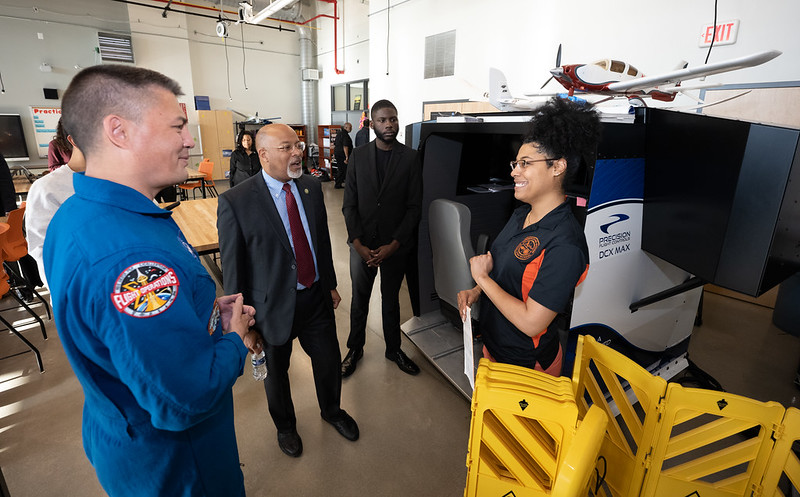
A bipartisan group of lawmakers are aiming to promote US leadership in space—and ensure commercial space players are in lockstep with the government along the way.
The Advancing Humanity in Space Congressional Caucus, which launched last month, is co-chaired by Rep. George Whitesides (D-CA), Rep. Gabe Evans (R-CO), Rep. Don Bacon (R-NE), and Rep. Glenn Ivey (D-MD).
What is it? The caucus is “dedicated to US leadership in space exploration,” according to the press release. Its main missions include promoting space sustainability, boosting international partnerships, supporting policies that help the space community thrive, and educating the public on the benefits of working in orbit.
Keep reading