


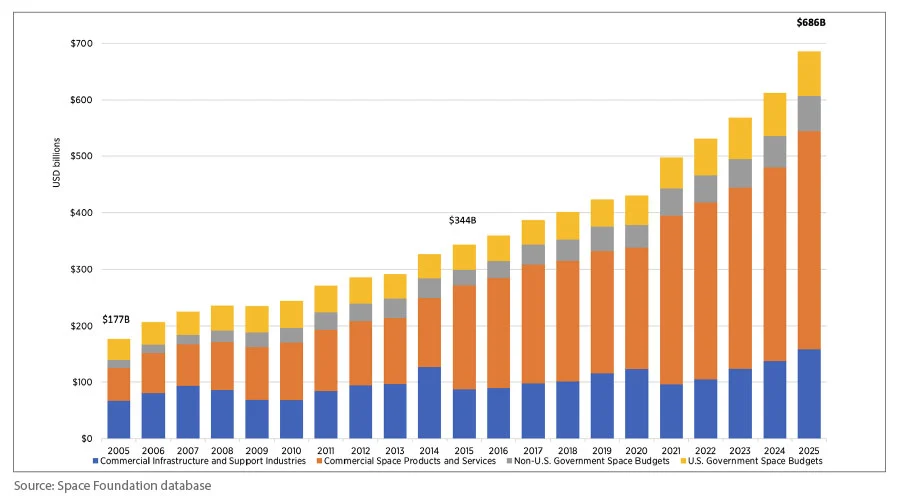
The global space economy totaled a record $686B in 2025, according to the Space Foundation.
The Space Foundation released its annual State of the Global Space Economy report yesterday, which tallies commercial revenue and government spending across dozens of countries and agencies. The report found the space economy grew 12% compared to 2024, and the upward trend isn’t stopping anytime soon.
“The five-year compound annual growth rate now approaches 10 percent, and Space Foundation expects continued growth for the next several years,” Space Foundation CEO Heather Pringle said in an announcement video. “The primary reason for this growth is simple: space has become critical infrastructure.”
Follow the money: Government space spending hit $141B across 53 budgets, up 7.4% YoY. The US accounted for 57% of the total, but the real movement came from allies building domestic capabilities—Canada more than doubled its spending to $612M, and the UK, France, and South Korea each grew their space budgets more than 40%.
Commercial activity reached $544.3B, or 79% of the space economy—almost quadruple what all 53 governments spent combined.
Sector split: PNT services generated about 41% of the total commercial revenue and, with ground equipment, account for more than three-quarters. Upstream commercial sectors are far smaller, but moving much faster, by revenue:
- Satellite manufacturing is up 67.2%;
- Launch is up 49.4%;
- In-space servicing and SSA are both up 42.9%.
The defense surge: The Pentagon wants to roughly double its national security space budget to $126B in FY27, pushing global military spending past $150B for the first time. The more notable number may be everyone else’s: Space Foundation projects non-US military space spending will nearly double in 2027, to $31.5B.
Sovereignty is the driver, as nations attempt to build, launch, and control their own space defense assets. Germany has pledged $41B in defense spending through 2030, and Finland now operates one satellite per 187,000 residents through Iceye’s constellation, compared to one sat per 1.1 million residents in China.
Private money: Private investment in space ventures crossed $12B in 2025, with expectations to surpass that this year. Emerging technologies carried several funding rounds into the hundreds of millions.
- Orbital data centers: Starcloud announced a $170M Series A in March; Cowboy Space (formerly Aetherflux) raised a $275M Series B in May.
- Reusable rockets: Stoke Space reported a $510M Series D in October, with a $350M extension in February.
- Next-gen buses: K2 Space raised a $110M Series B in February 2025, then topped it ten months later with a $250M Series C in December.
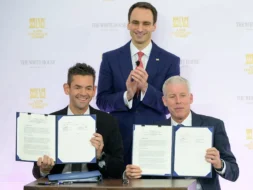
NASA Signs Space Nuclear Pact, Says Moon Base Is Ahead of Schedule
Isaacman gave updates at the White House’s “Science: A New Golden Age Summit.”

Nebex Partners with Thrusters Unlimited to Unlock $700M for Mexico’s Space Ecosystem
The capital will fund EO, telecoms and other strategic capabilities, according to Nebex.
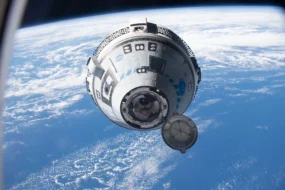
Starliner Targets Uncrewed Flight NET December, Crewed Follow Up in 2028
NASA and Boeing officials announced Monday that they have upgraded and redesigned Starliner following a dicey crewed test flight in 2024, which left NASA astronauts Butch Wilmore and Sunita Williams stuck on ISS for nine months.
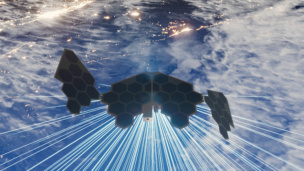
Exclusive: Meridian Space Spins Out from SpinLaunch
“Meridian will carry forward the satcom infrastructure business… SpinLaunch will continue to build on its vision for a lower-cost approach to launch, with further applications in hypersonics to support the Golden Dome program and in the lunar economy,” Meridian Space CEO Massimiliano Ladovaz told Payload.

The FCC announced last week that it will consider a proposal on Aug. 6 to allow unlicensed Part 15 wireless devices to communicate directly with satellites.
More than $40B has moved through D2D spectrum deals since 2024, from SpaceX’s $19.6B EchoStar spectrum purchase to the Amazon-Globalstar and Rocket Lab-Iridium acquisitions. The new FCC proposal would open more than 225 MHz of unlicensed spectrum—over three times what SpaceX bought—for free.
Unlicensed devices: The spectrum the FCC wants to open was never anyone’s to sell. Part 15 governs devices that operate without a license—think Wi-Fi routers, Bluetooth speakers, garage door openers, and smart meters. Rather than applying for spectrum rights, these devices simply comply with technical limitations.
Keep reading