


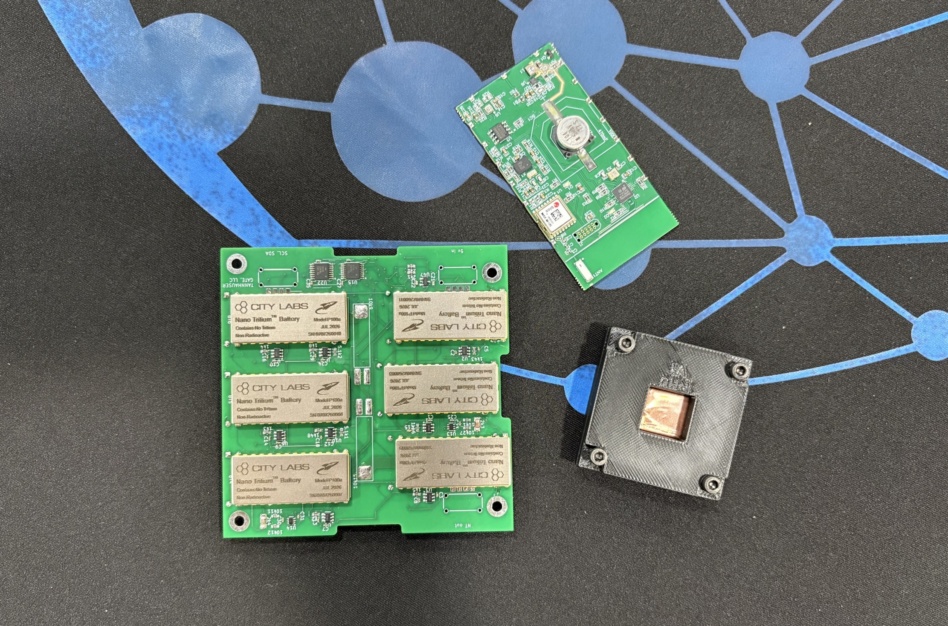
SALT LAKE CITY, UT — One nuclear satellite does not a nuclear space age make. Two though? Now we’re talking.
Following the success of City Labs’ first nuclear-powered payload demo—BOHR, which launched on SpaceX’s Transporter-17 rideshare in July—City Labs is planning a second, higher-power nuclear demo flight as early as next year, according to CEO Peter Cabauy.
- BOHR demonstrated City Labs’ Tritium-powered betavoltaic battery, which is designed to provide payloads with a source of energy independent of solar power.
- The second demo will test the company’s Tritium-powered radioisotope heating unit (RHU), which will provide payloads with a source of heat. Ultimately, the technology is intended to help lunar payloads continue operating throughout the epicly frigid lunar night.
“We’re repeating what we did—we’re just changing out the technology [and] taking it to the next natural level,” Cabauy told Payload.
One-two punch: When put together, Tritium-powered betavoltaic batteries and RHUs could enable lunar-surface missions to survive and operate through the two-week lunar night.
At a time when missions to the Moon can cost hundreds of millions of dollars—only to die after the sun goes down—nuclear energy and heat sources could enable longer-duration missions, improving the economics for commercial lunar ventures. For a couple of examples, look no further than NASA’s nuclear-powered Curiosity and Perseverance rovers running on Mars for 14 Earth years and five Earth years, respectively—and counting.
The heat-source and nuclear battery technologies are designed to scale to meet the needs of future payloads. Individually, each battery and RHU is small—weighing only a few grams, and giving off microwatts of power or heat each. But they can be stacked together to collectively provide just the right amount of warmth or power for each customers’ needs.
Since launching BOHR in July, City Labs has seen demand for its nuclear batteries spike, and Cabauy expects a similar reaction from the market following the 2027 demo. To meet this demand, the company has organized its supply chain to start churning out batteries and RHUs at scale, and has secured access to Tritium-based fuel from US and international sources.
The driving force behind this commercial push is to ensure missions to the Moon don’t end prematurely due to usually “preventable” circumstances like freezing in the dark, according to Cabauy.
“People talk about the lunar economy. You need to have heat,” Cabauy said. “There’s no Moon base without it, and there’s no permanence without heated sensors: betavoltaic or tritium-powered sensors that can run through the night.”
Why now? The company is experiencing a commercial renaissance largely thanks to NASA’s heightened focus on establishing a permanent lunar presence, which will necessarily require nuclear power and heating sources.
The agency’s push to get boots back on the Moon before the end of the decade has helped clear a regulatory pathway for commercial nuclear launches. With one mission already under its belt, Cabauy said he expects City Labs to fly its second without any regulatory speed bumps.
NASA Outlines the Details of Artemis III and IV Missions
NASA still wants to return US astronauts to the Moon in 2028. Today, officials shared a progress update on their efforts, as well as the finer details of the mission plans for Artemis III and IV, targeting flights in 2027 and 2028, respectively. Long story short: NASA remains confident it can meet the timeline for…
Exclusive: DoD Taps Orbital Operations for Cryogenic Spacecraft Demo
The Long Beach, CA, startup has won up to $35M from the DoD under a prototype Other Transaction Agreement to fly a full-scale, in-orbit demo of Astraeus—its cryogenic-maneuvering vehicle.
Xona Raises $250M Series D to Scale Commercial GPS Constellation
Xona’s long-term plan is to build a ~258-sat constellation to offer an upgraded commercial alternative to government GPS networks.
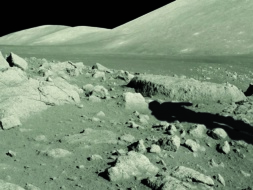
National Academies Rank Nonpolar Moon Sites
A new report from the National Academies ranks the top four non-polar sites for future crewed lunar missions.


The last time the US released a space transportation policy in November 2013, SpaceX Falcon 9 had flown just six times. Now, Falcon 9 has ~700 flights behind it—and the White House is aiming for more than 1,000 launches and reentries annually by 2030.
The new National Space Transportation Policy (NSTP), signed Aug. 20, which replaces the 2013 edition, asks what it would take to get to 1,000 annual launches. The answer? More pads, more airspace, more spectrum, and somewhere for all of it to come back down.
“The overwhelming concern is just reliable access to orbit,” Fenix Space CEO Jason Lee told Payload. “This [policy] is encouraging to foster looking at options and ways to facilitate that.”
Keep reading