


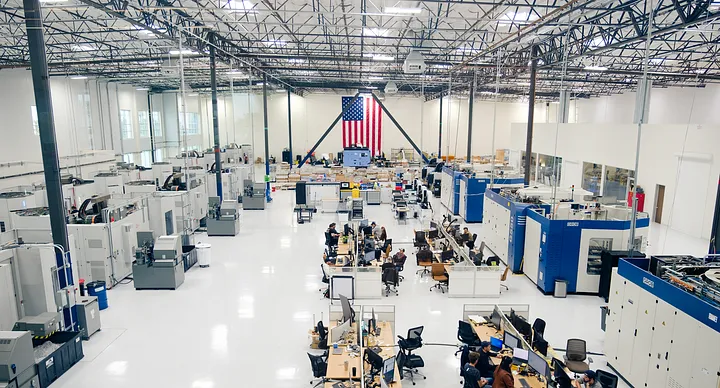
Hadrian, a CA-based advanced manufacturing startup, launched a new program today to help companies more effectively manage their supply chains.
The program, called Atlas, aims to make the space industry’s fragmented supplier landscape easier to navigate. With hundreds of manufacturing shops around the country—each with varying cost structures, capabilities, capacities, and quality standards—innovations from space startups run the risk of stalling due to inefficient supply chains.
Atlas rising: The new tool combines a vetted supplier network with supply chain management and DFM (design for manufacturing) software, providing startups with a single point of contact for their entire supply chain.
The software charges Hadrian with minimizing delays and errors and ensuring that manufacturers’ outputs meet rigorous quality standards without any effort from startups. Atlas aims to create more transparent supply chains by providing detailed status updates—think Domino’s pizza tracker—to help companies build with ease.
As startups grow and take on bigger contracts, suppliers who produced the initial prototype rarely have the capacity to fill mass production orders, threatening to derail forward momentum.
“We believe pretty firmly that it’s really difficult for any one shop or any one factory or any one supplier to be really, really good at both NPI [new product introduction] and mass production,” Mac Bohannon, Hadrian’s general manager, told Payload.
Impact radius: Instead of rebuilding their own supply chains as they grow, startups using Atlas can rely on Hadrian’s team of buyers and field representatives to do the legwork, freeing up resources to focus on their core products.
Once a piece of space hardware goes into mass production, Atlas can match startups to vetted suppliers with more capacity. Hadrian’s manufacturing expertise and facilities can also step in to manage those large orders. But as Hadrian’s VP Rob Pakalski pointed out, the goal isn’t to push Hadrian to the top of the pack.
“We’re finding the top shops that care as much as we do about the future of the defense industrial base,” Pakalski said. “Hadrian is producing a lot of really novel technology that [suppliers] don’t have the time and resources to be able to produce, and we want to be able to extend that to that supply base. We’re very huge on improving the entire defense industrial base, not necessarily just our company.”

RATLOG Wants to Cut ~90% of a Rocket Engine’s Parts
The heavy-lift rocket startup debuted on Y Combinator as part of the Fall 2026 batch.

Seraphim Space Investment Trust Doubled its Value in 2026
Seraphim’s major holdings—ICEYE, ALL.SPACE, D-Orbit, HawkEye 360, and Xona Space Systems, which together represent more than 75% of the firm’s portfolio—all had a great year, and that success has trickled upwards.

BlackSky Renews HEO Deal, Adds Gen-3 Imagery for Space Domain Awareness
BlackSky Technology inked a seven-figure deal to extend its partnership with Australian non-Earth imaging (NEI) provider HEO for another year.

Exclusive: In Orbit Aerospace Pivots From Re-entry Vehicles to Spacecraft Autonomy
In Orbit has won new government contracts for its onboard AI system, which the company says can run a spacecraft’s operations without waiting on ground control.


India successfully docked two satellites in LEO last week, becoming just the fourth country to pull off the difficult tech feat.
The mission is a significant step towards India’s pursuit of its aggressive space goals, including servicing satellites, transferring Moon samples between spacecraft for return to Earth, and assembling its space station in orbit.
Handshake in the sky: The two satellites, Target and Chaser—each the size of a large refrigerator—linked up 290 miles above Earth after over a week of carefully choreographed maneuvering.
Keep reading