


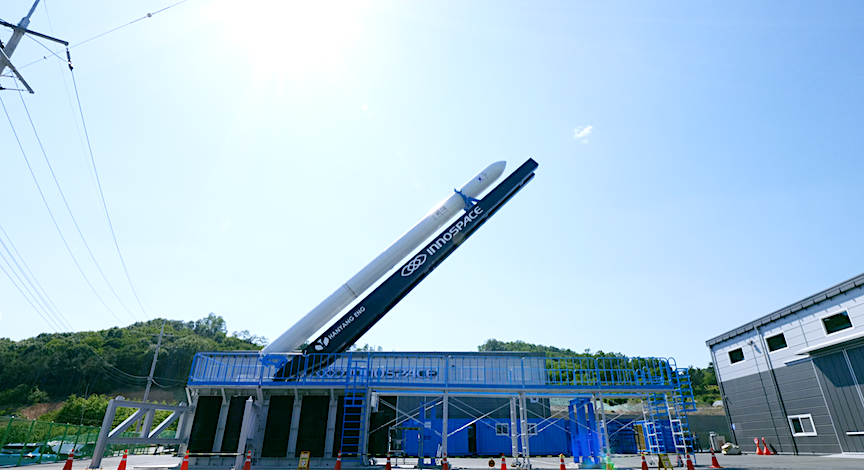
South Korea is angling to join the elite club of major spacefaring nations. Now, the second rocket developed domestically in the country has achieved liftoff.
Innospace, a Korean launch startup developing a suite of small-lift rockets, successfully got its Hanbit-TLV suborbital test rocket off the ground on Sunday. The flight lifted off from the Alcântara spaceport in Brazil at 1:52pm ET.
Innospace’s strategy: Innospace CEO Kim Soo-jong founded the company in 2017 and has since raised 55.2B won ($42M) in funding to develop the company’s small-lift rocket technology domestically in South Korea.
The Hanbit-TLV rocket, standing at 16.3 m tall, is a suborbital test rocket and precursor to the Hanbit-Nano, which is designed to carry payloads up to 50 kg to orbit. It comes equipped with a 15-ton hybrid engine that uses liquid oxygen and paraffin-based propellants. On this mission, Hanbit-TLV carried a 20 kg inertial navigation system called SISNAV for the Brazilian Air Force.
Launching from Brazil: The Brazilian space agency has issued a call to foreign nations that the Alcântara spaceport, operated by the Brazilian Air Force, is open for business. Innospace is the first foreign commercial company to take it up on its offer.
Test results…The Hanbit-TLV rocket successfully made it off the ground and is en route to its suborbital trajectory. The hybrid engine maintained a steady thrust for 106 seconds—12 less than the company’s target of 118—before falling into the sea off the coast of Brazil.
“The success of HANBIT-TLV shows Innospace is capable of launching a space rocket and paves the way for us to tap into the global launch service market,” Kim Soo-jong said in a statement.
+ Want more? Check out our Q&A with Carlos Moura, president of Brazil’s space agency, for more about the country’s initiative to invite more foreign launchers to Alcântara.
Stoke Space Raises $1B Initial Series E Round
Stoke Space Technologies announced today that it has closed an initial $1B tranche of a Series E round, bringing the company’s total capital raised to $2.3B.
Isar Aerospace Reaches Orbit on Second Attempt
Isar Aerospace became the first European Launcher Challenge startup to reach orbit this weekend, after the second launch attempt of its Spectrum rocket.
PLD Space, HyImpulse Close Major Extension Rounds
This week, two European launch hopefuls—Spain’s PLD Space, and Germany’s HyImpulse Technologies GmbH—closed major extension rounds to support their launch efforts.

SpaceX Announces New Starbase, Louisiana Spaceport
Gwynne Shotwell joined Louisiana Gov. Jeff Landry on Tuesday to announce a high-cadence launch site for future Starship operations.


In March Madness, your bracket can be busted by an unexpected upset, leaving your dream of predicting the perfect outcome in shambles. On expeditions to Mars, outcomes are equally unpredictable, with a mission’s fate resting on anything from a software glitch to a cosmic dust storm to a mix-up between metric and imperial units.
Today, Payload is excited to lift the wraps on our Mars Madness tournament and open the competition to all 16,000+ of our readers. Over the course of this week, you’ll vote on the “best”—or your favorite—Mars mission.
Just to get this out of the way upfront, March Madness ≠ Mars Madness. We are evaluating Mars missions, not basketball teams competing on primetime TV. While a sports tournament has a decisive outcome, a crowdsourced evaluation of the “best” Mars mission is very subjective, open to interpretation, and prone to Twitter clapbacks.
Keep reading