


What do a bird, a shipping container, and a polar bear have in common?
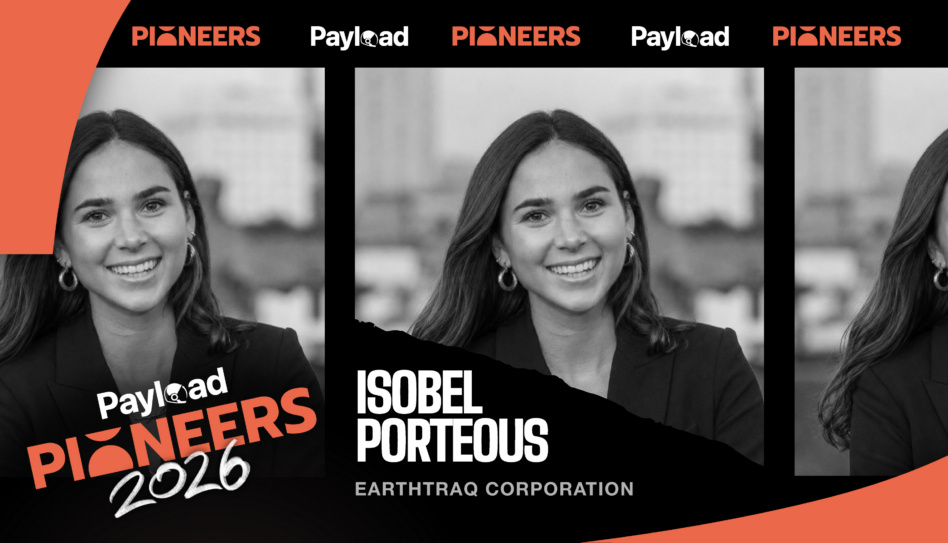
They can all be tracked with tech from EarthTraq, a company using space for asset monitoring, where Isobel Porteous is the founding head of business development.
Planting seeds: EarthTraq’s origins begin during Porteous’ undergraduate work at Stanford University, where she co-led the satellite team building two cubesats—Sapling-1 and Sapling-2.
The sats used a flight computer that had been developed by Max Holliday, a doctoral student at Stanford who went on to work at NASA’s Ames Research Center. When the team encountered trouble, they relied on Holliday to help them work through problems.
“I got into the habit a couple times of driving to his house in Mountain View late at night with this broken circuit board, going ‘Hey, Max, can you help us out?’” Porteous said. “It was one of those occasions…I’m on the couch with his then fiance, now wife, and their dog Luna…Max started telling me about the EarthTraq idea.”
Meet EarthTraq: Holliday originally focused on wildlife tracking—but the company’s coverage is now much larger, to include vessels and containers (among other things.)
- EarthTraq builds tracking tags for less than $1, which have a 10-year battery life and work anywhere on the planet.
- The tracking can be used in GPS-denied environments.
The company launched its first four satellites in July, on SpaceX’s Transporter-17 rideshare mission.
Nuclear threat: As a visiting fellow with the Council on Strategic Risks, Porteous is also studying how to use new tech to verify compliance with Article 4 of the Outer Space Treaty that bans nuclear weapons in space—the subject of her senior honors thesis.
“When the news came out in February 2024 that the US intelligence community had some evidence that the Russians had developed a nuclear weapon for placement in outer space, I really just sat there going, ‘This is a threat to my Sapling satellites,’” she said. “It felt not personal, but almost personal, because it is an indiscriminate weapon.”

James Shin, K2 Space
“As I begin to understand how much [impact]…things like cellular telecommunications, imaging, climate [research]…have globally—once I started to understand that, I was like, ‘Okay, this is definitely the industry that I want to work in,’” Shin told Payload.
Robert Ihnatisin, Orbital Matter
As an expert in 3D printing for terrestrial applications, Robert Ihnatisin was surprised by how slow the in-orbit manufacturing industry was progressing. So, naturally, he started a company to solve the problem himself.

Patrick Miga, Advanced Space
In first grade, Patrick Miga saw a photo of Neptune (snapped by the Voyager 2 spacecraft).. Ever since then, his life has been directed toward space.

Muhammad Hunain, Melagen Labs
“That’s where I realized we’re stuck at a 1980s standard: still shielding spacecraft with aluminum, and rad-hardened electronics [were] too expensive to build at the scale this economy demands,” Hunain told Payload.


Dallas-based Balerion Space Ventures has surpassed its $200M target for its second fund, the firm announced Thursday. Fund II—which remains open—is more than five times the size of the firm’s debut fund, which came in at just under $40M.
Balerion had closed ~$90M as of May, according to Venture Capital Journal. Cofounder and General Partner Daniel Kleinmann chalked up the momentum since then to portfolio companies hitting milestones and raising up-rounds—which he said resonated with LPs.
The firm is also holding back capital for follow-on rounds. “These are really capital-intensive businesses,” Kleinmann told Payload. “Having the ability to reserve capital to continue supporting these businesses as they hit major technical, commercial, government milestones is really important to us.”
Keep reading