


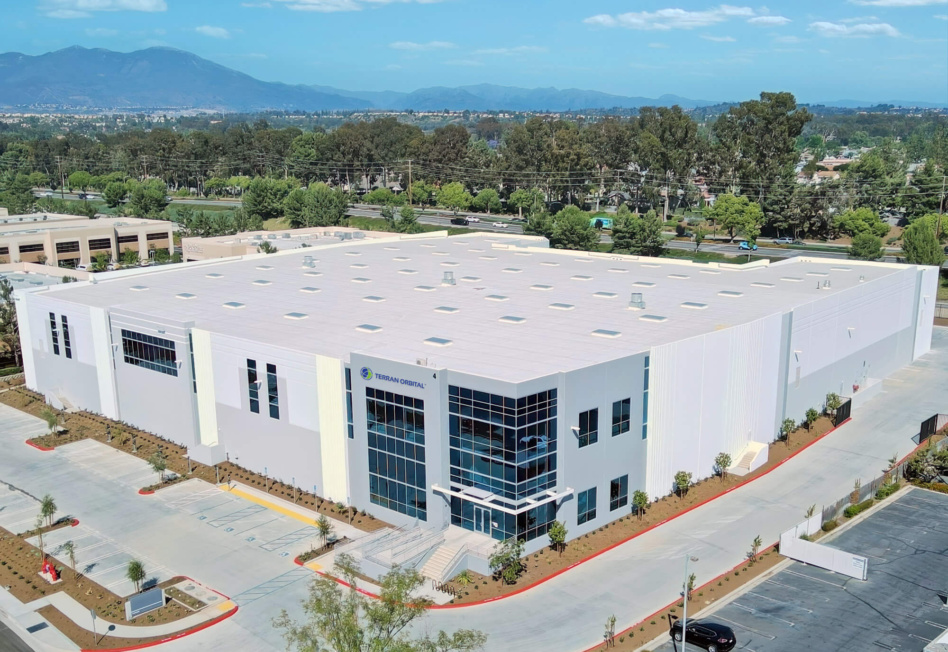
Aerospace prime Lockheed Martin will acquire Terran Orbital, a small satellite manufacturer that struggled as a public company, the companies announced yesterday.
The purchaser isn’t a huge surprise: Lockheed already owns a third of Terran, will provide 91% of its future revenue, and even offered to buy the firm earlier this year.
A transaction became inevitable on Monday when Terran reported substantial doubt about its ability to remain afloat without new investment or a sale. Notably, the company removed $2.4B in contract backlog previously attributed to a troubled deal with Rivada Space.
On July 24, Terran had just $14.5M in cash on its balance sheet after losing $25M in the previous quarter, alongside more than $190M in debt. The company needs to maintain $20M on hand to comply with the terms of its borrowing.
CEO Marc Bell wouldn’t comment on the acquisition, but when asked if he would remain as CEO, said, “I have no intentions of going anywhere.” Lockheed said the company will operate as a subsidiary and continue selling spacecraft to the industry at large.
Cry me a Rivada: Terran has received just $13.2M from its partnership with the German satellite operator, versus more than $180M initially expected.
Rivada claims to have $10B in customer commitments for a 600-satellite network, and has been planning to launch spacecraft next year to comply with a 2026 regulatory deadline. Bell said the project is approaching the preliminary design review phase.
“We are carrying on with Terran as our supplier and we don’t expect the acquisition to affect our contract with them or our timelines,” a Rivada spokesperson told Payload.
Timing is everything: Lockheed will pay $0.25 per share for the company’s stock, about $50M, and assume its debt—a far cry from the $1 per share offer it made just four months ago, which Lockheed pulled after Terran’s board didn’t respond in a timely fashion.
The acquisition values the company at $450M, compared to the $1.8B valuation it boasted when it went public through a SPAC transaction in 2021. Lockheed invested $100M in Terran in 2022, and the company is building buses for more than 70 spacecraft the major prime is designing to fulfill contracts with the Space Development Agency.
Terran’s management has been criticized, including from within—in October, three of the co-founders of Tyvak, Terran’s predecessor company, signed onto a shareholder letter that criticized CEO and Chair Marc Bell’s leadership of the company.
“Terran Orbital tripped itself up by not being a good allocator of capital,” B. Riley analyst Mike Crawford told Payload. “There is high demand for emerging satellite manufacturers, especially those demonstrating a niche capability.”
Nebex Partners with Thrusters Unlimited to Unlock $700M for Mexico’s Space Ecosystem
The capital will fund EO, telecoms and other strategic capabilities, according to Nebex.
Exclusive: Meridian Space Spins Out from SpinLaunch
“Meridian will carry forward the satcom infrastructure business… SpinLaunch will continue to build on its vision for a lower-cost approach to launch, with further applications in hypersonics to support the Golden Dome program and in the lunar economy,” Meridian Space CEO Massimiliano Ladovaz told Payload.
Rocket Lab CFO Adam Spice Predicts More M&A Deals on the Horizon
Iridium shareholders voted overwhelmingly to approve the company’s acquisition by Rocket Lab. According to Rocket Lab CFO Adam Spice, there’s more M&A on the horizon.
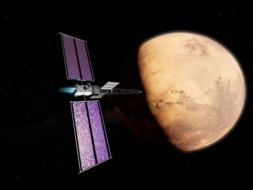
TRL11 Will Build Imaging Tech for SR-1 Freedom
TRL11 has received a NASA contract to provide imaging systems for the Space Reactor-1 (SR-1) Freedom mission to Mars.


John Grunsfeld has served as an astronaut, Hubble repairman, NASA chief scientist, and associate administrator of the agency’s science mission directorate during his career. With the launch of Space Cadets 4 Harris, he’s adding political activist to the list.
“There isn’t a whole lot I can do to affect the election. I can talk to my family, I can talk to my friends, I can vote,” he said. “But maybe I can organize a call, not so much to necessarily raise a lot of money…but to bring people together who are interested in space science, astronomy, space exploration to show candidates and the rest of the nation that this is an interest group.”
Star-studded: Grunsfeld spearheaded a virtual fundraiser to support the Harris-Walz presidential campaign on Thursday night that raised more than $50,000. It included remarks from the who’s-who of the space world, including Bill Nye, former Virgin Galactic CEO (and congressional candidate) George Whitesides, two former NASA administrators—Charlie Bolden and Sean O’Keefe—commercial astronaut Sian Proctor, and a handful of Star Trek stars such as actor Robert Picardo and lead artist Mike Okuda.
Keep reading