


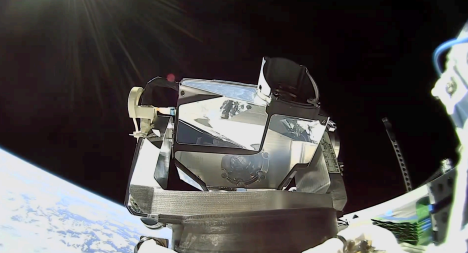
Muon Space will integrate Starlink’s mini-laser terminals into future iterations of Muon’s Halo satellite platform as soon as 2027.
The agreement with SpaceX, which was announced today, will allow Muon’s satellites to tap into Starlink’s global satellite network, offering Muon customers near-real-time access to their data.
Operation lightspeed: While Muon has long focused on building satellites with high-data-downlink capabilities—around five terabytes a day per spacecraft, using direct RF downlinks, according to Muon President Greg Smirin— the deal with Starlink stands to increase downlink rates by an order of magnitude.
Starlink-enabled Muon sats will no longer need to wait to pass over a ground station to kickstart downlink. Instead, they’ll beam data to the nearest Starlink satellite—at a rate of 25 Gbps, and up to 4,000 km away—which will then be routed through the Starlink network for downlink to a SpaceX ground station, where information will be sent to operators through terrestrial networks within minutes.
Not only will the new technology speed up access to satellite data, but it will also increase the amount of data customers can gather while flying remote sensing payloads aboard Muon satellites.
“The value of a satellite is, in part, scaled by how much data you can put through it,” Muon CTO Pascal Stang told Payload. “We no longer have to be selective about which data we bring down. You can really bring all of it down fast, and that just amplifies and expands the applications that you can service.”
Light my fire: For Muon customers like Earth Fire Alliance, the improvements for its FireSat wildfire detection constellation will be night-and-day, according to Muon officials.
“The target has been to get [data] down no later than 40 minutes from when it was observed,” Smirin said. “We’re going to end up with FireSat being able to bring data to the operators and their command centers…quicker than they currently are able to make decisions.”
Muon is already integrating the mini lasers into its satellites, and plans to launch its first Starlink-enabled sat in 2027.
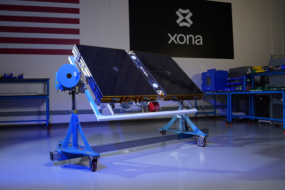
Xona Raises $250M Series D to Scale Commercial GPS Constellation
Xona’s long-term plan is to build a ~258-sat constellation to offer an upgraded commercial alternative to government GPS networks.
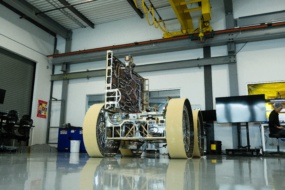
Hewlett Packard Enterprise to Send AI Compute Module to the Moon
Hewlett Packard Enterprise ($HPE) is taking remote working to a whole new level.
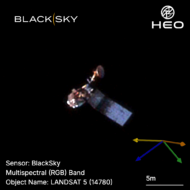
BlackSky Renews HEO Deal, Adds Gen-3 Imagery for Space Domain Awareness
BlackSky Technology inked a seven-figure deal to extend its partnership with Australian non-Earth imaging (NEI) provider HEO for another year.
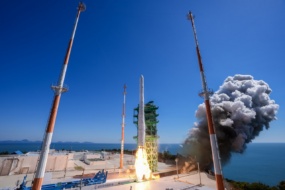
ArbaLabs Launches AI Verification Demo On South Korea’s Nuri Rocket
“In short, tons of companies are looking at the latest and greatest physical AI deployments,” ArbaLabs CEO Ashley Reeves told Payload. “Nobody is really thinking about putting some checks and balances on what these AI models are doing.”


Acting NASA chief Sean Duffy said Monday that NASA is opening up competition to bring astronauts to the lunar surface during Artemis III.
“I love SpaceX; it’s an amazing company. The problem is, they’re behind…and we’re in a race against China,” Duffy said on CNBC’s Squawk Box. “So I’m going to open up the contract. I’m going to let other space companies compete with SpaceX.”
What does that mean? A NASA spokesperson said SpaceX and Blue Origin have until Oct. 29 to present their ideas for how to accelerate the Moon landing. However, the agency is casting a wide net, and will also issue an RFI to the entire space industry to submit plans “for how NASA can increase the cadence of our mission to the Moon.”
Keep reading