


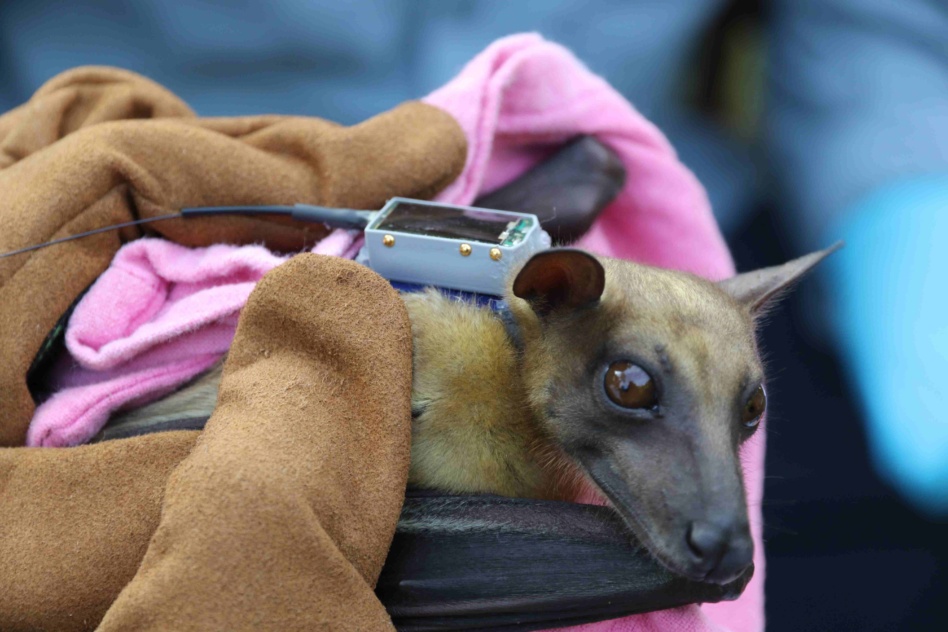
The Max Planck Society, a German research institution, has partnered with TALOS, a Munich-based startup, to build a constellation of cubesats that can track animal movements around the world.
The ICARUS 2.0 system has two major technological pillars:
- The Max Planck Society has been equipping birds and other animals with miniature trackers that collect data including temperature, pressure, humidity, luminosity, acceleration, and coordinates, which will be sent to ICARUS 2.0 sats.
- The constellation will consist of at least five cubesats. The first is planned to launch in October, while the rest are expected to be in orbit by the end of 2026. These sats will route data from the trackers to ground stations back on Earth.
Battlefield promotion: The Max Planck Society collaborated with DLR and Roscosmos on the original ICARUS system, which was operational on the ISS from 2020 until Russia’s invasion of Ukraine put a kibosh on the project.
ICARUS 2.0 is more than just a replacement, however. Once fully operational, the constellation will allow for as many as five revisits per day, providing more granular detail on the movements of animal populations around the globe.
“The knowledge that Max Planck brings is invaluable,” TALOS CEO Gregor Langer told Payload about the four-year partnership. “All the experience they had with the space station…they learned a lot from that, and we [will] build upon it by building a completely new system.”
Advanced birdwatching: The end result will show the direct impact the changing environment is having on animal populations. Early data from the original ICARUS system revealed how some migratory birds were choosing to winter in Southern France instead of flying all the way to Africa as they traditionally would, according to Langer.
On its face, the new system will continue to address problems wrought by humanity’s impact on the climate: biodiversity loss, poaching, and the transmission of zoonotic diseases, but TALOS hopes its constellation will have even more widespread applications to attract customers beyond the Max Planck Society.
“We also want to address use cases and applications in farming [and] livestock monitoring,” Langer said. “We say we create an ‘Internet of Animals,’ which is completely untapped, and that’s something we want to exploit.”

European MNOs Join Forces to Explore Joint MSS Spectrum Bid
Deutsche Telekom, Telefónica, Orange, and Vodafone plan to establish ground network infrastructure across Europe, and partner with an as-yet undetermined satellite operator for the D2D connection.

National Academies Rank Nonpolar Moon Sites
A new report from the National Academies ranks the top four non-polar sites for future crewed lunar missions.
Reaction Dynamics Targets 2031 for Borealis Medium-Lift Launch
In the contest to build up commercial launch capabilities in Canada, Quebec-based startup Reaction Dynamics has entered a new weight class.

Seraphim Space Investment Trust Doubled its Value in 2026
Seraphim’s major holdings—ICEYE, ALL.SPACE, D-Orbit, HawkEye 360, and Xona Space Systems, which together represent more than 75% of the firm’s portfolio—all had a great year, and that success has trickled upwards.


Wednesday’s planned Starship launch may be the seventh test flight of the mega-rocket, but it also represents a couple of important firsts—the first flight of the new and improved second stage and the first time the rocket will attempt to deploy payloads.
The rocket is set to launch at 5pm ET on Jan. 15 from SpaceX’s Texas launch facility. Here’s what we’re watching ahead of the test.
Upgrades: Starship V2 will feature significant changes up and down the spacecraft, taking lessons from previous flight tests to improve reliability and performance. The upgrades include:
Keep reading