



Sometimes, lowering the bar is a good thing.
Today, York Space Systems ($YSS) announced a new satellite platform built to fly sustained missions at lower altitudes than any of its spacecraft produced to date.
The new VLEO capable sats—dubbed the LX/V-Class—are based on the company’s S- and LX-Class satellites, with structural modifications to reduce orbital drag and ensure the spacecraft can maintain its altitude for 3+ year missions.
- The LX/V-Class spacecraft will be capable of carrying ~300 kg of payload mass at altitudes as low as 200 km.
- It will come equipped with a new, higher-thrust electric propulsion system built by York’s subsidiary Orbion Space Technology.
- The LX/V-Class sats will be capable of generating 2 kW of peak power.
High-hanging fruit: While other satellite manufacturers are targeting sub-300km altitudes—including Redwire, Kreios Space, and Bellatrix Aerospace—York is betting that speed to market can outsell slower, lower competitors.
Flying at lower altitudes requires clean-sheet designs and novel propulsion systems such as air-breathing electric propulsion. By choosing to redesign satellite systems built for LEO and GEO, York is passing on the chance to fly long-term missions below 300 km—but gaining the ability to churn out satellite systems quickly.
York expects to be able to build and launch LX/V-Class satellites in six to seven months from signing a contract, according to CEO Dirk Wallinger, who added that—for the immediate needs of government buyers—a 300 km floor is low enough.
“[Flying lower] requires changes that we don’t think are necessary for the market we’re going to attack,” Wallinger told Payload. “Our platform is going to be more intended for things like moving target indicators, missile warning, missile tracking applications, where there’s going to be different phenomenologies that you can do between 300 and 350 km.”
Ecosystem building: To win large government contracts for VLEO satellites, however, York isn’t betting on speed alone. In the past 18 months, the company has made multiple acquisitions, which has helped York graduate its offering from satellite buses and subsystems to complete turnkey solutions.
- In July, York completed its acquisition of ALL.SPACE, and will include ALL.SPACE’s jam-resistant RF comms capabilities into York’s LX/V-Class offering, ensuring the VLEO sats can send a signal even in denied environments.
- Last year, York purchased ATLAS Space Operations, giving York customers a network of 50+ ground antennas to beam signals down to.
“A lot of other quote-unquote spacecraft platform manufacturers still have to figure out those other pieces, whereas this is just going to plug right into the rest of our ecosystem,” Wallinger said.
Correction: This article was updated to correct details about LX/V-Class capabilities. It can fly as low as 200 km.
China’s Commercial Space Sector Is Going Public
A Shanghai listing rule has made orbital flight the price of entry for China’s rocket startups.
Firefly Announces Record Q2 Results
Firefly Aerospace ($FLY) posted its first-ever $100M+ quarter on Tuesday, backed by a fresh slate of launch and defense announcements.

Rocket Lab Unveils GHOST on a Record Quarter
Rocket Lab ($RKLB) unveiled a deployable launch system—dubbed GHOST—designed to enable responsive launch from anywhere in the world.

SpaceX Reports Q2 Earnings
After SpaceX’s record-breaking June IPO, the company released its first quarterly results on Tuesday, and the headline figures beat expectations.

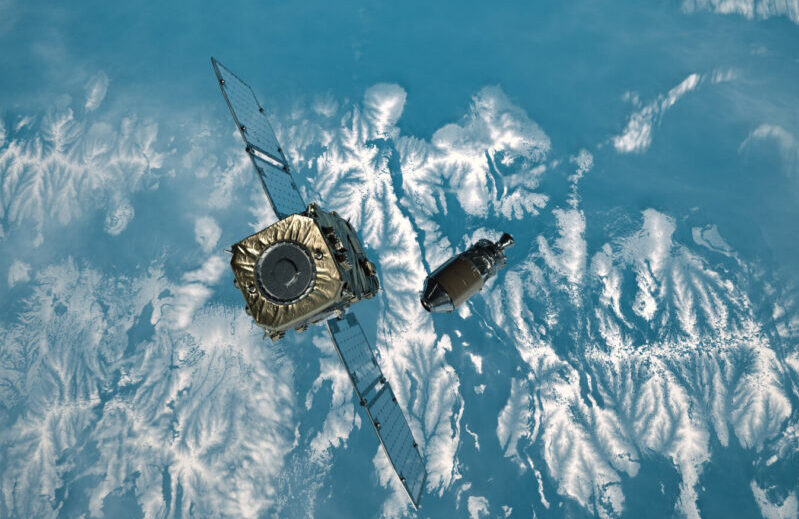
Astroscale Japan selected Germany’s Isar Aerospace to launch its ADRAS-J2 mission—which aims to be the first spacecraft to capture and remove a piece of large orbital debris.
The mission is slated to fly during Japan’s FY2027 (April 2027 to March 2028) on Isar’s Spectrum rocket, from the launcher’s pad at Norway’s Andøya Space spaceport.
ADRAS-J2 builds on the success of its predecessor, ADRAS-J, which demoed autonomous RPO around a non-cooperative object in 2024. The mission photographed a Japanese H-IIA upper stage left in LEO after the 2009 launch of the GOSAT greenhouse-gas monitor.
Keep reading