


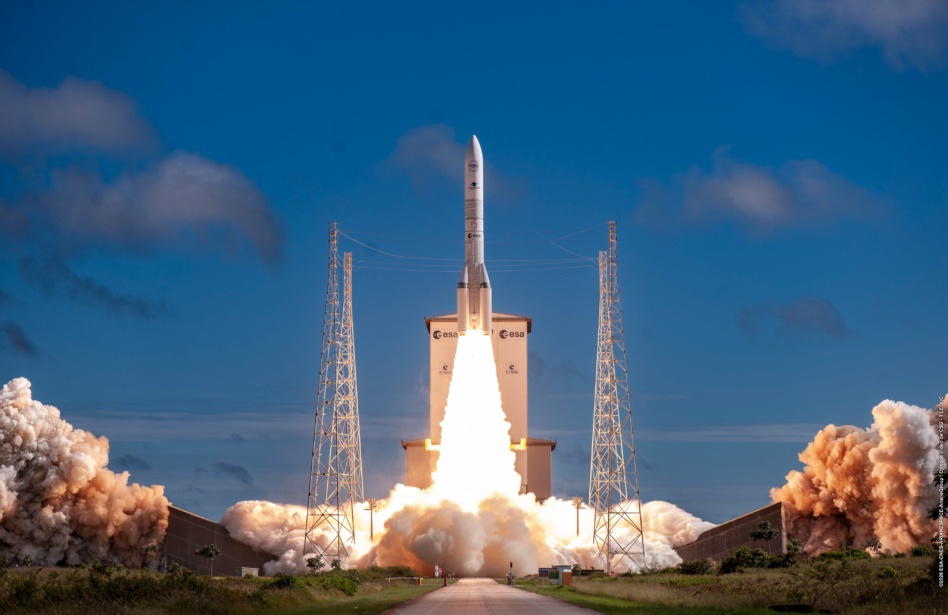
Europe is firing on all fronts to stand up new launch capabilities, but the continent isn’t moving as fast as it might hope.
Across the region, a slew of relatively young launch startups are making headway developing their new launch vehicles, with many projecting debut launches in the coming year. Even outside of Europe, rocket progress is rarely linear. You have to crawl before you can walk, and despite progress, “crawl” best describes the current pace.
Here’s where Europe’s launch capabilities stand:
Not for nothing: Europe today has three demonstrated launch providers in Arianespace and Avio (both launching multiple times a year), and Isar Aerospace, which notched its first flight to orbit on Sept. 5.
- Avio is scheduled to launch its next mission to orbit Sept. 14 from Europe’s Spaceport in Kourou, French Guiana—carrying the European Commission’s Copernicus Sentinel-3C and ESA’s FLuorescence EXplorer (FLEX) sat. Avio is focused “entirely on scaling up operations and launch frequency out of the Guiana Space Centre,” according to a company spokesperson, and recently took over an integration building in Kourou to increase its future launch cadence.
- Avio is also scaling its development of a heavier-lift Vega-E configuration, powered by a newly developed MR-10 engine, which has passed “all the firing test[s] so far.”
- Arianespace notched a big win in February launching its heavy-lift Ariane 64 configuration for the first time. In June, Ariane 64 launched using Avio’s P160C solid rocket motor for the first time, “further enhancing the launcher’s performance,” according to an Arianespace spokesperson. Ariane 6 is scheduled to launch next on August 27.
- Arianespace’s parent company ArianeGroup is also developing Themis, ESA’s low-cost, reusable rocket system, and completed a wet dress rehearsal of the demo version of the rocket last week.
- Isar Aerospace became latest European launcher to reach orbit on Sept. 5, during the second launch attempt of its Spectrum rocket. Spectrum lifted off the pad Norway’s Andøya spaceport—in a mission dubbed, fittingly, Onward and Upward—and succesfully delivered all six of its onboard payloads to orbit. The company’s next job is to prove that it can fly repeated, reliable flights. The company is also working toward its higher-lift follow-up to Spectrum, as well as on technologies for reusable capabilities, according to CEO Daniel Metzler.
The race is on: After spending a year without launch capabilities following Ariane 5’s retirement in 2023, Europe started pushing hard to get more competition in the market. Last year, ESA unveiled its European Launcher Challenge, which set aside €902.2M in funds, not all of which are yet allocated, to five companies pursuing an orbital launch no later than 2027.
One of these startups has already bitten the dust—UK launcher Orbex entered into insolvency proceedings in February—while another (Isar) has reached orbit.
But for the rest of the challengers, progress is moving along at a two-steps-forward, one-step-back pace.
- Rocket Factory Augsburg (RFA) had its RFA ONE rocket on the pad at the UK’s SaxaVord Spaceport this month, preparing for its first flight when it encountered an issue that forced the company to de-stack its vehicle to investigate. RFA has yet to release the cause of the issue, or an updated timeline on its debut flight.
- PLD Space is also building its capacity while awaiting its first flight. The Spanish launcher raised €210M this year—through a €180M Series C and €30M in venture debt from the European Investment Bank. The company is “nearing completion” of its launch site in Kourou, according to a spokesperson, and told Payload in March that it’s anticipating a debut launch in mid-2027.
- Maiaspace is trending in the same direction. The company has spent recent years developing and testing its tech in parallel to making investments to ramp production capacity. Maiaspace has begun construction on a factory in France to churn out components, targeting production to support 20 launches annually by 2032. Maiaspace will arrive at the pad a little later than its competition, but expects a first orbital launch of its Maia rocket in late 2027, according to a spokesperson.
Best of the rest: Europe’s launch ambitions, however, aren’t confined to the ELC competition. The region is home to more than a few launch startups marching their own paths to orbit.
In France, no less than five companies are working on launch vehicles not funded directly by ELC:
- Latitude notched a successful hotfire test of its full-integrated Navier engine in June, and recently finalized the assembly of the second stage of its vehicle. The company announced an agreement with Etlaq Spaceport in Oman in July, and plans to launch its debut flight from the Omani spaceport in late 2027, according to a company spokesperson.
- HyPrSpace completed its fourth full-scale engine test campaign in June, and is working to be ready for a debut launch of its Baguette One suborbital rocket before the end of the year—though a company spokesperson added that timing is dependent on a green light from the French Defence Procurement Agency, and “a launch in 2026 appears very unlikely.” The orbital variant OB1 is expected to launch by late 2027.
- Sirius Space Services was selected by CNES in June to occupy a vacancy at the Guiana Space Centre, where the company hopes to launch its first suborbital mission in 2027, according to a spokesperson.
- Alpha Impulsion is developing a unique autophage propulsion system, which it hotfired for the first time in 2025. Alpha is scaling this test engine up to a 150 kN version, which is targeting 500-kg-payload-class launches in the early 2030s, according to a spokesperson.
- The Exploration Company unveiled a new engine program—called Storm—in June, which is designed for reusable launcher concepts.
In the UK, two launchers are building outside of ELC:
- Skyrora landed its first launch license in August 2025 to fly from SaxaVord. The company is “in a queue process at the moment,” according to a spokesperson. CEO JJ Marlow told Payload the company is aiming to fly a suborbital flight as early as next year, but doesn’t expect to attempt an orbital launch until 2030.
- Astron Systems is knee-deep in development. The company is producing its prototype engine, and turbopump systems, both of which it hopes to test in the next few months, according to CEO Eddie Brown.
Germany, despite funding two local ELC competitors, has at least one other launcher under development:
- HyImpulse “continues to make steady progress in advancing its proprietary hybrid propulsion technology,” according to a company spokesperson. HyImpulse is targeting a launch of its suborbital SR75 rocket this year.
Update: This article was last updated on October 1, 2026.
Skyrora Shifts Orbital Launch Timeline to 2030
First-mover advantage isn’t all it’s cracked up to be—at least, that’s the thought process for UK launcher Skyrora.
Transporter-18 Tests the Building Blocks of Orbital Data Centers
Few rideshares come with a theme, but SpaceX’s Transporter-18 had one: getting power to compute in orbit.
Foundational Raises £8.2M for Satellite Laser Ranging
Foundational emerged from stealth today with Europe’s largest space tech pre-seed round.
Blackswan Space Raises €2.5M Seed to Fund RPO Kit Demo
The round comes as Blackswan gears up for its first in-orbit mission of its RPO Kit payload.

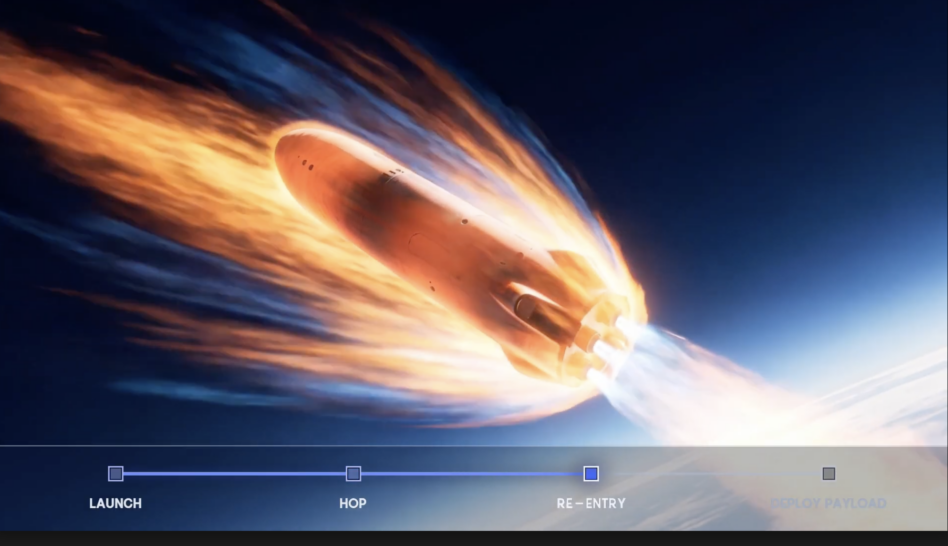
Shipping freight fast is a frustrating problem. Hop Aero wants to solve it using Rook–an autonomous suborbital rocket meant to launch and land cargo hundreds of kilometers away in minutes. The company launched on Y Combinator this week with a rendered video of a small launcher capable of flying a 15-minute delivery route between Okinawa and Taiwan.
Meet Rook: Rook is designed to launch from a standard 12-m shipping container, fly a suborbital arc, fly in at low hypersonic speeds, and land on unprepared surfaces, including in contested environments.
Hop Aero CEO and cofounder Matija Milenovic said Hop Aero’s first product, Rook Two, will:
Keep reading