


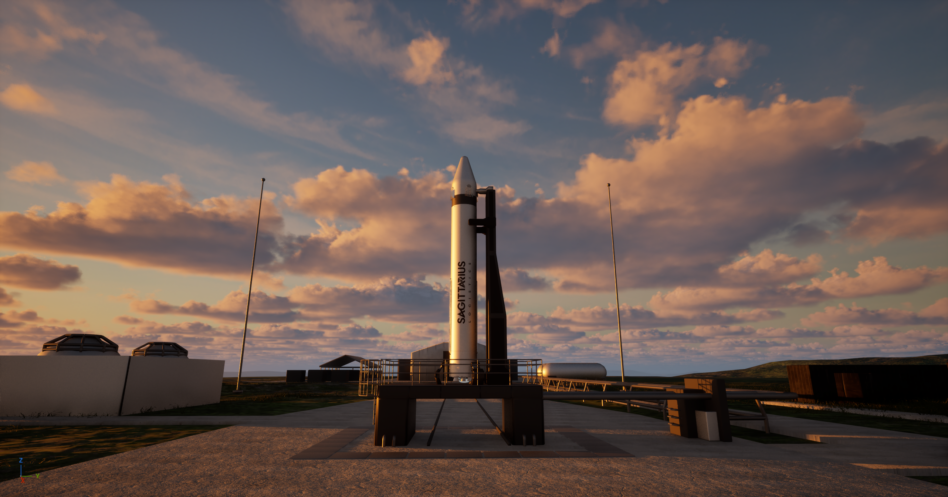
There’s a new launcher in town.
CO-based Sagittarius Logistics, a startup founded last year by former employees of Masten Space Systems, announced the closing of a $1.2M pre-seed round today. The money will fund early development of its reusable-launch program.
The round included funds from Nova Threshold, Felicis Scout Fund, Ingenuity VC, and Space Venture Studios.
Location, location, location: Sagittarius arose out of the ashes of Masten Space Systems, which went bankrupt in 2022 after going over budget on a lunar lander. Unfortunately, the name Phoenix was already taken.
While the IP is all new, Sagittarius was founded by Masten Space Systems’ founder David Masten, and three former Masten employees—CEO Jonathan Slavik, COO Jenna Edwards, and chief of production Daniel Sinkel. Sagittarius is built on the idea that global launch demand is going to continue outstripping supply for the foreseeable future.
The company’s solution, however, is not to simply add another rocket to the market, but to build an entirely new launch system that can fly on tight timelines, and from a wider range of launch sites across the country.
“A lot of the unique aspects of what we’re designing at Sagittarius—with our core IP—allows us to book launches faster, book launches from inland launch sites that we control, [so] we’re not competing for launch slots at the Cape,” CEO Jonathan Slavik told Payload. “That’s where a lot of the business value comes in, and we see ourselves as a much more durable launch solution.”
To open up launch possibilities at non-coastal sites, Sagittarius is building reusable launchers that can abort mid-flight without exploding over population centers. The company’s technology would allow for the first and second stages of its launch vehicles to return to land in the event of an abort, according to Slavik.
“We are able to throttle back, separate the fully reusable first and second stage, and land them either at downrange locations or back at the launch site,” Slavik said. “That capability allows us to meet much more stringent safety requirements for overflight…[and] we believe we have a unique IP-protected path to a level of safety to enable that kind of overland flight.”
Parks and rec: Sagittarius is building three rockets:
- Yellowstone: Sagittarius’ suborbital vehicle is aiming for a pathfinder flight in mid-2027 to validate much of the tech and IP for follow-on models.
- Sequoia: The company’s first orbital vehicle is targeting the ability to bring four tons of customer payload to LEO, and is expected to fly its first mission in the early 2030s.
- Denali: Sagittarius’ heavy-lift vehicle is expected to be capable of carrying 30 tons to LEO, according to Slavik.
The timeline for development is aggressive, but Slavik told Payload that the company has already made major strides. Sagittarius is acquiring a rocket engine from an undisclosed supplier, which will arrive fully tested and hotfired. Its to-do list ahead of the pathfinder mission includes completing the tanks and vehicle structure, as well as the guidance, navigation, and control systems.
While the company plans to raise successive funding rounds to finance each step of its maturation, Slavik told Payload that the three vehicles would require over $1B in capital to bring to market.
“It would be foolish to say anyone can get to space without a total capitalization over a billion dollars. We’re looking at somewhere north of that, but not astronomically beyond it,” Slavik said. “We’ve built Sagittarius in our fundraising structure, and plan to really climb the capital ladder in a way that we view as very capital-efficient—only raising enough to get to that next milestone.”

Gama Raises €15M Seed to Boost Europe’s Solar Array Supply Chain
Europe continues to stack the building blocks for a more robust space economy.

NeuralSat Raises €2.9M to Build Orbital Data Relay Network
The Autobahn is coming for in-space data traffic.
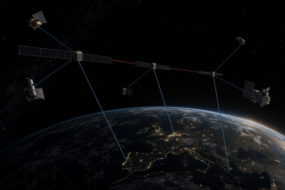
OwlO Cloud Emerges from Stealth to Build European Orbital Cloud Network
OwlO Cloud is planning to have at least 10 spacecraft—orbital cloud nodes (OCN)—operational by 2030.
Exclusive: Lyra Systems Emerges from Stealth to Solve the Valley of Death
Lyra Systems announced an agreement with the DoD aimed at helping early-stage technologies traverse unscathed across the Valley of Death.

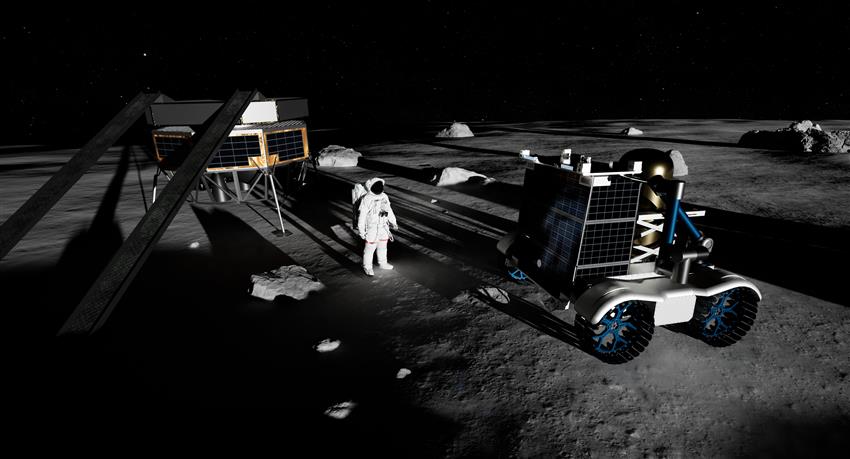
Three Canadian companies are racing Moon-cart concepts.
Canadensys, MDA Space, and Mission Control collectively received C$14.6M ($10.3M) in July 2025 for a Phase 0 lunar-utility-rover study supporting Artemis. And now, work is almost done.
Phase shift: This year, NASA unveiled its plan to build a Moon Base—an undertaking that will require a transportation network that includes big rovers. As a result, CSA is expected to boost funding for its rover projects, and a new RFP should drop within days that will downselect to two companies to keep building in 2027 alongside science-instrument procurements.
Keep reading