



What goes up must come down—and the US military wants to make sure satellites do it on their terms.
Last week, the SDA and DIU selected three companies—Firefly Aerospace ($FLY), D-Orbit, and Katalyst Space—to develop designs for scalable satellite capabilities including rendezvous, capture, and deorbit.
An SDA spokesperson told Inside Defense that the companies were awarded a combined $8.4M for the initial design phase. While the deorbit-as-a-service (DaaS) project’s primary objective is to give the US government flexible, on-demand access to orbital logistics, the awardees told Payload that the program helps lay the foundation for a broader space-logistics market.
“A successful demonstration would really accelerate the market,” D-Orbit USA CEO Mike Cassidy told Payload. “If this program works, then commercial satellite vendors would be even more comfortable saying, ‘Yeah, let’s do that thing. Let’s design for 98.5% reliability, and we’ll just use D-Orbit to bring down the ones that are stragglers.’”
Grab and go: Each of the awardees will move into preliminary design review before the SDA and DIU decide which solutions proceed to an on-orbit demonstration.
- D-Orbit is partnering with TransAstra to encompass potential debris with soft, pool-noodle-esque arms.
- Firefly plans on using the Elytra Dawn configuration of its multi-mission, in-space servicing vehicle. It’s the same vehicle that the company is using for its SDA mission with the DIU launching NET 2027—called Sinequone.
- Katalyst Space would use its standardized NEXUS robotic spacecraft. The company notes that the hardware is similar to the tech on its LINK mission, which is aiming to boost the NASA Neil Gehrels Swift Observatory after a delay.
“NEXUS is a multi-mission spacecraft,” a Katalyst Space spokesperson told Payload via email. “By applying the same vehicle with underlying capabilities across multiple missions, customers, and targets, we can spread the cost of the platform and make the economics close in a way that one-off approaches historically have not.”
The proposals will be evaluated on technical maturity, mission approach, schedule, and affordability. Each of the companies emphasized their existing flight heritage as an asset for the award.
“A lot of the core capabilities draw directly from existing programs. Elytra’s propulsion system—our Spectre thrusters—was flight-proven on Blue Ghost Mission 1, where it performed our final autonomous descent to the lunar surface,” Firefly CEO Jason Kim told Payload via email. “The preliminary design review we’re on contract to complete will further mature our deorbit system, but the fundamental building blocks of in-space maneuverability and autonomous guidance are already there.”
Rising tides: Even companies that didn’t receive awards are excited to see the government adopt a deorbit-as-a-service model.
“We’ve been hearing from our government customers for a while now—an interest in having these services as a service,” Kall Morris Inc. (KMI) CEO Troy Morris told Payload. “One wanted to be able to request relocation of satellites as easily as ordering a pizza, and having a tracker on your phone that shows you how close to complete it is. That’s the modern world we’re moving towards.”
While KMI’s gecko-adhesive arm for securing space objects was not one of the selected proposals, the company noted that these kinds of awards serve as an important validation for the in-space logistics market, thus supporting all companies developing similar capabilities.
“With any new tech, many people are excited to be second,” Morris said. “So getting that proof and that demonstration, they’re all moving the industry towards a brighter future.”

UKSA Taps ClearSpace for Country’s First Debris Removal Mission
The UK Space Agency is dressing up as a waste-management company for Halloween.
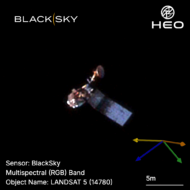
BlackSky Renews HEO Deal, Adds Gen-3 Imagery for Space Domain Awareness
BlackSky Technology inked a seven-figure deal to extend its partnership with Australian non-Earth imaging (NEI) provider HEO for another year.
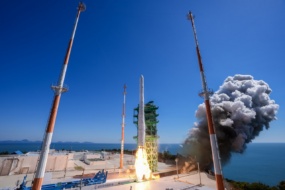
ArbaLabs Launches AI Verification Demo On South Korea’s Nuri Rocket
“In short, tons of companies are looking at the latest and greatest physical AI deployments,” ArbaLabs CEO Ashley Reeves told Payload. “Nobody is really thinking about putting some checks and balances on what these AI models are doing.”
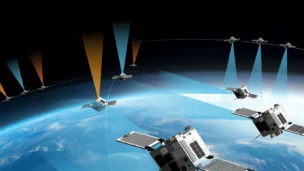
HawkEye 360 Turns its RF-Sensors to Orbital Targets
The DoD wants to better understand what’s going on in orbit. HawkEye 360 ($HAWK) has the inside scoop.

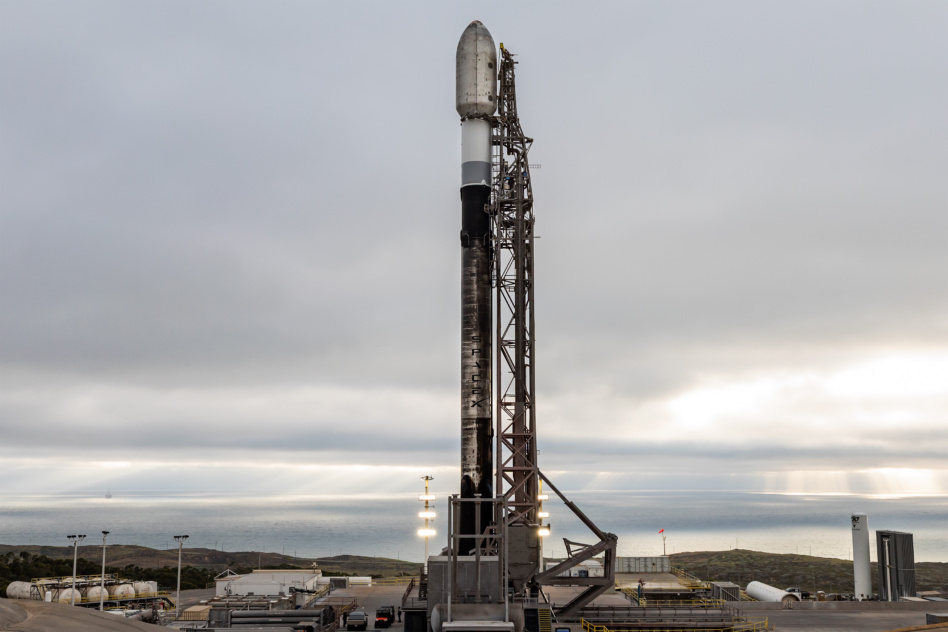
The end of SpaceX’s Transporter program could leave a giant hole for space startups looking for cost effective rides to orbit. SEOPS is trying to fill it.
SEOPS announced today it’s planning a LEO rideshare flight in 2028 to a mid-inclination orbit on board a previously acquired SpaceX Falcon 9 rocket. The mission will repurpose SEOPS’ Darkstar-1 dedicated rideshare flight—originally planned to fly to GTO in 2028—under the company’s new Waymaker dedicated LEO rideshare program.
Under new management: The announcement is part of a new business model for SEOPS, which includes plans to expand its Waymaker program to include more launchers, more launch sites, and access to a wider range of orbits, according to President Evan Hoyt.
Keep reading