


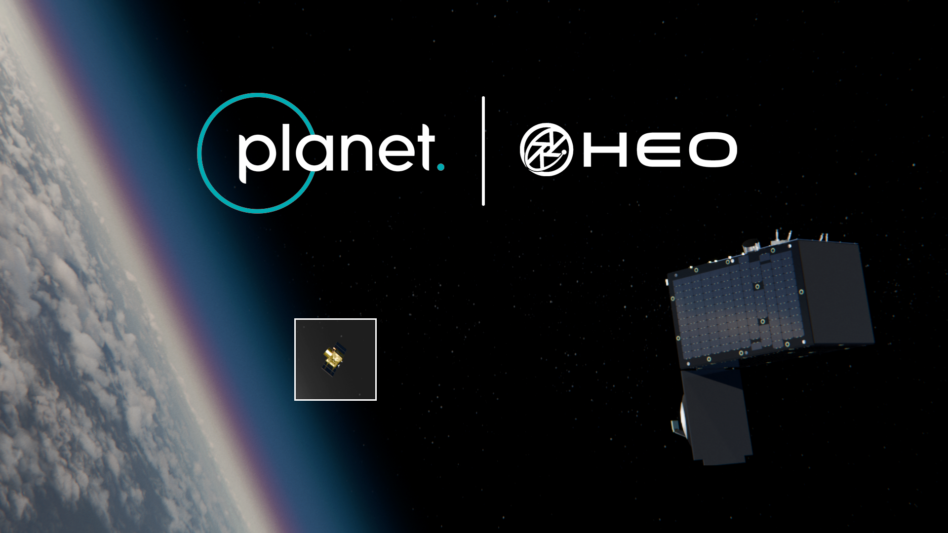
HEO and Planet Labs ($PL) announced a partnership Monday to integrate Planet’s SkySat constellation into HEO’s non-Earth imaging (NEI) sensor network.
The deal expands HEO’s NEI network to 50+ in-space sensors, allowing customers to capture more frequent, high-resolution images of objects on orbit—from a wider range of angles.
Eyes in the sky: As orbital freeways get more crowded, government and commercial satellite operators are increasingly turning to NEI capabilities—to gather insights on the health of their own satellites, and to spot potentially nefarious activities in space.
- Under the partnership, HEO will plug its NEI software into Planet’s SkySat network, allowing HEO customers to autonomously task Planet sats to image objects on orbit.
- The expanded NEI network will give HEO customers more opportunities to capture imagery of space objects from a wider variety of angles, painting a clearer picture of the situation in orbit.
“If someone needs something imaged fast, that positioning can matter more than raw resolution does,” HEO marketing manager Dane Brumm told Payload via email. “Everything up there is constantly moving, so no single sensor can cover it all, and that’s really the point of building a big network—so there’s always something well-placed when you need it.”
HEO will add its software to up to 15 SkySats in its network, giving it a lot more data to train its NEI capabilities. That creates a flywheel effect in which the additional data is expected to improve HEO’s analytics tools, and increase its understanding of how to take a good image on-orbit.
Double vision: While NEI capabilities have been central to government SDA programs, helping national-defense satellites identify and characterize adversarial spacecraft nearby, HEO has seen a “massive increase in inbound from [commercial] operators,” according to Brumm.
These commercial requests have largely focused on determining the health of a newly deployed satellite in orbit, but HEO expects commercial demand for NEI data to compound as the in-space servicing sector takes off.
“Those servicing vehicles are going to need to know exactly what they’re approaching before they get close to it, and that’s where our information comes in,” said Brumm.

UKSA Taps ClearSpace for Country’s First Debris Removal Mission
The UK Space Agency is dressing up as a waste-management company for Halloween.

Europe’s Space Defenses Fall Just Shy of Weaponization
Europe doesn’t have any weapons in space—but that doesn’t mean the region is comfortable flying around in orbit defenseless.
ArbaLabs Launches AI Verification Demo On South Korea’s Nuri Rocket
“In short, tons of companies are looking at the latest and greatest physical AI deployments,” ArbaLabs CEO Ashley Reeves told Payload. “Nobody is really thinking about putting some checks and balances on what these AI models are doing.”

Turkey Uses IAC Stage to Pitch Peace & Homegrown Hardware
During the 2026 IAC in Antalya, representatives from Turkey are leveraging the opportunity to showcase the country’s prgoress in space.


What goes up must come down—and the US military wants to make sure satellites do it on their terms.
Last week, the SDA and DIU selected three companies—Firefly Aerospace ($FLY), D-Orbit, and Katalyst Space—to develop designs for scalable satellite capabilities including rendezvous, capture, and deorbit.
An SDA spokesperson told Inside Defense that the companies were awarded a combined $8.4M for the initial design phase. While the deorbit-as-a-service (DaaS) project’s primary objective is to give the US government flexible, on-demand access to orbital logistics, the awardees told Payload that the program helps lay the foundation for a broader space-logistics market.
Keep reading