


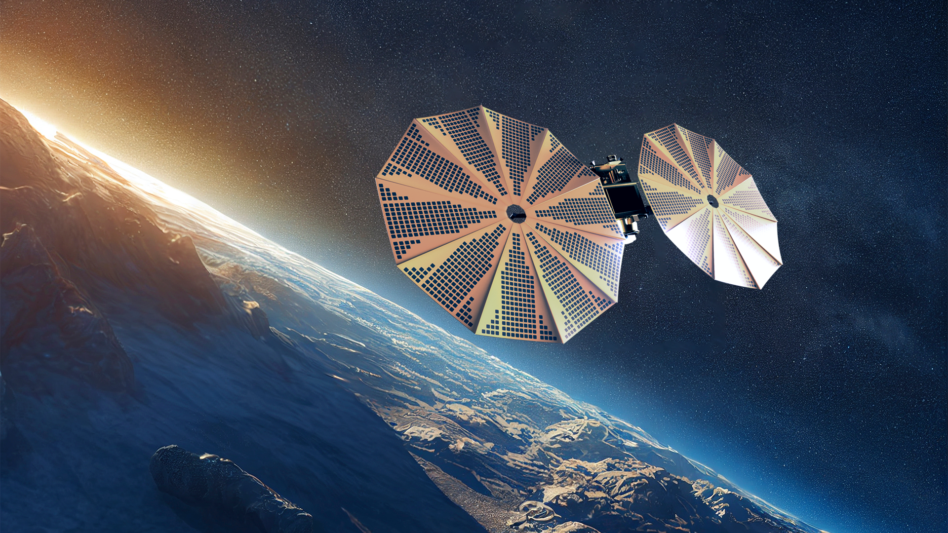
The UAE unveiled plans on Sunday to send a spacecraft to explore the asteroid belt by 2028, a follow-on to the emerging space nation’s ambitious Mars mission currently orbiting the Red Planet.
The Emirates Mission to the Asteroid Belt, or EMA, will study six asteroids before reaching its final destination: a mysterious red asteroid that may hold clues about the genesis of life on Earth.
A rare item: Discovered in 2021, the 30-mile wide asteroid “269 Justitia” is one of two known red asteroids. Its distinct color is attributed to the presence of organic compounds called tholins, more common to the icy objects of the Kuiper Belt, suggesting its potential origin.
The two-ton spacecraft, named “MBR Explorer” after UAE’s Prime Minister Sheikh Mohammed bin Rashid Al Maktoum, will be constructed over the next six years. The first asteroid flyby is expected in 2030, followed by five subsequent flybys before reaching Justitia in 2034.
Buy local: The mission has the dual goals of scientific discovery and boosting the commercial space sector much closer to home. Half of the mission’s budget will be spent within the UAE, and a small lander to be deployed to Justitia’s surface from the MBR Explorer will be fully developed by UAE-based startups.
International organizations are also working on the mission, including:
- The Italian Space Agency, which is developing an imaging spectrometer in collaboration with the National Institute of Astrophysics and Leonardo S.p.A.
- US-based Malin Space Science Systems is adding two cameras to the spacecraft.
- The University of Colorado Boulder is serving as a knowledge partner to the mission. The university was also a partner on UAE’s “Hope” Martian orbiter that launched in 2020.

Czech Radiation Chips on Artemis II Bring ISS Experience
With the sun at solar maximum, HERA serves as an instant warning system if a solar flare emerges.

Mars Rover Drives with the Help of Anthropic AI
AI is everywhere these days—even on Mars.
Engineers at JPL announced Friday that they had successfully used Anthropic’s AI model, called Claude, to map a 450-meter Martian path for NASA’s Perseverance rover.
New Glenn Launches ESCAPADE, a NASA Mission to Mars
After a five-year gap in new missions focused on Mars, NASA is on its way back.
Yesterday afternoon at 3:55pm, Blue Origin’s New Glenn rocket launched for the second time, carrying its first NASA mission—the Escape and Plasma Acceleration and Dynamics Explorers project, better known as ESCAPADE.

Venus Exploration Hangs in the Balance
Earth’s sulfuric, fiery, evil twin has been the subject of study for a long line of spacecraft over decades. But—while Venus remains a fascinating subject for planetary science and a candidate in the search for life away from home—there’s going to be a gap in our up-close study. The last spacecraft studying Venus up close, Japan’s Akatsuki orbiter, is officially out of commission.


The State Department released its first Strategic Framework for Space Diplomacy today, proving that diplomacy in orbit has become a reality much sooner than Futurama would have had us believe.
The framework: The document highlights how the State Department will advance US leadership in orbit on priorities like establishing norms of behavior, as well as expand international cooperation on programs like the Artemis Accords.
“The Strategic Framework provides a critical foundation for our work, grounded in US strategic objectives and values,” Secretary of State Antony Blinken said. “We are committed to expanding space benefits for all humankind by engaging allies and partners who share our democratic values of openness, transparency, adaptability, and the free flow of ideas and information.”
Keep reading