


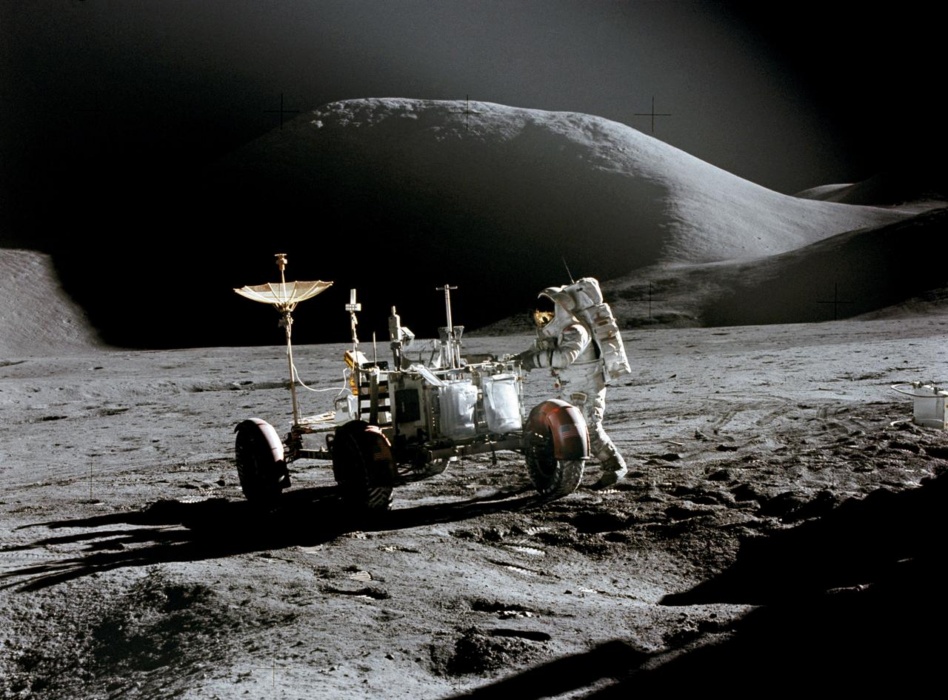
As NASA and its partners push harder toward a sustained human presence on the Moon, mobility is mission-critical. Moon buggies with lawn chairs might’ve been good enough for the Apollo-era, but long-term surface operations depend on lunar rovers that can pull their weight (quite literally).
For decades, lunar rovers were the domain of national space agencies, and built to support short-duration science missions. Those days are long gone. Today, rovers—backed by private capital—are being designed to do more than poke and prod. They’re being tasked with transporting cargo, scouting resources, supporting astronauts, and generating commercial data for customers beyond NASA.
Ignition remix: At NASA’s Ignition event in March, Administrator Jared Isaacman announced changes to the agency’s lunar rover program. Because Isaacman had already laid out a new plan for a lunar base, regular crewed missions to the surface, and monthly robotic lunar landings, all of that would require a new approach to lunar rovers—one that focuses on delivering rovers to the lunar surface faster and at scale.
The players: Here are the companies and agencies shaping the future of lunar surface mobility:
- Astrobotic Technology has developed its CubeRover platform, which is expected to launch on its Griffin-1 lunar mission this year, to support science, commercial, and defense payloads. The company positions rovers as an extension of its lunar delivery services, offering mobility as part of an end-to-end lunar logistics stack.
- Lunar Outpost is betting on rovers as a service. Its Mobile Autonomous Prospecting Platform (MAPP) made it to the lunar surface on the IM-2 mission last year, but failed to exit the tipped over lander. MAPP is designed to generate data for customers, rather than to complete one-off missions—a model that has drawn interest from both NASA and the DoD. Lunar Outpost is also developing the larger Eagle Lunar Terrain Vehicle for more advanced missions, as well as a scaled down version—called Pegasus—aimed at satisfying NASA’s wish for a lower-mass LTV that could be ready to fly in 2027.
- ispace’s TENACIOUS micro-rover is tightly integrated with the company’s lander architecture, reflecting a vertically integrated approach to lunar exploration that blends commercial payload hosting with long-term lunar infrastructure ambitions. TENACIOUS launched on ispace’s second mission to the lunar surface last year onboard the Resilience lander, which failed to touch down softly on the Moon. ispace is planning a third landing attempt for 2028.
- Intuitive Machines is best known for its Nova-C landers. That said, IM is expanding into surface mobility. The Micro Nova hopper/rover hybrid is designed to traverse challenging terrain, and to support distributed lunar operations. Also, the company has a Moon RACER that was submitted as part of NASA’s Lunar Terrain Vehicle Services contract.
- Venturi Astrolab is building the FLEX Rover, targeting both robotic cargo transport and future crewed missions. The vehicle is designed to operate continuously on the lunar surface, and to support Artemis-era logistics. Venturi Astrolab is planning to send a precursor (called FLIP) to the Moon on the Griffin-1 lander this year.
- JAXA (with Toyota) is developing a pressurized human lunar rover—often referred to as the Lunar Cruiser—aimed at enabling long-range, multi-day surface missions. The project underscores how mobility is central to sustained human exploration.
Upcoming milestones: The next few years will be decisive for lunar mobility.
Through the late 2020s, multiple commercial rovers are expected to reach the Moon aboard CLPS landers, testing everything from autonomous navigation to power systems capable of surviving the lunar night. At the same time, NASA and its partners are expected to downselect designs for human-scale and cargo-capable rovers that could be flight-ready by 2028.
As missions shift from demonstration to sustained operations, rover providers will need to prove they can operate reliably, scale manufacturing, and generate revenue beyond NASA science payloads.
Why it matters: Lunar rovers sit at the intersection of exploration, infrastructure, and commerce. They are a prerequisite for resource prospecting, habitat construction, and long-term human presence—and one of the clearest paths for private companies to build recurring lunar business models.
In the race to industrialize the Moon, mobility may be the quiet enabler that determines who succeeds.
Update: This article was last updated on May 12, 2026.
Better Moon-Tech Tops NASA Stakeholder Wishlist
Two years ago, NASA asked the space community what technical challenges are giving people the biggest headaches to help NASA prioritize its space tech investments.
York Space Systems to Acquire Solestial
York Space Systems’ ($YSS) M&A team is having a busy year.
Astrolab Unveils Payloads Flying on FLIP Lunar Mission
Astrolab is headed to the Moon this year with a rover-load of science payloads.
Potomac Database Systems Unveils Plans to Amass Lunar Data
There’s money to be made on the Moon, but it’s not all mining and infrastructure.
There’s been a lot of criticism of the FY27 NASA budget proposal. Leaders on multiple congressional committees have vowed to block the proposed cuts, and The Planetary Society’s Casey Dreier likened it to an “extinction-level event” for the agency.
But not everyone is unhappy with the proposal as written, and that faint sound of cheering is coming from the budding space nuclear industry, which sees the bill as potentially kick-starting their wildest dreams.
Love language: Isaacman is framing the FY27 proposal as an attempt to reorganize the agency around a singular focus: space exploration. As a result, it advances many high-level goals that will necessarily require space nuclear power for lunar spacecraft to survive the lunar night, and eventually, to support human efforts on Mars. Three line items in the FY27 proposal specifically set aside funds for space nuclear efforts:
Keep reading