

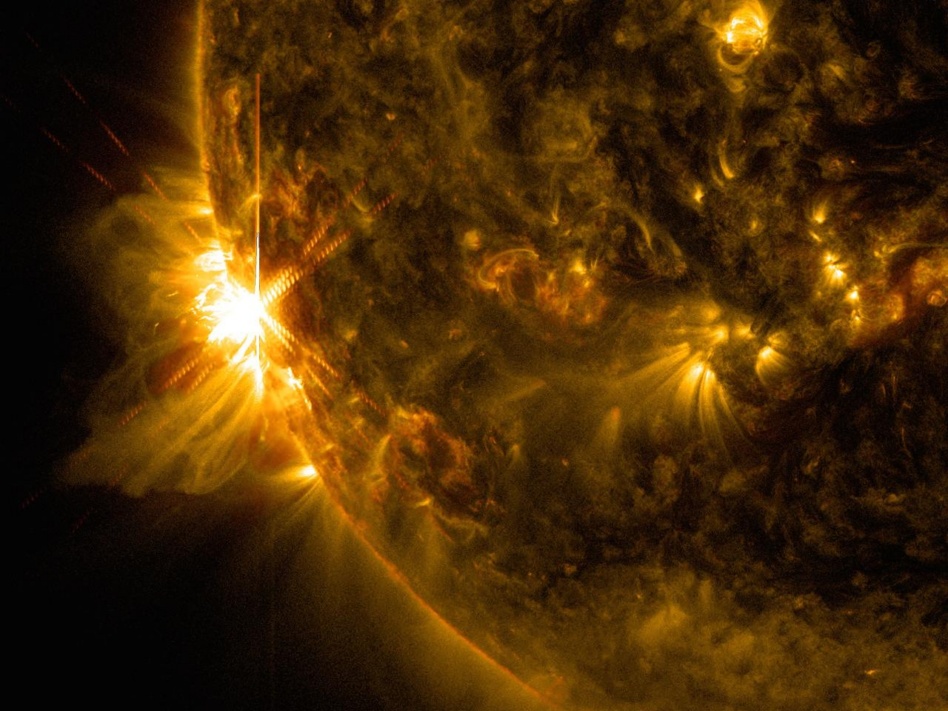
Space weather forecasters have good news and bad news, and it’s the exact same: it’s going to be sunny.
Solar storms will cause a $20.65B economic hit in 2026—and that number will rocket to $44.27B in annualized losses by 2035, according to a new report from space-environment intelligence firm Mission Space.
The growth is driven not by a more active sun, but by an increase in exposed space assets because there are more satellites and space infrastructure in orbit at risk for solar radiation.
Space weather has been an infrastructure risk for decades, but the reference point for most loss scenarios is still a period of particularly intense solar activity in 2003. Technology has evolved slightly since then, so Mission Space sought to rebuild the exposure baseline.
Line items: Mission Space splits the findings into nine channels, from the GNSS-dependent ground economy to Mars and deep space.
In 2026:
- Power grids are the most exposed at $12.88B;
- GNSS-dependent ground economy comes next at $3.23B;
- Space infrastructure and connectivity follow at $2.21B.
By 2035, the projected profile tilts skyward:
- Power grids remain the largest at $18.03B;
- Space infrastructure and connectivity rises to $8.83B;
- GNSS-dependent ground economy grows to $6.46B, but slips to third.
Altogether, orbital and beyond-Earth channels swell from 17% of expected loss to 42%.
Cloud cover: Orbital compute is expected to grow the fastest—a 25x jump from $130M in 2026, to $3.26B in 2035. Orbital-data-center resilience depends on redundancy, replication, checkpointing, and automatically switching to backups when a node fails. A single severe particle event could hit every node in the same orbital neighborhood at once—degrading the redundancy of the entire network.
Solar storms also create orbital traffic chaos. Environmental shifts reduce the accuracy of predicted trajectories, rapidly changing large parts of LEO. Meanwhile, operators must respond to these deviations, introducing more trajectory changes into the catalogue.
Moon burn: Future lunar operations must consider both the frequency and severity of space weather events. Without the protection of Earth’s magnetosphere, radiation defines the atmosphere (however thin it may be)—impacting EVA schedules, shelter access, power operations, surface transport, and more.
A 1972 particle event, fortunately timed between Apollo 16 and 17, would have delivered a potentially lethal dose to anyone caught on an ill-timed Moonwalk.
The Apollo 17 mission wrapped up that human Moon program ~54 years ago. Yet according to Mission Space most companies flying today’s orbital infrastructure haven’t been around for a full, 11-year solar cycle.
Zeno Power Books its First Nuclear Mission to the Moon
Zeno Power is ready to pull its first all-nighter. On Wednesday, the nuclear-energy startup announced a commercial payload agreement with Firefly Aerospace ($FLY) to send a radioisotope heating unit (RHU) on a Firefly mission launching to the Moon NET 2028. The mission—flying on Firefly’s CS-8 CLPS mission—aims to demonstrate Zeno’s ability to keep a 5W…
Exclusive: Reflect Orbital Responds to its Critics
The space community is divided over whether Reflect Orbital’s sunlight-reflecting satellites are a bright idea.
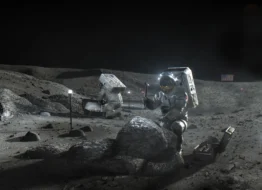
NASA Opens Call on Moon Base Health Research
NASA’s Human Research Program is asking researchers what they want to know as the agency transitions to long-term stays at a Moon Base.

Redwire Books Starfall’s First Dedicated Mission
Redwire subsidiary SpaceMD announced a contract to fly up to 32 mini-labs on a future SpaceX Starfall mission.


LeoLabs is applying its radar tech to national security missions under a new contract with the Space Force, announced Wednesday.
The military awarded the commercial SDA company a $20.68M Prototype Other Transaction Agreement—a contracting vehicle that bypasses the typical procurement process to allow the Pentagon to quickly test out new tech.
You make me wanna: Scout was unveiled in April 2025 as the newest part of LeoLab’s product line. While the SDA company operates nearly a dozen fixed radars globally, Scout is a mobile option, roughly the size of a shipping container, which can be deployed anywhere to collect orbital intel.
Keep reading