


HEO, the Australian non-Earth-imaging startup, announced Monday it closed a $25M Series B to expand its imaging network to GEO.
Beaten Zone Venture Partners led the round, which included participation from Australia’s National Reconstruction Fund Corporation (NRFC), DCode Capital and Wunala Capital, as well as existing investors Airtree and Salus Ventures.
“GEO is a kind of a weird orbit where governments will subsidize the crap out of capital-intensive solutions,” CEO Will Crowe told Payload. “So really critical that we get up there fast…We really want to give our customers confidence that they can rely on this—way more cost-effective—commercial solution.”
The high road: HEO operates a network of 50+ sensors on orbit. These sensors are a mix of cameras owned by partner constellations and HEO’s internally developed sensors flying as hosted payloads.
- HEO has already imputed Planet and BlackSky sensors into its network, which HEO is actively looking to grow further. “We would love to onboard Vantor, if they would have us,” said Crowe.
- HEO also purchased an in-orbit satellite from Satellogic in January, and is considering making other in-orbit satellite purchases down the line to further boost its network..
HEO plans to invest the new capital to keep the network growing through new HEO sensor deployments and more satellite-operator partnerships to grow its coverage. With the Series B, HEO aims to monitor 90% of all space objects on-orbit, according to Crowe.
HEO has also booked two launches to kickstart its sensor network in GEO, with the first expected to fly before the end of this year, and “reliable and repeatable” GEO imaging service beginning in 2027, according to the announcement. The first two sensors in GEO, however, are only the beginning of a campaign to get as many sensors flying as possible.
“Whoever has the most sensors in this game wins,” Crowe said. “Some time in the future—hopefully it’s less than 10 years from now—there will need to be 1,000 cameras plus in a variety of orbits in order to really well solve this problem, and we’re nowhere near there.”
More of a good thing: The Series B comes amid a successful few years at HEO.
Since raising its $8M Series A in 2023, the company has tripled its revenue year-over-year, in part due to HEO’s landing of major contracts from international governments.
- In February, HEO won a contract with the NRO to provide imagery under the office’s Strategic Commercial Enhancements CSO program.
- In July 2025, HEO was selected by the Australian Department of Defence to provide its sensors for a new sovereign LEO constellation, led by Optus.
- HEO is also working with the UKSA and Japan’s Ministry of Defense.
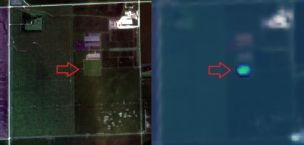
InnerPlant’s Glowing Soy Demos Hyperspectral Use Case
InnerPlant, which was founded in 2018, has enabled plants to let humans know when they’re under stress.
Hydrosat Unveils Osiris Constellation Ahead of 2027 Launch
Very rarely can someone offer you the best of both worlds, but Hydrosat’s newest constellation claims to do just that.
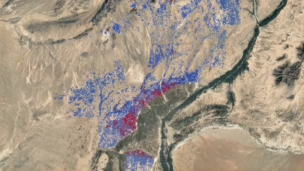
Kuva Space Spots Illegal Poppy Farms from Orbit
Kuva Space released data today from a pilot program that demonstrated its ability to monitor illegal crop farming from space.
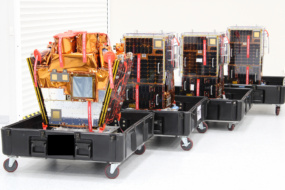
Satellogic Expands DoD Work As it Preps for Next Launch
Satellogic is gearing up to launch its latest batch of satellites next month, potentially including the company’s first Merlin sat, which is designed to gather constant 1-m-resolution EO imagery.

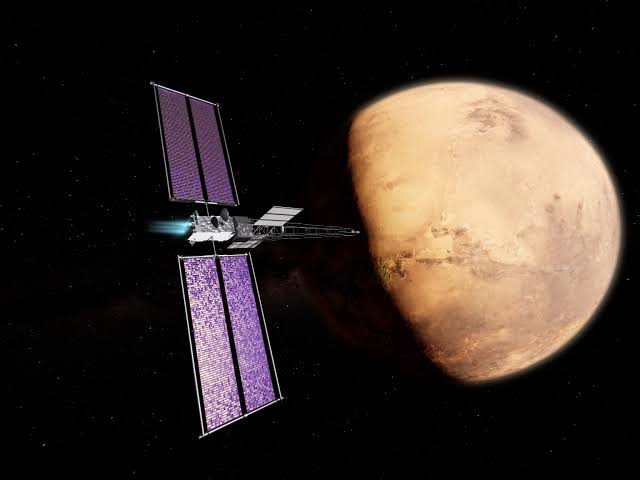
TRL11 has received a NASA contract to provide imaging systems for the Space Reactor-1 (SR-1) Freedom mission to Mars.
“It will be the first time a camera we built travels to another planet and captures images of it,” TRL11 CEO Nicolaas Verheem said in a statement.
Freedom isn’t free: The $2B SR-1 mission is expected to launch in late 2028 to Mars as the first fission-powered interplanetary spacecraft. NASA first announced SR-1 at the space agency’s Ignition event in March.
Keep reading